____________________________________________________________________________________________________________
The Number of the Beast.
Revelation 13:16-18
16. And he causeth all, both small and great, rich and poor, free and bond, to receive a mark in their right hand, or in their foreheads:
17. And that no man might buy or sell, save he that had the mark, or the name of the beast, or the number of his name.
18. Here is wisdom. Let him that hath understanding count the number of the beast: for it is the number of a man; and his number is Six hundred threescore and six.
Note that according to verse 17, there are three different characteristics that distinguish the beast:
his mark (of authority)
his name
the number of his name (666).
It might be argued by some that 666 must be applied to one man’s name, and that this will then help identify him as the antichrist. I would offer the following verse to show that 666 need not apply solely to a man’s name:
Rev 19:16 And he hath on his vesture and on his thigh a name written, KING OF KINGS, AND LORD OF LORDS.
The same Greek word translated as name (onoma: G3686) that appears in Revelation 13:17-18 is also used in chapter 19:16, so clearly the word can also apply to a title, and not just one man’s name.
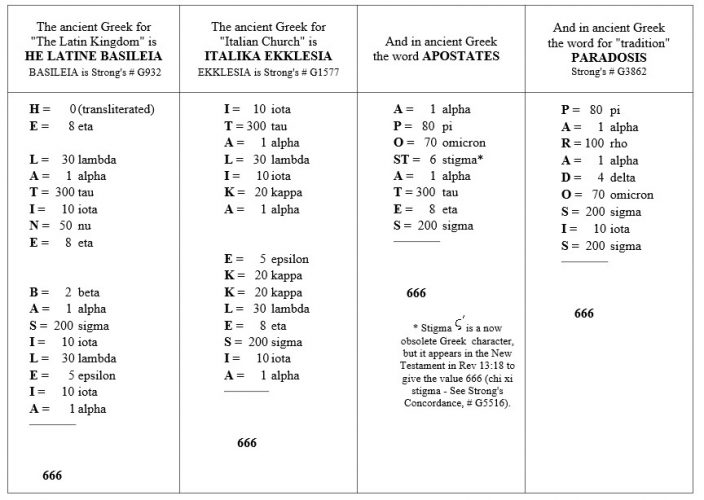
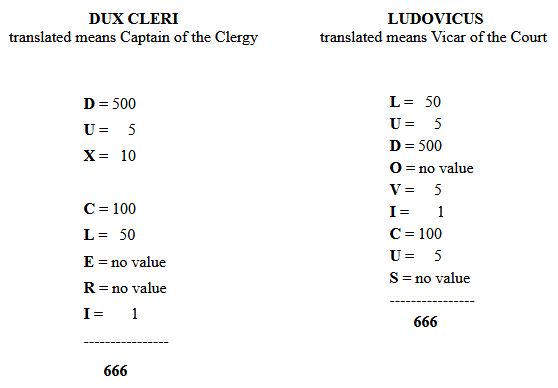
Now, we are told that it takes a certain understanding and wisdom to discern just how this number is actually applied. Based on the fact that 666 can apply to a title, below are several words and phrases that have been put forth over the centuries as probable solutions to the enigma of 666.
____________________________________________________________________________________________________________
GREEK
The numeric equivalents of Greek letters can also be found in the Encyclopedia Britannica under “Languages of the World”, Table 8.
The ancient Greek word for “the Latin speaking man” is LATEINOS
L = 30 lambda
A = 1 alpha
T = 300 tau
E = 5 epsilon
I = 10 iota
N = 50 nu
O = 70 omicron
S = 200 sigma
——–
666
NOTE: Latin is the official language of the Roman Catholic Church. Church Documents are usually published first in Latin, and then translated from the Latin into other languages. The association of “Lateinos” with 666 was first suggested by Irenæus (ca. 130-202 A.D.) who proposed in his “Against Heresies” that it might be the name of the fourth kingdom in Daniel 7:7.
Then also Lateinos has the number six hundred and sixty-six; and it is a very probable [solution], this being the name of the last kingdom [of the four seen by Daniel]. For the Latins are they who at present bear rule: I will not, however, make any boast over this [coincidence]:
Source: Against Heresies, by Irenæus, Book 5, chapter 30, paragraph 3.
St. Irenaeus biography online at the New Advent Catholic web site.
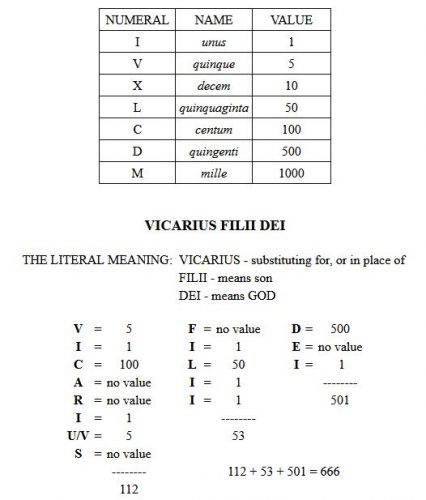
LATIN
HEBREW
The numeric equivalents of Hebrew letters can be found in the Encyclopedia Britannica under “Languages of the World”, Table 50.
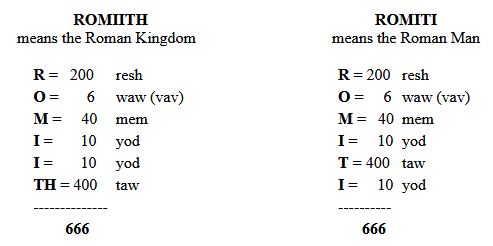
Note:
*Lateinos, Ecclesia Italika, and Romith are cited as possible solutions by Johannes Gerhard (1582-1637), a Lutheran, in his Adnotationes in Apocalypsin, page 110.
*Romith, Vicarius Filii Dei, Dux Cleri, Ordinarius Ovilis Christi Pastor, and Dic Lux are cited by the rector of Berlin, Andreas Helwig [or Helwich] (1572-1643) in his Antichristus Romanus, in proprio suo nomine, numerum illum Apocalypticum (DCLXVI) continente proditus, published in 1612 in Wittenberg.
*Dux Cleri is cited by Walter Brute (or Britte), a fourteenth century follower of Wycliff, in his Registrum, page 356.
*Ludovicus was proposed by James Bicheno (d. 1831), a British minister and author, applying it at the time to the French King Louis XIV, as the two-horned beast from the earth.
He Latine Basileia and Lateinos are cited by Alexander Campbell (1788-1866), founder of the Disciples of Christ, in A Debate on the Roman Catholic Religion of 1837.
See The PROPHETIC FAITH OF OUR FATHERS, The Historical Development of Prophetic Interpretation, by Le Roy Edwin Froom, Volumes II and IV, published by the Review and Herald Publishing Association, Washington D.C., Copyright 1948.
____________________________________________________________________________________________________________
This relationship of 666 in Greek, Latin, and Hebrew is only one relatively small, yet important indicator that the Papacy is the Antichrist and the beast from the sea of Revelation 13. This association by itself proves little, as 666 can fit other people using the same methods. All the other biblical characteristics of the Antichrist must be considered and met as well, then this association becomes significant.
____________________________________________________________________________________________________________
An objection has been raised that the method of gematria used above to calculate the Roman numeral value of phrases is incorrect. The word VICARIUS it is argued, must be calculated with letters grouped as follows: VI=6 C=100 A=0 R=0 IU= 4 S=0, for a value of only 110, instead of 112. This is patently incorrect. The value of each individual letter is to be added to yield a total value. It is totally irrelevant to the calculation if adjacent letters can be combined in groups to give a value. This assertion that letters must be grouped is nothing but sheer nonsense.
____________________________________________________________________________________________________________
666 and CÆSAR NERO
Some will suggest that the book of Revelation was written only for those living at the time, and that 666 most probably applies to Cæsar Nero, who ruled Rome from 54 to 68 A.D., rather than someone from latter centuries. This point of view, which suggests Revelation had an immediate application to the first century, rather than being prophetic, is known as preterism, and is commonly held by the Catholic Church. So, just how is Nero linked to 666?
The preterist takes a relatively uncommon form of Nero’s name, Nero Cæsar or Cæsar Nero, and adds an “n”, resulting in Neron Cæsar. Next the Latin is transliterated into Aramaic, resulting in nrwn qsr, which when using the numeric equivalent of the letters, then adds up to 666 as follows:
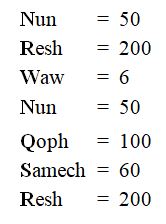
An example of this spelling has apparently been recently discovered in one of the Dead Sea scrolls. If you use the same process, but without the added “n” the result is 616. Interestingly, some early manuscripts have 616 rather than 666, but even scholars such as Irenæus [A.D. 120-202] attribute the 616 to only a copyist error (Against Heresies: Book V Chapter XXX.), “this number [666] being found in all the most approved and ancient copies” [of the Apocalypse] and asserts that “men who saw John face to face bearing their testimony” [to it – 666].
There is a problem though with the above calculation. According to the rules of Jewish numerology, known as gematria, when the letter Nun appears a second time in a word, it is known as a “Final”, and takes the value of 700.* So to be precise, NRWN QSR actually adds up to 1316 and not 666.
*Source: Behind Numerology, by Shirley Blackwell Lawrence, copyright 1989, published by Newcastle Publishing Co., Inc., North Hollywood, California, ISBN 0-87877-145-X, page 41.
So the preterist calculation which attributes 666 to Nero, however, is nothing more than a rather desperate attempt to find some likely candidate for the Antichrist other than the Papacy.
THE WORD ANTI
Look up in Strong’s Concordance word 473 in the Greek dictionary. You will find the the word anti is often used to denote substitution-
473. anti, an-tee’; a prim. particle; opposite, i.e. instead or because of (rarely in addition to):–for, in the room of. Often used in composition to denote contrast, requital, *substitution*, correspondence, etc.
An example of how anti is used this way can be found in the words type and antitype, which are used with respect to Bible prophecy. The “type” is the pattern or symbol, and the antitype is the fulfillment. The Jewish Passover was a “type” and the crucifixion of Jesus is the “antitype” or fulfillment of the example of the type. You substitute the antitype into the symbolism of the type to arrive at the complete meaning.
The Catholic Church has essentially confirmed this usage of the word anti. In the 1994 Catholic Almanac on page 158 there is “the list of men who claimed or exercised the papal office in an uncanonical manner.” So these men tried to substitute themselves for the true Pope, and usurp that office, so to speak. The Catholic church denies the papal authority of the men on that list because they attempted a substitute (false) claim on the Papacy. That list is a list of ANTI-POPES! So the word anti can clearly mean a substitute for something.
THE WORD ANTICHRIST
Antichrist (word 500 in Strong’s Greek dictionary) can be correctly interpreted then, as someone who substitutes himself for Jesus Christ, the Son of God, just as an antipope substituted himself into the office of the Papacy.
The Vicar of Christ (Vicarius Christi)
“Vicar of Christ . . . Title used almost exclusively of the Bishop of Rome as successor of Peter and, therefore, the one in the Church who particularly takes the place of Christ; but used also of bishops in general and even of priests. First used by the Roman Synod of A.D. 495 to refer to Pope Gelasius; more commonly in Roman curial usage to refer to the Bishop of Rome during the pontificate of Pope Eugene III (1145-1153). Pope Innocent III (1198-1216) asserted explicitly that the Pope is the Vicar of Christ; further defined at the Council of Florence in the Decree for the Greeks (1439) and Vatican Council I in Pastor Aerternus (1870). The Second Vatican Council, in Lumen Gentium , n.27, calls bishops in general “vicars and legates of Christ.” All bishops are vicars of Christ for their local churches in their ministerial functions as priest, prophet, and king, as the Pope is for the universal church; the title further denotes they exercise their authority in the Church not by delegation from any other person, but from Christ Himself.”
Source: Catholic Dictionary, Peter M.J. Stravinskas, Editor, published by Our Sunday Visitor, Inc., Huntington, 1993, pp. 484-485.
THE WORDS VICARIOUS AND VICAR
Now look up the word vicarious in almost any common dictionary. Here is what you would find in the Webster Handy College Dictionary: “substituting for or, feeling in place of another.”
Also in the Webster’s II New Riverside Desk Dictionary for the definition of Vicar-
1. A parish priest in the Church of England.
2. A cleric in the Episcopal Church in charge of a chapel.
3. One who serves as a *substitute* for another.
A Vicar General is defined in the 1994 Catholic Almanac on page 330 as “a priest or bishop appointed by the bishop of a diocese to serve as his deputy, with ordinary executive power, in the administration of the diocese.” So a vicar serves in the place of (substituting for) the bishop, and assumes his power of office for certain duties.
So the Papal title of VICAR OF CHRIST which in Latin is VICARIUS CHRISTI, means a SUBSTITUTE FOR CHRIST, which is synonymous with Antichrist, i.e., assuming the power of God on earth! This blasphemous claim is made repeatedly by various Popes and is the very foundation of Roman Catholicism and it’s Papacy.
Some Catholics may protest that the Pope represents, but does not substitute for Jesus Christ, to avoid the association.
Now, from the Webster Hand College Dictionary, the definition of the word represent:
1. portray; depict; describe.
2. play the role of; impersonate.
3. denote; symbolize; stand for.
4. speak and act for; *be a substitute for*.
5. set forth; assert.
6. be composed of; consist in.
Clearly then, Vicar of Christ (Vicarius Christi) and Antichrist have exactly the same meaning. The Pope substitutes himself in place of God on earth, and that is *exactly* the meaning of Antichrist.
VICAR OF THE SON OF GOD
Some Catholics will claim that the title VICARIUS FILII DEI is an anti-catholic fabrication, a complete fake, never used by the Catholic church. One example of this was online at the Catholic Envoy Magazine in the article titled Pope Fiction by Patrick Madrid (See Fiction 5). My complete discussion with Patrick Madrid.
Another Catholic apologist, Karl Keating of the organization Catholic Answers, in a debate in the fall of 1989 with Jose Ventilacion of Iglesia ni Cristo, stated the following:
“The whole Iglesia argument against the Catholic Church is a big fraud, and let me prove it to you, from Pasugo [God’s Message]. I mentioned in my opening remarks, Iglesia is so fond of claiming that the Pope is the beast of Revelation. We know that the beast of Revelation has the number 666, right?”
“Now here is the argument, follow this carefully. The Pope’s have what is known as a tiara, that means a triple crown, a triply high crown, three levels. The beast can be identified. You find a man whose name, when added up adds up to 666, or a man whose title adds up to 666. Now, Iglesia ni Cristo says two things. One, that the title of the Pope, in Latin, is Vicarius Filii Dei, and second, that that title appears on the three bands of the tiara. I have in front of me a photo copy of the September 1976 issue of Pasugo. Here is a drawing made by the staff showing the tiara with those words on it. This is just a pen drawing. Two things to say. Does the title Vicarius Filii Dei add up to 666? Yes it does. But, is that a title of the Popes? Have they ever used it? No.”
“Do you know what Vicarius Filii Dei means? It means vicar, or representative, or agent, Vicar of the Son of God. The Pope has never used that title. No Pope ever. The official title of the pope, one of several, is Vicar of Christ, not Vicar of the Son of God. We Catholics claim he is the representative on earth of the God-man the Messiah, not of the second person of the Trinity as such. But you see, the Vicar of Christ, in Latin, is Vicarius Christi, and when you add up the letters, they don’t add up to 666.”
“So the first thing, the first thing, that the Iglesia ni Cristo has done, and as I say, it repeats this story every four issues or so in its magazine. The first thing is to claim that the title of the Pope is Vicarius Filii Dei. That’s a lie. It’s not at all. Why does it claim that? Because it wants to find a title that adds up to 666. It doesn’t care about the truth!”
Here is the video on YouTube.
Here is audio of the above quote (mp3).
Mr. Keating also stated this in print: “Vicarius Filii Dei never has been used as a title by any Pope.”, Catholicism and Fundamentalism, by Karl Keating, Ignatius Press, 1988, pg 221.
The following evidence is prove positive that VICARIUS FILII DEI is indeed genuine.
VICARIUS FILII DEI
THE HISTORICAL PROOF
The Donation of Constantine is the most famous forgery in European history, and was discovered in the Pseudo-Isidorian Decretals in the 9th century (c. 847-853). The forger is thought to have been Johannes Hymonides (John the Deacon of the 9th century). The Pseudo-Isidorian Decretals are fictitious letters alleged to be from early popes [Clement (A.D. 100) to Gregory the Great (A.D. 600)], collected by Isidore Mercator in the 9th century. Since the scholarly criticism of the fifteenth century they have been known to be forgeries and have been called “Pseudo-Isidorian Decretals” or False Decretals, to acknowledge that they are fraudulent.
The donation reads in part as follows in Latin: (caps added for emphasis) –
… ut sicut B. Petrus in terris VICARIUS FILII DEI esse videtur constitutus, ita et Pontifices, qui ipsius principis apostolorum gerunt vices, principatus potestatem amplius quam terrena imperialis nostrae serenitatis mansuetudo habere videtur, conscessam a nobis nostroque imperio obtineant…
In English that is-
… as the Blessed Peter is seen to have been constituted vicar of the Son of God on the earth, so the Pontiffs who are the representatives of that same chief of the apostles, should obtain from us and our empire the power of a supremacy greater than the clemency of our earthly imperial serenity is seen to have conceded to it,
(continuing beyond the Latin above) choosing that same chief of the apostles and his vicars to be our constant intercessors with God. And to the extent of our earthly Imperial power, we have decreed that his holy Roman Church shall be honored with veneration, and that more than our empire and earthly throne the most sacred seat of the Blessed Peter shall be gloriously exalted, we giving to it power, and dignity of glory, and vigor, and honor imperial. And we ordain and decree that he shall have the supremacy as well over the four principal seats, Alexandria, Antioch, Jerusalem, and Constantinople, as also over all the churches of God in the whole earth. And the Pontiff, who at the time shall be at the head of the holy Roman church itself, shall be more exalted than, and chief over, all the priests of the whole world, and according to his judgment everything which is provided for the service of God and for the stability of the faith of Christians is to be administered.
Source: Christopher B. Coleman’s The Treatise of Lorenzo Valla on the Donation of Constantine, pp. 12,13 Copyright 1922 by Yale University Press, New Haven, Conn.
___________________________________________________________________________________________________________
Photos of a 16th century copy of the Donation previously online at the Vatican Secret Archive web site. The phrase vicarius filli Dei appears at the end of the 5th line down of the left page of the 7th photo. The image below is enlarged by 100% and sharpened to make it readable. See also this page, #11.
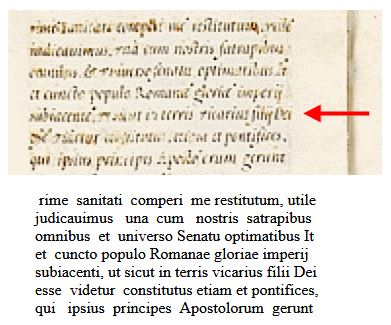
The Donation of Constantine has two parts, the first relates the alleged conversion story of Constantine to the Christian faith, and is called the “Confessio”. The second part, called the “Donatio”, lists the authority, privileges and property bestowed on the papacy by the emperor. It was later incorporated into most of the medieval collections of Catholic canon law (Anselm’s, Cardinal Deusdedit’s (c. 1087), and Gratian’s Decretum (c. 1148) also known as Concordia Discordantium Canonum).
*Scanned page (.gif) – Distinctio 96 vicarius filii Dei
(Quote of Donation of Constantine)
Below is the page of Gratian’s Decretum printed in 1512 with the title vicarius filii dei indicated by the arrow. The entire volume is online at Bayerische Staatsbibliothek, the title appears on photo 201.
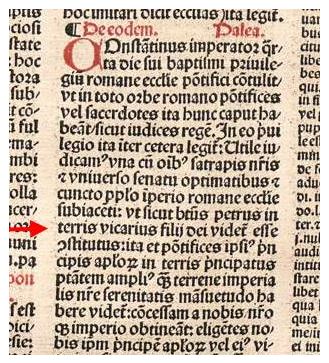
The Donation of Constantine was cited in writing by no less than 10 Popes as proof of their civil authority and sovereignty over Rome, and what came to be known as the Papal States, which included a large portion of Italy. It was also eventually exposed as a pious fraud in 1440 by Laurentius Valla who proved the donation had to have been written several centuries after the death of Constantine (337 A.D.) The Vatican condemned Valla’s scholarly work by listing it in the Index Librorum Prohibitorum, the Index of Prohibited Books of 1559 (a 1569 printing at Google books), and as late as 1580 the official edition of the Corpus Juris upheld the genuineness of the False Decretals. So the Donation of Constantine was held to be genuine for centuries.
Catholics finally abandoned the defense of the authenticity of the Donation of Constantine shortly after Cesare Baronius published his Annales Ecclesiastici in 1592, which admitted the fraud, although the Donation and title Vicarius Filii Dei continued to appear in Canon law and other Catholic publications well into the 19th century.
[Pg. 206] In his Annales Ecclesiastici (published 1588-1607) written in advocacy of the papacy and the Catholic Church, he [Baronius] took the position that the falsity of the Donation had been proven and, abandoning its defence, discussed it as a forgery. 2…
[Pg. 207] … Starting with his apologetic attitude on behalf of the papacy, and the existence of Greek texts of the Donation, he advanced the theory that Greeks had perpetrated the forgery and used it to establish the antiquity of the See of Constantinople.
2 Under the year 324, nos. 117-123. Cf. also A. D. 1191, no 51.
Source: Constantine the Great and Christianity, by Christopher Bush Coleman, New York, The Columbia University Press; Longmans, Green & Co., Agents, 1914, pgs. 206, 207.
Annales Ecclesiastici: Auctore Cesare Baronio Sorano, Congregationis Oratorii Presbytero, Tomus Tertius [Volume 3], Romae, 1594, pg. 262.
Annales Ecclesiastici: Auctore Cesare Baronio Sorano, Congregationis Oratorii Presbytero, Tomus Tertius [Volume 3], Antverpiae, 1624, pg. 275.
___________________________________________________________________________________________________________
Here are papal documents in which Vicarius Filii Dei
appears in various forms:
1. Pope Leo IX, In Terra Pax Hominibus, 1054
2. Pope Nicholaus IV, letter to Caydonius the Tartar, 1289
3. Pope John XXII, Licet juxta doctrinam, 1327
4. Pope Paul VI, Rivi Muniensis, 1965
5. Pope Paul VI, Bafianae, 1968
___________________________________________________________________________________________________________
POPE LEO IX — 1054 — IN TERRA PAX HOMINIBUS
VICARIUS FILII DEI USED BY POPE LEO IX IN AN OFFICIAL LETTER THAT RESULTED IN THE CATHOLIC CHURCH BEING SPLIT IN TWO!
According to the 1913 Catholic Encyclopedia entry on the Donation of Constantine:
The first pope who used it in an official act and relied upon it, was Leo IX; in a letter of 1054 to Michael Cærularius, Patriarch of Constantinople, he cites the “Donatio” to show that the Holy See possessed both an earthly and a heavenly imperium, the royal priesthood. … Gregory VII himself never quoted this document in his long warfare for ecclesiastical liberty against the secular power. But Urban II made use of it in 1091 to support his claims on the island of Corsica. Later popes (Innocent III, Gregory IX, Innocent IV) took its authority for granted (Innocent III, Sermo de sancto Silvestro, in P.L., CCXVII, 481 sqq.; Raynaldus, Annales, ad an. 1236, n. 24; Potthast, Regesta, no. 11,848), and ecclesiastical writers often adduced its evidence in favour of the papacy. The medieval adversaries of the popes, on the other hand, never denied the validity of this appeal to the pretended donation of Constantine … The authenticity of the document, as already stated, was doubted by no one before the fifteenth century.
*Source: The 1913 Catholic Encyclopedia online at the New Advent web site. Scanned page of Volume 5, entry on Donation of Constantine, page 120.
The text of the letter of Leo IX to Michael Cærularius, “In terra pax hominibus”, is cited in the following work: Several Tracts Against Popery, by Michael Geddes, LL.D., London, 1715. See pages 12 – 20.
In this letter, which the 1913 Catholic Encyclopedia deems an official act, Pope Leo IX was asserting his primacy as the Bishop of Rome, and to that end he reproduced that portion of the donation containing vicarius filii Dei (see page 12 at left below) for the edification of the Greek Patriarch. In the prologue of his citation of the donation, Leo IX said, in affirming the donation as genuine:
“But lest perhaps”, saith Leo, “some Scruple may still remain with you concerning it’s earthly Domination, (that is the Papacy’s) and that you may not so much as lightly suspect, that the holy Roman See seeks to vindicate and defend its unshaken Honour with foolish and old Wives Fables, we will here produce a few Privileges which were confirmed by the Hand of the said Constantine, … by which Truth will be confirmed, … we do not follow learned Fables, but do manifest unto you the Power of Our Lord Jesus Christ [2 Pet. 1:16], … Know ye that the same glorious Prince in the aforesaid Privilege, did, … thus promulgate the special Dignity of the Roman Church”. (pgs. 18, 19)
As Geddes says:
“Was there ever any Truth spoke of with more Assurance, or with a greater Air of Devotion, than Constantine’s Donation, and the Roman Church’s never having made use of Fables, as spoke of here by Leo.”
“As Leo is, you see, in his Prologue to this Donation, very peremptory that it is authentick, so he triumphs in his Epilogue to it, as if its being so were made indubitable by him, saying,” … ‘Wherefore Truth being supported by these and many more such Testimonies, does not blush, but impudent Vanity is confounded.’ “If this Pope had any Shame in him, he would never have ventured on this Occasion to have spoke either of Blushing or of Impudence; or if he had had any Religion, would he have dared to have made such a Grimace as this.”
“For as if he himself believed all that he saith here so positively, and with so great an Air of Religion, concerning these Donations being indubitably authentick, he was certainly the simplest and most credulous Man that ever put Pen to Paper: So if he did not believe it himself, as it is more than probable he did not, he was a most profane and vile Hypocrite to cant about it, as he does. However, what this Pope saith here so dogmatically of the Instrument of Constantine’s Donation, and its being authentick, ought to be remembered.” (pgs. 19, 20)
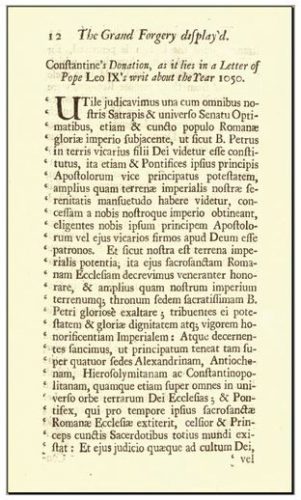
The letter begins with the Intitulatio: “Leo episcopus, servus servorum Dei”, which is characteristic of official papal bulls. It was addressed to Michael Cærularius, Patriarch of Constantinople, and Leo, Metropolitan of Achrida, and was in response to a letter sent by Leo, Metropolitan of Achrida to John, Bishop of Tranum (Bulgaria), that categorically attacked the customs of the Latin Church that differed from those of the Greeks. Especially criticized were the Roman traditions of fasting on the Saturday Sabbath and consecration of unleavened bread. Leo IX in his letter accused Constantinople of historically being the source of heresy and claimed in emphatic terms the primacy of the Bishop of Rome over even the Patriarch of Constantinople*, who would have none of it. After Leo’s assertion of primacy was summarily rejected, Patriarch Cærularius was excommunicated by papal legates who entered Constantinople’s St. Sophia during the liturgy on July 16, 1054, and publicly threw down the Bull that anathematized Cerularius on the altar table. By that dramatic act, the Church was split in two in the Great Schism that has ever since divided East and West.
* “Pope Leo IX. cites long extracts of it [the Donation] in his letter to Michael Cerularius, patriarch of Constantinople, in 1054, in order to establish against the Greeks the spiritual and temporal jurisdiction of the Holy See.2″— The Power of the Pope During the Middle Ages, by M. Gosselin, Vol. 1., Translated by Rev. Matthew Kelly, London, pg. 318.
The full Latin text of the epistle of Pope Leo IX is online:
* Migne’s Patrologia Latina, Vol. 143 (cxliii), Leo IX Epistolae Et Decreta .pdf – 1.9 Mb
See Col. 744B-769D (pgs. 76-89) for Leo IX’s letter, and Col. 753B (paragraph XIII, pg. 80) for Vicarius Filii Dei.
* Mansi, Labbe and Cossart’s Sacrorum Conciliorum Nova Amplissima Collectio, Vol. 19 (xix) .pdf – 66 Mb See Col. 635-656. Vicarius Filii Dei appears in paragraph XIII of Col. 643. (Online at Gallica (National Library of France), Col. 643, pg. 391 – page scan).
*
Labbe and Cossart, Sacrosancta Concilia Ad Regiam Editionem Exacta: Book 9, 1671, Paris, Col. 949-971, Vicarius Filii Dei appears in section XIII, Col. 957.
* Acta et scripta quae de controversiis ecclesiae Graecae et Latinae, Dr. Cornelius Will, 1861. This book has the text of the letters relevant to the Great Schism of 1054. Vicarius Filii Dei appears in section XIII, pg. 72.
* Cited in Sources of Catholic Dogma, translated by Roy J. Deferrari from the 30th ed. of Heinrich Denzinger’s Enchiridion Symbolorum, The Primacy of the Roman Pontiff, 350-353 (Google), pg. 142, St. Louis: Herder, 1957.
The full Latin text of the Donation of Constantine is online:
* Migne’s Patrologia Latina, Vol. 130 (cxxx), Isidorus Mercator Collectio Decretalium .pdf – 9 Mb (See Col. 245- 252B, pgs. 115-119 Vicarius Filii Dei appears on pg. 117, Col. 248C
The same volume online at Google Books.
___________________________________________________________________________________________________________
Vicar of Jesus Christ
Pope Innocent III — (1198-1216) — Inter corporalia
Pope Innocent III popularized the title “Vicar of Jesus Christ”. In Inter corporalia, he claimed that as the Vicar of Jesus Christ, only the Roman Pontiff could remove or transfer bishops, because he acted not with human, but with divine power and authority reserved for the Roman Pontiff alone:
Non enim humana sed potius divina potestate conjugium spirituale dissolvitur, cum per translationem, vel depositionem auctoritate Romani Pontificis (quem constat esse vicarium Jesu Christi), episcopus ab ecclesia removetur: et ideo tria haec, quae praemisimus, non tam constitutione canonica, quam institutione divina soli sunt Romano Pontifici reservata. — Official 1582 “In Aedibus Populi Romani” edition of Corpus Juris Canonici, Decretal. Greg. IX., de Transl., lib. i. tit. 7, c. 2, Inter corporalia, col. 213, pg. 107.
For it is not by human but rather divine power that spiritual marriage is dissolved, when as by translation or cession by the authority of the Bishop of Rome (Whom it is known to be the Vicar of Jesus Christ) a Bishop is removed from his Church: These three are reserved to the Roman Pontiff alone—not so much by Canonical institution as by Divine institution.
In Licet in tantum, Pope Innocent III stated that he was the successor of Peter and Vicar of Jesus Christ:
Sicut legitimi matrimonii vinculum, quod est virum est et uxorem, homo dissolvere nequit, Domino dicente in Evangelio, Quod Deus conjunxit, homo non separet (Matth. xix,6) : sic et spirituale foedus conjugii, quod est inter episcopum et Ecciesiam, quod in electione initiatum, ratum in confirmatione et in consecratione intelligitur consummatum, sine illius auctoritate solvi non potest, qui successor est Petri et vicarius Jesu Christi. — Official 1582 “In Aedibus Populi Romani” edition of Corpus Juris Canonici, Decretal. Greg. IX., de Transl., lib. i. tit. 7, c. 4, Licet in tantum, col 218, pg. 109.
For instance, man can not overthrow the bond of a legitimate marriage of husband and wife, the Lord saying in the Gospel, That which God hath joined together, let not man put asunder (Matt. xix, 6): so also is the spiritual covenant of marriage, which is between the bishop and the church, which begins in the election, is ratified in confirmation and in the consecration is completed, it is understood, can not be dissolved without the authority of he who is the successor of Peter, and the vicar of Jesus Christ.
Jam ergo videtis quis iste servus, qui super familiam constituitur, profecto vicarius Jesu Christi, successor Petri, Christus Domini, Deus Pharaonis : inter Deum et hominem medius constitutus, citra Deum, sed ultra hominem : minor Deo, sed major homine : qui de omnibus judicat, et a nemine judicatur : Apostoli voce pronuntians, < qui me judicat, Dominus est (1 Cor. IV)
Now, therefore, you see this servant, who is appointed over the family, verily the vicar of Jesus Christ, the successor of Peter, the Lord’s Anointed, the God of Pharaoh, placed in the middle between God and man, this side of God, but beyond man, inferior to God, but greater than man: who judges all, and is judged of no man: The Apostles affirming voice, “he who judges me is the Lord.” (1 Cor 4:4)
Innocent III, Sermo II, In Consecratione Pontficis Maximi, Migne, Patrologia Latina, vol. 217, col. 658.
___________________________________________________________________________________________________________
In the 12th century, the canonist John the Deacon of the Lateran wrote Liber de ecclesia Lateranensi (On the Lateran Church) in which the text of the Donation of Constantine appeared, including Vicarius Filii Dei.
* See Migne, Gregorii Papaei, Cognomento Magni, Opera Omnia, Book IV, Liber de ecclesia Lateranensi, pg. 1389.
* See Migne, Patrologiae Cursus Completus, Book CXCIV (194), Liber de ecclesia Lateranensi, Col 1545.
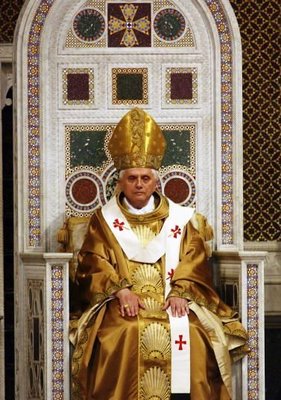
Pope Benedict XVI
St. John Lateran Cathedral figures prominently in Bible prophecy as it has the official “cathedra” or throne of the Bishop of Rome, it is the oldest or “Mother” church of Christendom, and it was in fact formerly the palace of the emperor, bequeathed to the Pope when Constantine vacated Rome for Constantinople, leaving the Bishop of Rome to fill the vacuum. This is mentioned in both the Donation and in the book of Revelation:
Rev 13:2 And the beast [papal Rome] which I saw was like unto a leopard [Greece], and his feet were as the feet of a bear [Medo-Persia], and his mouth as the mouth of a lion [Babylon]: and the dragon [pagan Rome / Satan] gave him [the papacy] his power, and his seat [cathedra, St. John Lateran], and great authority.
Above is Pope Benedict XVI on the throne in the apse of St. John Lateran Cathedral, formerly the palace of Emperor Constantine the Great, now the official cathedra of the Bishop of Rome. St. John Lateran is located on one of the seven hills of Rome.
See: What Does The Word Vatican Mean?
___________________________________________________________________________________________________________
Vicar of God
Pope Nicholas II — 1278 — Fundamenta Militantis Ecclesiae
“Vicar of Christ (Lat. Vicarius Christi), a title of the pope implying his supreme and universal primacy, both of honour and of jurisdiction, over the Church of Christ. … The title Vicar of God used for the pope by Nicholas III is employed as an equivalent for Vicar of Christ.” — Vicar of Christ entry, Catholic Encyclopedia, 1913, Volume 15, pg. 403.
In Fundamenta Militantis Ecclesiae, a papal constitution issued on July 18, 1278, Pope Nicholas III decreed that the city of Rome was to be governed by a senate composed of Roman citizens, but only with his express papal approval. (see this book)
Decet ipsius nullo modo vacillare iudicia: ut fratres ipsos nullus saecularis potestatis metus exterreat, nullus temporalis favor absorbeat, nullus eis terror immineat, nihil eos a veri consilii soliditate removeat: quin, per ipsum Romanum Pontificem in quibuscumque negotiis contingeret eorum peti consilia, in consulendo per omnia liberi, eidem Romano Pontifici in omnibus, quae pro tempore imminent, libere consulant, et assistant: ipsaque Romani Pontificis Vicarii Dei, quae suis temporibus occurrerit, electio, et eorundem cardinalium, (cum expedierit) facienda promotio, in omni libertate procedant. — Official 1582 “In Aedibus Populi Romani” edition of Corpus Juris Canonici, Liber Sextus, Book 1, tit. vi – De electione, cap. 17 – Fundamenta Militantis Ecclesiae, col. 129, (Romani Pontificis vicarij Dei occurs at bottom of column 132), pg. 68. Also see footnote z – sed Dei vicarius, and footnote t – vicarij Dei, at the bottom of the page.
___________________________________________________________________________________________________________
Vicar of Jesus Christ Son of God
Pope Nicholas IV — 1289 — Letter to Caydonius the Tatar
Pope Nicolaus IV in a letter dated July 13th, 1289, inviting Caydonius the Tatar to embrace the Christian faith, assured him that the Roman Pontiff’s office of Vicar of Jesus Christ the Son of God was in fact a divine appointment:
Prudentia, magnificentia, auctoritate eminebat inter Tartaros Caydonius Princeps.
Hunc ad fidem pertrahere conatur Nicolaus ratus multos alios Tartariae; principes movendos esse ad eam amplectendam ejus principis auctoritate.
Ne miretur Caydonius, si a Romano Pontifice per litteras invitatur ad Christianam fidem amplectendam. Ex munere enim sibi divinitus imposito ita agit, et ita illi est agendum;
Vicarius enim Jesu Christi Filii Dei est.
Hic illi explanat Mysterium Incarnationis, vitam, mortemque Chrifti pro hominum salute latam.
Quare quam maxime potest eum orat, obtestaturque, si quicquam aeternam salutem suam cordi habet, ut Chriftianae fidei nomen det.
D. Reate III. Id. Jul. P. a. II. a. D. 1289.
* Source: PONTIFICIARUM CONSTITUTIONUM, IN BULLAMIS MAGNO, ET ROMANO CONTENTARUM, ET ALIUNDE DESUMPTARUM, Aloysius Guerra, STD, Tomus Secundus, Venetiis, 1772, pg. 456.
___________________________________________________________________________________________________________
Augustinus Triumphus — (1243-1328)
— Summa de potestate ecclesiastica
14th Century Canon Lawyer Applies
Vicarius Filii Dei To The Pope

Agostino Trionfo of Ancona (Augustinus Triumphus) 1243-1328 A.D.
Summa de potestate ecclesiastica (Summary On The Power Of The Church)
Trionfo was expressly commissioned by Pope John XXII to produce a book that would set forth and defend the ecclesiastical and temporal authority of the papacy. The result was Summa de potestate ecclesiastica, which was completed in the year 1320 and dedicated to the same Pope, and is considered the high water mark of papal pretentions.
The Summa de potestate ecclesiastica of Augustinus Triumphus has been described as ‘one of the half dozen most influential and most important books ever written’ on the nature of the papal supremacy in the Middle ages, 1…
1 C. H. McIlwain, The Growth of Political Thought in the West (London, 1932), p. 278. — The Problem of Sovereignty in the Later Middle Ages: The Papal Monarchy with Augustinus Triumphus and the Publicists by Michael Wilks, Cambridge University Press, 2008, ISBN 052107018X, 9780521070188, p. 2
Augustinus’ Summa de potestate ecclesiastica is an extensive treatise, counting over 600 double column pages in the early printed editions. It consists of 112 questions, divided into three major parts. There are at least twenty-four extant manuscripts of the complete work, and another fifteen containing fragments. The Summa received five editions in the fifteenth century, and the four successive editions in Rome, beginning in 1582 and ending in 1585, which was the last edition of Augustinus’ work. — High Way To Heaven, The Augustinian Platform Between Reform and Reformation, 1292-1524, by Eric Leland Saak, Leiden; Boston, MA: Brill, 2002, page 50.
The University of Maryland claims 29 editions of Summa were published between 1320 and 1584 in Latin, and it is held by 55 libraries worldwide.
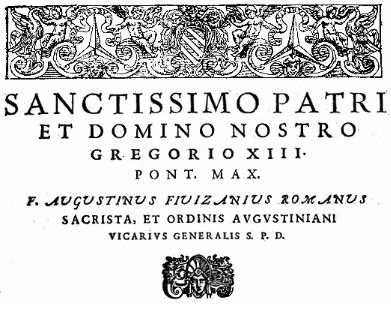
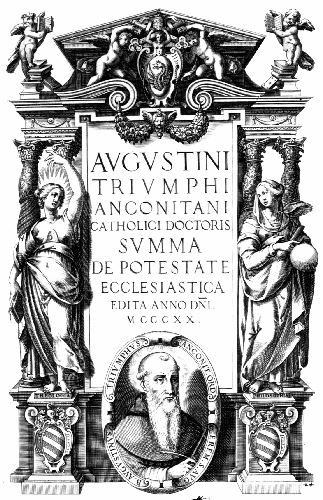
Note that Summa was coming off the presses of Rome during the early years of the Catholic Church’s enforcement of the Tridentine Index of Forbidden Books (Index Librorum Prohibitorum), which began in 1546 under Pope Pius IV and the Council of Trent, and remained in effect for over 300 years. The 1582 printing is prefaced by an endorsement by F. Augustinus Fiuizanius Romanus, Sacrista, Et Ordinis Augustiniani, Vicarius Generalis, under the name of Pope Gregory XIII. The crest of Pope Gregory XIII, with the winged dragon, appears on the title page, as shown below. In Summa, Agostino applied Vicarius Filii Dei to the papacy.
Refer to the following guide for the Latin and corresponding English for each edition of Summa. The Latin spelling varies slightly depending on abbreviations used.
___________________________________________________________________________________________________________
Then also Lateinos has the number six hundred and sixty-six; and it is a very probable [solution], this being the name of the last kingdom [of the four seen by Daniel]. For the Latins are they who at present bear rule: I will not, however, make any boast over this [coincidence]:
Source: Against Heresies, by Irenæus, Book 5, chapter 30, paragraph 3.
St. Irenaeus biography online at the New Advent Catholic web site.
HEBREW
The numeric equivalents of Hebrew letters can be found in the Encyclopedia Britannica under “Languages of the World”, Table 50.
Note:
*Lateinos, Ecclesia Italika, and Romith are cited as possible solutions by Johannes Gerhard (1582-1637), a Lutheran, in his Adnotationes in Apocalypsin, page 110.
*Romith, Vicarius Filii Dei, Dux Cleri, Ordinarius Ovilis Christi Pastor, and Dic Lux are cited by the rector of Berlin, Andreas Helwig [or Helwich] (1572-1643) in his Antichristus Romanus, in proprio suo nomine, numerum illum Apocalypticum (DCLXVI) continente proditus, published in 1612 in Wittenberg.
*Dux Cleri is cited by Walter Brute (or Britte), a fourteenth century follower of Wycliff, in his Registrum, page 356.
*Ludovicus was proposed by James Bicheno (d. 1831), a British minister and author, applying it at the time to the French King Louis XIV, as the two-horned beast from the earth.
He Latine Basileia and Lateinos are cited by Alexander Campbell (1788-1866), founder of the Disciples of Christ, in A Debate on the Roman Catholic Religion of 1837.
See The PROPHETIC FAITH OF OUR FATHERS, The Historical Development of Prophetic Interpretation, by Le Roy Edwin Froom, Volumes II and IV, published by the Review and Herald Publishing Association, Washington D.C., Copyright 1948.
____________________________________________________________________________________________________________
This relationship of 666 in Greek, Latin, and Hebrew is only one relatively small, yet important indicator that the Papacy is the Antichrist and the beast from the sea of Revelation 13. This association by itself proves little, as 666 can fit other people using the same methods. All the other biblical characteristics of the Antichrist must be considered and met as well, then this association becomes significant.
____________________________________________________________________________________________________________
An objection has been raised that the method of gematria used above to calculate the Roman numeral value of phrases is incorrect. The word VICARIUS it is argued, must be calculated with letters grouped as follows: VI=6 C=100 A=0 R=0 IU= 4 S=0, for a value of only 110, instead of 112. This is patently incorrect. The value of each individual letter is to be added to yield a total value. It is totally irrelevant to the calculation if adjacent letters can be combined in groups to give a value. This assertion that letters must be grouped is nothing but sheer nonsense.
____________________________________________________________________________________________________________
666 and CÆSAR NERO
Some will suggest that the book of Revelation was written only for those living at the time, and that 666 most probably applies to Cæsar Nero, who ruled Rome from 54 to 68 A.D., rather than someone from latter centuries. This point of view, which suggests Revelation had an immediate application to the first century, rather than being prophetic, is known as preterism, and is commonly held by the Catholic Church. So, just how is Nero linked to 666?
The preterist takes a relatively uncommon form of Nero’s name, Nero Cæsar or Cæsar Nero, and adds an “n”, resulting in Neron Cæsar. Next the Latin is transliterated into Aramaic, resulting in nrwn qsr, which when using the numeric equivalent of the letters, then adds up to 666 as follows:
An example of this spelling has apparently been recently discovered in one of the Dead Sea scrolls. If you use the same process, but without the added “n” the result is 616. Interestingly, some early manuscripts have 616 rather than 666, but even scholars such as Irenæus [A.D. 120-202] attribute the 616 to only a copyist error (Against Heresies: Book V Chapter XXX.), “this number [666] being found in all the most approved and ancient copies” [of the Apocalypse] and asserts that “men who saw John face to face bearing their testimony” [to it – 666].
There is a problem though with the above calculation. According to the rules of Jewish numerology, known as gematria, when the letter Nun appears a second time in a word, it is known as a “Final”, and takes the value of 700.* So to be precise, NRWN QSR actually adds up to 1316 and not 666.
*Source: Behind Numerology, by Shirley Blackwell Lawrence, copyright 1989, published by Newcastle Publishing Co., Inc., North Hollywood, California, ISBN 0-87877-145-X, page 41.
So the preterist calculation which attributes 666 to Nero, however, is nothing more than a rather desperate attempt to find some likely candidate for the Antichrist other than the Papacy.
THE WORD ANTI
Look up in Strong’s Concordance word 473 in the Greek dictionary. You will find the the word anti is often used to denote substitution-
473. anti, an-tee’; a prim. particle; opposite, i.e. instead or because of (rarely in addition to):–for, in the room of. Often used in composition to denote contrast, requital, *substitution*, correspondence, etc.
An example of how anti is used this way can be found in the words type and antitype, which are used with respect to Bible prophecy. The “type” is the pattern or symbol, and the antitype is the fulfillment. The Jewish Passover was a “type” and the crucifixion of Jesus is the “antitype” or fulfillment of the example of the type. You substitute the antitype into the symbolism of the type to arrive at the complete meaning.
The Catholic Church has essentially confirmed this usage of the word anti. In the 1994 Catholic Almanac on page 158 there is “the list of men who claimed or exercised the papal office in an uncanonical manner.” So these men tried to substitute themselves for the true Pope, and usurp that office, so to speak. The Catholic church denies the papal authority of the men on that list because they attempted a substitute (false) claim on the Papacy. That list is a list of ANTI-POPES! So the word anti can clearly mean a substitute for something.
THE WORD ANTICHRIST
Antichrist (word 500 in Strong’s Greek dictionary) can be correctly interpreted then, as someone who substitutes himself for Jesus Christ, the Son of God, just as an antipope substituted himself into the office of the Papacy.
The Vicar of Christ (Vicarius Christi)
“Vicar of Christ . . . Title used almost exclusively of the Bishop of Rome as successor of Peter and, therefore, the one in the Church who particularly takes the place of Christ; but used also of bishops in general and even of priests. First used by the Roman Synod of A.D. 495 to refer to Pope Gelasius; more commonly in Roman curial usage to refer to the Bishop of Rome during the pontificate of Pope Eugene III (1145-1153). Pope Innocent III (1198-1216) asserted explicitly that the Pope is the Vicar of Christ; further defined at the Council of Florence in the Decree for the Greeks (1439) and Vatican Council I in Pastor Aerternus (1870). The Second Vatican Council, in Lumen Gentium , n.27, calls bishops in general “vicars and legates of Christ.” All bishops are vicars of Christ for their local churches in their ministerial functions as priest, prophet, and king, as the Pope is for the universal church; the title further denotes they exercise their authority in the Church not by delegation from any other person, but from Christ Himself.”
Source: Catholic Dictionary, Peter M.J. Stravinskas, Editor, published by Our Sunday Visitor, Inc., Huntington, 1993, pp. 484-485.
THE WORDS VICARIOUS AND VICAR
Now look up the word vicarious in almost any common dictionary. Here is what you would find in the Webster Handy College Dictionary: “substituting for or, feeling in place of another.”
Also in the Webster’s II New Riverside Desk Dictionary for the definition of Vicar-
1. A parish priest in the Church of England.
2. A cleric in the Episcopal Church in charge of a chapel.
3. One who serves as a *substitute* for another.
A Vicar General is defined in the 1994 Catholic Almanac on page 330 as “a priest or bishop appointed by the bishop of a diocese to serve as his deputy, with ordinary executive power, in the administration of the diocese.” So a vicar serves in the place of (substituting for) the bishop, and assumes his power of office for certain duties.
So the Papal title of VICAR OF CHRIST which in Latin is VICARIUS CHRISTI, means a SUBSTITUTE FOR CHRIST, which is synonymous with Antichrist, i.e., assuming the power of God on earth! This blasphemous claim is made repeatedly by various Popes and is the very foundation of Roman Catholicism and it’s Papacy.
Some Catholics may protest that the Pope represents, but does not substitute for Jesus Christ, to avoid the association.
Now, from the Webster Hand College Dictionary, the definition of the word represent:
1. portray; depict; describe.
2. play the role of; impersonate.
3. denote; symbolize; stand for.
4. speak and act for; *be a substitute for*.
5. set forth; assert.
6. be composed of; consist in.
Clearly then, Vicar of Christ (Vicarius Christi) and Antichrist have exactly the same meaning. The Pope substitutes himself in place of God on earth, and that is *exactly* the meaning of Antichrist.
VICAR OF THE SON OF GOD
Some Catholics will claim that the title VICARIUS FILII DEI is an anti-catholic fabrication, a complete fake, never used by the Catholic church. One example of this was online at the Catholic Envoy Magazine in the article titled Pope Fiction by Patrick Madrid (See Fiction 5). My complete discussion with Patrick Madrid.
Another Catholic apologist, Karl Keating of the organization Catholic Answers, in a debate in the fall of 1989 with Jose Ventilacion of Iglesia ni Cristo, stated the following:
“The whole Iglesia argument against the Catholic Church is a big fraud, and let me prove it to you, from Pasugo [God’s Message]. I mentioned in my opening remarks, Iglesia is so fond of claiming that the Pope is the beast of Revelation. We know that the beast of Revelation has the number 666, right?”
“Now here is the argument, follow this carefully. The Pope’s have what is known as a tiara, that means a triple crown, a triply high crown, three levels. The beast can be identified. You find a man whose name, when added up adds up to 666, or a man whose title adds up to 666. Now, Iglesia ni Cristo says two things. One, that the title of the Pope, in Latin, is Vicarius Filii Dei, and second, that that title appears on the three bands of the tiara. I have in front of me a photo copy of the September 1976 issue of Pasugo. Here is a drawing made by the staff showing the tiara with those words on it. This is just a pen drawing. Two things to say. Does the title Vicarius Filii Dei add up to 666? Yes it does. But, is that a title of the Popes? Have they ever used it? No.”
“Do you know what Vicarius Filii Dei means? It means vicar, or representative, or agent, Vicar of the Son of God. The Pope has never used that title. No Pope ever. The official title of the pope, one of several, is Vicar of Christ, not Vicar of the Son of God. We Catholics claim he is the representative on earth of the God-man the Messiah, not of the second person of the Trinity as such. But you see, the Vicar of Christ, in Latin, is Vicarius Christi, and when you add up the letters, they don’t add up to 666.”
“So the first thing, the first thing, that the Iglesia ni Cristo has done, and as I say, it repeats this story every four issues or so in its magazine. The first thing is to claim that the title of the Pope is Vicarius Filii Dei. That’s a lie. It’s not at all. Why does it claim that? Because it wants to find a title that adds up to 666. It doesn’t care about the truth!”
Here is the video on YouTube.
Here is audio of the above quote (mp3).
Mr. Keating also stated this in print: “Vicarius Filii Dei never has been used as a title by any Pope.”, Catholicism and Fundamentalism, by Karl Keating, Ignatius Press, 1988, pg 221.
The following evidence is prove positive that VICARIUS FILII DEI is indeed genuine.
VICARIUS FILII DEI
THE HISTORICAL PROOF
The Donation of Constantine is the most famous forgery in European history, and was discovered in the Pseudo-Isidorian Decretals in the 9th century (c. 847-853). The forger is thought to have been Johannes Hymonides (John the Deacon of the 9th century). The Pseudo-Isidorian Decretals are fictitious letters alleged to be from early popes [Clement (A.D. 100) to Gregory the Great (A.D. 600)], collected by Isidore Mercator in the 9th century. Since the scholarly criticism of the fifteenth century they have been known to be forgeries and have been called “Pseudo-Isidorian Decretals” or False Decretals, to acknowledge that they are fraudulent.
The donation reads in part as follows in Latin: (caps added for emphasis) –
… ut sicut B. Petrus in terris VICARIUS FILII DEI esse videtur constitutus, ita et Pontifices, qui ipsius principis apostolorum gerunt vices, principatus potestatem amplius quam terrena imperialis nostrae serenitatis mansuetudo habere videtur, conscessam a nobis nostroque imperio obtineant…
In English that is-
… as the Blessed Peter is seen to have been constituted vicar of the Son of God on the earth, so the Pontiffs who are the representatives of that same chief of the apostles, should obtain from us and our empire the power of a supremacy greater than the clemency of our earthly imperial serenity is seen to have conceded to it,
(continuing beyond the Latin above) choosing that same chief of the apostles and his vicars to be our constant intercessors with God. And to the extent of our earthly Imperial power, we have decreed that his holy Roman Church shall be honored with veneration, and that more than our empire and earthly throne the most sacred seat of the Blessed Peter shall be gloriously exalted, we giving to it power, and dignity of glory, and vigor, and honor imperial. And we ordain and decree that he shall have the supremacy as well over the four principal seats, Alexandria, Antioch, Jerusalem, and Constantinople, as also over all the churches of God in the whole earth. And the Pontiff, who at the time shall be at the head of the holy Roman church itself, shall be more exalted than, and chief over, all the priests of the whole world, and according to his judgment everything which is provided for the service of God and for the stability of the faith of Christians is to be administered.
Source: Christopher B. Coleman’s The Treatise of Lorenzo Valla on the Donation of Constantine, pp. 12,13 Copyright 1922 by Yale University Press, New Haven, Conn.
___________________________________________________________________________________________________________
Photos of a 16th century copy of the Donation previously online at the Vatican Secret Archive web site. The phrase vicarius filli Dei appears at the end of the 5th line down of the left page of the 7th photo. The image below is enlarged by 100% and sharpened to make it readable. See also this page, #11.
The Donation of Constantine has two parts, the first relates the alleged conversion story of Constantine to the Christian faith, and is called the “Confessio”. The second part, called the “Donatio”, lists the authority, privileges and property bestowed on the papacy by the emperor. It was later incorporated into most of the medieval collections of Catholic canon law (Anselm’s, Cardinal Deusdedit’s (c. 1087), and Gratian’s Decretum (c. 1148) also known as Concordia Discordantium Canonum).
*Scanned page (.gif) – Distinctio 96 vicarius filii Dei
(Quote of Donation of Constantine)
Below is the page of Gratian’s Decretum printed in 1512 with the title vicarius filii dei indicated by the arrow. The entire volume is online at Bayerische Staatsbibliothek, the title appears on photo 201.
The Donation of Constantine was cited in writing by no less than 10 Popes as proof of their civil authority and sovereignty over Rome, and what came to be known as the Papal States, which included a large portion of Italy. It was also eventually exposed as a pious fraud in 1440 by Laurentius Valla who proved the donation had to have been written several centuries after the death of Constantine (337 A.D.) The Vatican condemned Valla’s scholarly work by listing it in the Index Librorum Prohibitorum, the Index of Prohibited Books of 1559 (a 1569 printing at Google books), and as late as 1580 the official edition of the Corpus Juris upheld the genuineness of the False Decretals. So the Donation of Constantine was held to be genuine for centuries.
Catholics finally abandoned the defense of the authenticity of the Donation of Constantine shortly after Cesare Baronius published his Annales Ecclesiastici in 1592, which admitted the fraud, although the Donation and title Vicarius Filii Dei continued to appear in Canon law and other Catholic publications well into the 19th century.
[Pg. 206] In his Annales Ecclesiastici (published 1588-1607) written in advocacy of the papacy and the Catholic Church, he [Baronius] took the position that the falsity of the Donation had been proven and, abandoning its defence, discussed it as a forgery. 2…
[Pg. 207] … Starting with his apologetic attitude on behalf of the papacy, and the existence of Greek texts of the Donation, he advanced the theory that Greeks had perpetrated the forgery and used it to establish the antiquity of the See of Constantinople.
2 Under the year 324, nos. 117-123. Cf. also A. D. 1191, no 51.
Source: Constantine the Great and Christianity, by Christopher Bush Coleman, New York, The Columbia University Press; Longmans, Green & Co., Agents, 1914, pgs. 206, 207.
Annales Ecclesiastici: Auctore Cesare Baronio Sorano, Congregationis Oratorii Presbytero, Tomus Tertius [Volume 3], Romae, 1594, pg. 262.
Annales Ecclesiastici: Auctore Cesare Baronio Sorano, Congregationis Oratorii Presbytero, Tomus Tertius [Volume 3], Antverpiae, 1624, pg. 275.
___________________________________________________________________________________________________________
Here are papal documents in which Vicarius Filii Dei
appears in various forms:
1. Pope Leo IX, In Terra Pax Hominibus, 1054
2. Pope Nicholaus IV, letter to Caydonius the Tartar, 1289
3. Pope John XXII, Licet juxta doctrinam, 1327
4. Pope Paul VI, Rivi Muniensis, 1965
5. Pope Paul VI, Bafianae, 1968
___________________________________________________________________________________________________________
POPE LEO IX — 1054 — IN TERRA PAX HOMINIBUS
VICARIUS FILII DEI USED BY POPE LEO IX IN AN OFFICIAL LETTER THAT RESULTED IN THE CATHOLIC CHURCH BEING SPLIT IN TWO!
According to the 1913 Catholic Encyclopedia entry on the Donation of Constantine:
The first pope who used it in an official act and relied upon it, was Leo IX; in a letter of 1054 to Michael Cærularius, Patriarch of Constantinople, he cites the “Donatio” to show that the Holy See possessed both an earthly and a heavenly imperium, the royal priesthood. … Gregory VII himself never quoted this document in his long warfare for ecclesiastical liberty against the secular power. But Urban II made use of it in 1091 to support his claims on the island of Corsica. Later popes (Innocent III, Gregory IX, Innocent IV) took its authority for granted (Innocent III, Sermo de sancto Silvestro, in P.L., CCXVII, 481 sqq.; Raynaldus, Annales, ad an. 1236, n. 24; Potthast, Regesta, no. 11,848), and ecclesiastical writers often adduced its evidence in favour of the papacy. The medieval adversaries of the popes, on the other hand, never denied the validity of this appeal to the pretended donation of Constantine … The authenticity of the document, as already stated, was doubted by no one before the fifteenth century.
*Source: The 1913 Catholic Encyclopedia online at the New Advent web site. Scanned page of Volume 5, entry on Donation of Constantine, page 120.
The text of the letter of Leo IX to Michael Cærularius, “In terra pax hominibus”, is cited in the following work: Several Tracts Against Popery, by Michael Geddes, LL.D., London, 1715. See pages 12 – 20.
In this letter, which the 1913 Catholic Encyclopedia deems an official act, Pope Leo IX was asserting his primacy as the Bishop of Rome, and to that end he reproduced that portion of the donation containing vicarius filii Dei (see page 12 at left below) for the edification of the Greek Patriarch. In the prologue of his citation of the donation, Leo IX said, in affirming the donation as genuine:
“But lest perhaps”, saith Leo, “some Scruple may still remain with you concerning it’s earthly Domination, (that is the Papacy’s) and that you may not so much as lightly suspect, that the holy Roman See seeks to vindicate and defend its unshaken Honour with foolish and old Wives Fables, we will here produce a few Privileges which were confirmed by the Hand of the said Constantine, … by which Truth will be confirmed, … we do not follow learned Fables, but do manifest unto you the Power of Our Lord Jesus Christ [2 Pet. 1:16], … Know ye that the same glorious Prince in the aforesaid Privilege, did, … thus promulgate the special Dignity of the Roman Church”. (pgs. 18, 19)
As Geddes says:
“Was there ever any Truth spoke of with more Assurance, or with a greater Air of Devotion, than Constantine’s Donation, and the Roman Church’s never having made use of Fables, as spoke of here by Leo.”
“As Leo is, you see, in his Prologue to this Donation, very peremptory that it is authentick, so he triumphs in his Epilogue to it, as if its being so were made indubitable by him, saying,” … ‘Wherefore Truth being supported by these and many more such Testimonies, does not blush, but impudent Vanity is confounded.’ “If this Pope had any Shame in him, he would never have ventured on this Occasion to have spoke either of Blushing or of Impudence; or if he had had any Religion, would he have dared to have made such a Grimace as this.”
“For as if he himself believed all that he saith here so positively, and with so great an Air of Religion, concerning these Donations being indubitably authentick, he was certainly the simplest and most credulous Man that ever put Pen to Paper: So if he did not believe it himself, as it is more than probable he did not, he was a most profane and vile Hypocrite to cant about it, as he does. However, what this Pope saith here so dogmatically of the Instrument of Constantine’s Donation, and its being authentick, ought to be remembered.” (pgs. 19, 20)
The letter begins with the Intitulatio: “Leo episcopus, servus servorum Dei”, which is characteristic of official papal bulls. It was addressed to Michael Cærularius, Patriarch of Constantinople, and Leo, Metropolitan of Achrida, and was in response to a letter sent by Leo, Metropolitan of Achrida to John, Bishop of Tranum (Bulgaria), that categorically attacked the customs of the Latin Church that differed from those of the Greeks. Especially criticized were the Roman traditions of fasting on the Saturday Sabbath and consecration of unleavened bread. Leo IX in his letter accused Constantinople of historically being the source of heresy and claimed in emphatic terms the primacy of the Bishop of Rome over even the Patriarch of Constantinople*, who would have none of it. After Leo’s assertion of primacy was summarily rejected, Patriarch Cærularius was excommunicated by papal legates who entered Constantinople’s St. Sophia during the liturgy on July 16, 1054, and publicly threw down the Bull that anathematized Cerularius on the altar table. By that dramatic act, the Church was split in two in the Great Schism that has ever since divided East and West.
* “Pope Leo IX. cites long extracts of it [the Donation] in his letter to Michael Cerularius, patriarch of Constantinople, in 1054, in order to establish against the Greeks the spiritual and temporal jurisdiction of the Holy See.2″— The Power of the Pope During the Middle Ages, by M. Gosselin, Vol. 1., Translated by Rev. Matthew Kelly, London, pg. 318.
The full Latin text of the epistle of Pope Leo IX is online:
* Migne’s Patrologia Latina, Vol. 143 (cxliii), Leo IX Epistolae Et Decreta .pdf – 1.9 Mb
See Col. 744B-769D (pgs. 76-89) for Leo IX’s letter, and Col. 753B (paragraph XIII, pg. 80) for Vicarius Filii Dei.
* Mansi, Labbe and Cossart’s Sacrorum Conciliorum Nova Amplissima Collectio, Vol. 19 (xix) .pdf – 66 Mb See Col. 635-656. Vicarius Filii Dei appears in paragraph XIII of Col. 643. (Online at Gallica (National Library of France), Col. 643, pg. 391 – page scan).
*
Labbe and Cossart, Sacrosancta Concilia Ad Regiam Editionem Exacta: Book 9, 1671, Paris, Col. 949-971, Vicarius Filii Dei appears in section XIII, Col. 957.
* Acta et scripta quae de controversiis ecclesiae Graecae et Latinae, Dr. Cornelius Will, 1861. This book has the text of the letters relevant to the Great Schism of 1054. Vicarius Filii Dei appears in section XIII, pg. 72.
* Cited in Sources of Catholic Dogma, translated by Roy J. Deferrari from the 30th ed. of Heinrich Denzinger’s Enchiridion Symbolorum, The Primacy of the Roman Pontiff, 350-353 (Google), pg. 142, St. Louis: Herder, 1957.
The full Latin text of the Donation of Constantine is online:
* Migne’s Patrologia Latina, Vol. 130 (cxxx), Isidorus Mercator Collectio Decretalium .pdf – 9 Mb (See Col. 245- 252B, pgs. 115-119 Vicarius Filii Dei appears on pg. 117, Col. 248C
The same volume online at Google Books.
___________________________________________________________________________________________________________
Vicar of Jesus Christ
Pope Innocent III — (1198-1216) — Inter corporalia
Pope Innocent III popularized the title “Vicar of Jesus Christ”. In Inter corporalia, he claimed that as the Vicar of Jesus Christ, only the Roman Pontiff could remove or transfer bishops, because he acted not with human, but with divine power and authority reserved for the Roman Pontiff alone:
Non enim humana sed potius divina potestate conjugium spirituale dissolvitur, cum per translationem, vel depositionem auctoritate Romani Pontificis (quem constat esse vicarium Jesu Christi), episcopus ab ecclesia removetur: et ideo tria haec, quae praemisimus, non tam constitutione canonica, quam institutione divina soli sunt Romano Pontifici reservata. — Official 1582 “In Aedibus Populi Romani” edition of Corpus Juris Canonici, Decretal. Greg. IX., de Transl., lib. i. tit. 7, c. 2, Inter corporalia, col. 213, pg. 107.
For it is not by human but rather divine power that spiritual marriage is dissolved, when as by translation or cession by the authority of the Bishop of Rome (Whom it is known to be the Vicar of Jesus Christ) a Bishop is removed from his Church: These three are reserved to the Roman Pontiff alone—not so much by Canonical institution as by Divine institution.
In Licet in tantum, Pope Innocent III stated that he was the successor of Peter and Vicar of Jesus Christ:
Sicut legitimi matrimonii vinculum, quod est virum est et uxorem, homo dissolvere nequit, Domino dicente in Evangelio, Quod Deus conjunxit, homo non separet (Matth. xix,6) : sic et spirituale foedus conjugii, quod est inter episcopum et Ecciesiam, quod in electione initiatum, ratum in confirmatione et in consecratione intelligitur consummatum, sine illius auctoritate solvi non potest, qui successor est Petri et vicarius Jesu Christi. — Official 1582 “In Aedibus Populi Romani” edition of Corpus Juris Canonici, Decretal. Greg. IX., de Transl., lib. i. tit. 7, c. 4, Licet in tantum, col 218, pg. 109.
For instance, man can not overthrow the bond of a legitimate marriage of husband and wife, the Lord saying in the Gospel, That which God hath joined together, let not man put asunder (Matt. xix, 6): so also is the spiritual covenant of marriage, which is between the bishop and the church, which begins in the election, is ratified in confirmation and in the consecration is completed, it is understood, can not be dissolved without the authority of he who is the successor of Peter, and the vicar of Jesus Christ.
Jam ergo videtis quis iste servus, qui super familiam constituitur, profecto vicarius Jesu Christi, successor Petri, Christus Domini, Deus Pharaonis : inter Deum et hominem medius constitutus, citra Deum, sed ultra hominem : minor Deo, sed major homine : qui de omnibus judicat, et a nemine judicatur : Apostoli voce pronuntians, < qui me judicat, Dominus est (1 Cor. IV)
Now, therefore, you see this servant, who is appointed over the family, verily the vicar of Jesus Christ, the successor of Peter, the Lord’s Anointed, the God of Pharaoh, placed in the middle between God and man, this side of God, but beyond man, inferior to God, but greater than man: who judges all, and is judged of no man: The Apostles affirming voice, “he who judges me is the Lord.” (1 Cor 4:4)
Innocent III, Sermo II, In Consecratione Pontficis Maximi, Migne, Patrologia Latina, vol. 217, col. 658.
___________________________________________________________________________________________________________
In the 12th century, the canonist John the Deacon of the Lateran wrote Liber de ecclesia Lateranensi (On the Lateran Church) in which the text of the Donation of Constantine appeared, including Vicarius Filii Dei.
* See Migne, Gregorii Papaei, Cognomento Magni, Opera Omnia, Book IV, Liber de ecclesia Lateranensi, pg. 1389.
* See Migne, Patrologiae Cursus Completus, Book CXCIV (194), Liber de ecclesia Lateranensi, Col 1545.
Pope Benedict XVI
St. John Lateran Cathedral figures prominently in Bible prophecy as it has the official “cathedra” or throne of the Bishop of Rome, it is the oldest or “Mother” church of Christendom, and it was in fact formerly the palace of the emperor, bequeathed to the Pope when Constantine vacated Rome for Constantinople, leaving the Bishop of Rome to fill the vacuum. This is mentioned in both the Donation and in the book of Revelation:
Rev 13:2 And the beast [papal Rome] which I saw was like unto a leopard [Greece], and his feet were as the feet of a bear [Medo-Persia], and his mouth as the mouth of a lion [Babylon]: and the dragon [pagan Rome / Satan] gave him [the papacy] his power, and his seat [cathedra, St. John Lateran], and great authority.
Above is Pope Benedict XVI on the throne in the apse of St. John Lateran Cathedral, formerly the palace of Emperor Constantine the Great, now the official cathedra of the Bishop of Rome. St. John Lateran is located on one of the seven hills of Rome.
See: What Does The Word Vatican Mean?
___________________________________________________________________________________________________________
Vicar of God
Pope Nicholas II — 1278 — Fundamenta Militantis Ecclesiae
“Vicar of Christ (Lat. Vicarius Christi), a title of the pope implying his supreme and universal primacy, both of honour and of jurisdiction, over the Church of Christ. … The title Vicar of God used for the pope by Nicholas III is employed as an equivalent for Vicar of Christ.” — Vicar of Christ entry, Catholic Encyclopedia, 1913, Volume 15, pg. 403.
In Fundamenta Militantis Ecclesiae, a papal constitution issued on July 18, 1278, Pope Nicholas III decreed that the city of Rome was to be governed by a senate composed of Roman citizens, but only with his express papal approval. (see this book)
Decet ipsius nullo modo vacillare iudicia: ut fratres ipsos nullus saecularis potestatis metus exterreat, nullus temporalis favor absorbeat, nullus eis terror immineat, nihil eos a veri consilii soliditate removeat: quin, per ipsum Romanum Pontificem in quibuscumque negotiis contingeret eorum peti consilia, in consulendo per omnia liberi, eidem Romano Pontifici in omnibus, quae pro tempore imminent, libere consulant, et assistant: ipsaque Romani Pontificis Vicarii Dei, quae suis temporibus occurrerit, electio, et eorundem cardinalium, (cum expedierit) facienda promotio, in omni libertate procedant. — Official 1582 “In Aedibus Populi Romani” edition of Corpus Juris Canonici, Liber Sextus, Book 1, tit. vi – De electione, cap. 17 – Fundamenta Militantis Ecclesiae, col. 129, (Romani Pontificis vicarij Dei occurs at bottom of column 132), pg. 68. Also see footnote z – sed Dei vicarius, and footnote t – vicarij Dei, at the bottom of the page.
___________________________________________________________________________________________________________
Vicar of Jesus Christ Son of God
Pope Nicholas IV — 1289 — Letter to Caydonius the Tatar
Pope Nicolaus IV in a letter dated July 13th, 1289, inviting Caydonius the Tatar to embrace the Christian faith, assured him that the Roman Pontiff’s office of Vicar of Jesus Christ the Son of God was in fact a divine appointment:
Prudentia, magnificentia, auctoritate eminebat inter Tartaros Caydonius Princeps.
Hunc ad fidem pertrahere conatur Nicolaus ratus multos alios Tartariae; principes movendos esse ad eam amplectendam ejus principis auctoritate.
Ne miretur Caydonius, si a Romano Pontifice per litteras invitatur ad Christianam fidem amplectendam. Ex munere enim sibi divinitus imposito ita agit, et ita illi est agendum;
Vicarius enim Jesu Christi Filii Dei est.
Hic illi explanat Mysterium Incarnationis, vitam, mortemque Chrifti pro hominum salute latam.
Quare quam maxime potest eum orat, obtestaturque, si quicquam aeternam salutem suam cordi habet, ut Chriftianae fidei nomen det.
D. Reate III. Id. Jul. P. a. II. a. D. 1289.
* Source: PONTIFICIARUM CONSTITUTIONUM, IN BULLAMIS MAGNO, ET ROMANO CONTENTARUM, ET ALIUNDE DESUMPTARUM, Aloysius Guerra, STD, Tomus Secundus, Venetiis, 1772, pg. 456.
___________________________________________________________________________________________________________
Augustinus Triumphus — (1243-1328)
— Summa de potestate ecclesiastica
14th Century Canon Lawyer Applies
Vicarius Filii Dei To The Pope
Agostino Trionfo of Ancona (Augustinus Triumphus) 1243-1328 A.D.
Summa de potestate ecclesiastica (Summary On The Power Of The Church)
Trionfo was expressly commissioned by Pope John XXII to produce a book that would set forth and defend the ecclesiastical and temporal authority of the papacy. The result was Summa de potestate ecclesiastica, which was completed in the year 1320 and dedicated to the same Pope, and is considered the high water mark of papal pretentions.
The Summa de potestate ecclesiastica of Augustinus Triumphus has been described as ‘one of the half dozen most influential and most important books ever written’ on the nature of the papal supremacy in the Middle ages, 1…
1 C. H. McIlwain, The Growth of Political Thought in the West (London, 1932), p. 278. — The Problem of Sovereignty in the Later Middle Ages: The Papal Monarchy with Augustinus Triumphus and the Publicists by Michael Wilks, Cambridge University Press, 2008, ISBN 052107018X, 9780521070188, p. 2
Augustinus’ Summa de potestate ecclesiastica is an extensive treatise, counting over 600 double column pages in the early printed editions. It consists of 112 questions, divided into three major parts. There are at least twenty-four extant manuscripts of the complete work, and another fifteen containing fragments. The Summa received five editions in the fifteenth century, and the four successive editions in Rome, beginning in 1582 and ending in 1585, which was the last edition of Augustinus’ work. — High Way To Heaven, The Augustinian Platform Between Reform and Reformation, 1292-1524, by Eric Leland Saak, Leiden; Boston, MA: Brill, 2002, page 50.
The University of Maryland claims 29 editions of Summa were published between 1320 and 1584 in Latin, and it is held by 55 libraries worldwide.
Note that Summa was coming off the presses of Rome during the early years of the Catholic Church’s enforcement of the Tridentine Index of Forbidden Books (Index Librorum Prohibitorum), which began in 1546 under Pope Pius IV and the Council of Trent, and remained in effect for over 300 years. The 1582 printing is prefaced by an endorsement by F. Augustinus Fiuizanius Romanus, Sacrista, Et Ordinis Augustiniani, Vicarius Generalis, under the name of Pope Gregory XIII. The crest of Pope Gregory XIII, with the winged dragon, appears on the title page, as shown below. In Summa, Agostino applied Vicarius Filii Dei to the papacy.
Refer to the following guide for the Latin and corresponding English for each edition of Summa. The Latin spelling varies slightly depending on abbreviations used.
___________________________________________________________________________________________________________
Note:
*Lateinos, Ecclesia Italika, and Romith are cited as possible solutions by Johannes Gerhard (1582-1637), a Lutheran, in his Adnotationes in Apocalypsin, page 110.
*Romith, Vicarius Filii Dei, Dux Cleri, Ordinarius Ovilis Christi Pastor, and Dic Lux are cited by the rector of Berlin, Andreas Helwig [or Helwich] (1572-1643) in his Antichristus Romanus, in proprio suo nomine, numerum illum Apocalypticum (DCLXVI) continente proditus, published in 1612 in Wittenberg.
*Dux Cleri is cited by Walter Brute (or Britte), a fourteenth century follower of Wycliff, in his Registrum, page 356.
*Ludovicus was proposed by James Bicheno (d. 1831), a British minister and author, applying it at the time to the French King Louis XIV, as the two-horned beast from the earth.
He Latine Basileia and Lateinos are cited by Alexander Campbell (1788-1866), founder of the Disciples of Christ, in A Debate on the Roman Catholic Religion of 1837.
See The PROPHETIC FAITH OF OUR FATHERS, The Historical Development of Prophetic Interpretation, by Le Roy Edwin Froom, Volumes II and IV, published by the Review and Herald Publishing Association, Washington D.C., Copyright 1948.
____________________________________________________________________________________________________________
This relationship of 666 in Greek, Latin, and Hebrew is only one relatively small, yet important indicator that the Papacy is the Antichrist and the beast from the sea of Revelation 13. This association by itself proves little, as 666 can fit other people using the same methods. All the other biblical characteristics of the Antichrist must be considered and met as well, then this association becomes significant.
____________________________________________________________________________________________________________
An objection has been raised that the method of gematria used above to calculate the Roman numeral value of phrases is incorrect. The word VICARIUS it is argued, must be calculated with letters grouped as follows: VI=6 C=100 A=0 R=0 IU= 4 S=0, for a value of only 110, instead of 112. This is patently incorrect. The value of each individual letter is to be added to yield a total value. It is totally irrelevant to the calculation if adjacent letters can be combined in groups to give a value. This assertion that letters must be grouped is nothing but sheer nonsense.
____________________________________________________________________________________________________________
666 and CÆSAR NERO
Some will suggest that the book of Revelation was written only for those living at the time, and that 666 most probably applies to Cæsar Nero, who ruled Rome from 54 to 68 A.D., rather than someone from latter centuries. This point of view, which suggests Revelation had an immediate application to the first century, rather than being prophetic, is known as preterism, and is commonly held by the Catholic Church. So, just how is Nero linked to 666?
The preterist takes a relatively uncommon form of Nero’s name, Nero Cæsar or Cæsar Nero, and adds an “n”, resulting in Neron Cæsar. Next the Latin is transliterated into Aramaic, resulting in nrwn qsr, which when using the numeric equivalent of the letters, then adds up to 666 as follows:
An example of this spelling has apparently been recently discovered in one of the Dead Sea scrolls. If you use the same process, but without the added “n” the result is 616. Interestingly, some early manuscripts have 616 rather than 666, but even scholars such as Irenæus [A.D. 120-202] attribute the 616 to only a copyist error (Against Heresies: Book V Chapter XXX.), “this number [666] being found in all the most approved and ancient copies” [of the Apocalypse] and asserts that “men who saw John face to face bearing their testimony” [to it – 666].
There is a problem though with the above calculation. According to the rules of Jewish numerology, known as gematria, when the letter Nun appears a second time in a word, it is known as a “Final”, and takes the value of 700.* So to be precise, NRWN QSR actually adds up to 1316 and not 666.
*Source: Behind Numerology, by Shirley Blackwell Lawrence, copyright 1989, published by Newcastle Publishing Co., Inc., North Hollywood, California, ISBN 0-87877-145-X, page 41.
So the preterist calculation which attributes 666 to Nero, however, is nothing more than a rather desperate attempt to find some likely candidate for the Antichrist other than the Papacy.
THE WORD ANTI
Look up in Strong’s Concordance word 473 in the Greek dictionary. You will find the the word anti is often used to denote substitution-
473. anti, an-tee’; a prim. particle; opposite, i.e. instead or because of (rarely in addition to):–for, in the room of. Often used in composition to denote contrast, requital, *substitution*, correspondence, etc.
An example of how anti is used this way can be found in the words type and antitype, which are used with respect to Bible prophecy. The “type” is the pattern or symbol, and the antitype is the fulfillment. The Jewish Passover was a “type” and the crucifixion of Jesus is the “antitype” or fulfillment of the example of the type. You substitute the antitype into the symbolism of the type to arrive at the complete meaning.
The Catholic Church has essentially confirmed this usage of the word anti. In the 1994 Catholic Almanac on page 158 there is “the list of men who claimed or exercised the papal office in an uncanonical manner.” So these men tried to substitute themselves for the true Pope, and usurp that office, so to speak. The Catholic church denies the papal authority of the men on that list because they attempted a substitute (false) claim on the Papacy. That list is a list of ANTI-POPES! So the word anti can clearly mean a substitute for something.
THE WORD ANTICHRIST
Antichrist (word 500 in Strong’s Greek dictionary) can be correctly interpreted then, as someone who substitutes himself for Jesus Christ, the Son of God, just as an antipope substituted himself into the office of the Papacy.
The Vicar of Christ (Vicarius Christi)
“Vicar of Christ . . . Title used almost exclusively of the Bishop of Rome as successor of Peter and, therefore, the one in the Church who particularly takes the place of Christ; but used also of bishops in general and even of priests. First used by the Roman Synod of A.D. 495 to refer to Pope Gelasius; more commonly in Roman curial usage to refer to the Bishop of Rome during the pontificate of Pope Eugene III (1145-1153). Pope Innocent III (1198-1216) asserted explicitly that the Pope is the Vicar of Christ; further defined at the Council of Florence in the Decree for the Greeks (1439) and Vatican Council I in Pastor Aerternus (1870). The Second Vatican Council, in Lumen Gentium , n.27, calls bishops in general “vicars and legates of Christ.” All bishops are vicars of Christ for their local churches in their ministerial functions as priest, prophet, and king, as the Pope is for the universal church; the title further denotes they exercise their authority in the Church not by delegation from any other person, but from Christ Himself.”
Source: Catholic Dictionary, Peter M.J. Stravinskas, Editor, published by Our Sunday Visitor, Inc., Huntington, 1993, pp. 484-485.
THE WORDS VICARIOUS AND VICAR
Now look up the word vicarious in almost any common dictionary. Here is what you would find in the Webster Handy College Dictionary: “substituting for or, feeling in place of another.”
Also in the Webster’s II New Riverside Desk Dictionary for the definition of Vicar-
1. A parish priest in the Church of England.
2. A cleric in the Episcopal Church in charge of a chapel.
3. One who serves as a *substitute* for another.
A Vicar General is defined in the 1994 Catholic Almanac on page 330 as “a priest or bishop appointed by the bishop of a diocese to serve as his deputy, with ordinary executive power, in the administration of the diocese.” So a vicar serves in the place of (substituting for) the bishop, and assumes his power of office for certain duties.
So the Papal title of VICAR OF CHRIST which in Latin is VICARIUS CHRISTI, means a SUBSTITUTE FOR CHRIST, which is synonymous with Antichrist, i.e., assuming the power of God on earth! This blasphemous claim is made repeatedly by various Popes and is the very foundation of Roman Catholicism and it’s Papacy.
Some Catholics may protest that the Pope represents, but does not substitute for Jesus Christ, to avoid the association.
Now, from the Webster Hand College Dictionary, the definition of the word represent:
1. portray; depict; describe.
2. play the role of; impersonate.
3. denote; symbolize; stand for.
4. speak and act for; *be a substitute for*.
5. set forth; assert.
6. be composed of; consist in.
Clearly then, Vicar of Christ (Vicarius Christi) and Antichrist have exactly the same meaning. The Pope substitutes himself in place of God on earth, and that is *exactly* the meaning of Antichrist.
VICAR OF THE SON OF GOD
Some Catholics will claim that the title VICARIUS FILII DEI is an anti-catholic fabrication, a complete fake, never used by the Catholic church. One example of this was online at the Catholic Envoy Magazine in the article titled Pope Fiction by Patrick Madrid (See Fiction 5). My complete discussion with Patrick Madrid.
Another Catholic apologist, Karl Keating of the organization Catholic Answers, in a debate in the fall of 1989 with Jose Ventilacion of Iglesia ni Cristo, stated the following:
“The whole Iglesia argument against the Catholic Church is a big fraud, and let me prove it to you, from Pasugo [God’s Message]. I mentioned in my opening remarks, Iglesia is so fond of claiming that the Pope is the beast of Revelation. We know that the beast of Revelation has the number 666, right?”
“Now here is the argument, follow this carefully. The Pope’s have what is known as a tiara, that means a triple crown, a triply high crown, three levels. The beast can be identified. You find a man whose name, when added up adds up to 666, or a man whose title adds up to 666. Now, Iglesia ni Cristo says two things. One, that the title of the Pope, in Latin, is Vicarius Filii Dei, and second, that that title appears on the three bands of the tiara. I have in front of me a photo copy of the September 1976 issue of Pasugo. Here is a drawing made by the staff showing the tiara with those words on it. This is just a pen drawing. Two things to say. Does the title Vicarius Filii Dei add up to 666? Yes it does. But, is that a title of the Popes? Have they ever used it? No.”
“Do you know what Vicarius Filii Dei means? It means vicar, or representative, or agent, Vicar of the Son of God. The Pope has never used that title. No Pope ever. The official title of the pope, one of several, is Vicar of Christ, not Vicar of the Son of God. We Catholics claim he is the representative on earth of the God-man the Messiah, not of the second person of the Trinity as such. But you see, the Vicar of Christ, in Latin, is Vicarius Christi, and when you add up the letters, they don’t add up to 666.”
“So the first thing, the first thing, that the Iglesia ni Cristo has done, and as I say, it repeats this story every four issues or so in its magazine. The first thing is to claim that the title of the Pope is Vicarius Filii Dei. That’s a lie. It’s not at all. Why does it claim that? Because it wants to find a title that adds up to 666. It doesn’t care about the truth!”
Here is the video on YouTube.
Here is audio of the above quote (mp3).
Mr. Keating also stated this in print: “Vicarius Filii Dei never has been used as a title by any Pope.”, Catholicism and Fundamentalism, by Karl Keating, Ignatius Press, 1988, pg 221.
The following evidence is prove positive that VICARIUS FILII DEI is indeed genuine.
VICARIUS FILII DEI
THE HISTORICAL PROOF
The Donation of Constantine is the most famous forgery in European history, and was discovered in the Pseudo-Isidorian Decretals in the 9th century (c. 847-853). The forger is thought to have been Johannes Hymonides (John the Deacon of the 9th century). The Pseudo-Isidorian Decretals are fictitious letters alleged to be from early popes [Clement (A.D. 100) to Gregory the Great (A.D. 600)], collected by Isidore Mercator in the 9th century. Since the scholarly criticism of the fifteenth century they have been known to be forgeries and have been called “Pseudo-Isidorian Decretals” or False Decretals, to acknowledge that they are fraudulent.
The donation reads in part as follows in Latin: (caps added for emphasis) –
… ut sicut B. Petrus in terris VICARIUS FILII DEI esse videtur constitutus, ita et Pontifices, qui ipsius principis apostolorum gerunt vices, principatus potestatem amplius quam terrena imperialis nostrae serenitatis mansuetudo habere videtur, conscessam a nobis nostroque imperio obtineant…
In English that is-
… as the Blessed Peter is seen to have been constituted vicar of the Son of God on the earth, so the Pontiffs who are the representatives of that same chief of the apostles, should obtain from us and our empire the power of a supremacy greater than the clemency of our earthly imperial serenity is seen to have conceded to it,
(continuing beyond the Latin above) choosing that same chief of the apostles and his vicars to be our constant intercessors with God. And to the extent of our earthly Imperial power, we have decreed that his holy Roman Church shall be honored with veneration, and that more than our empire and earthly throne the most sacred seat of the Blessed Peter shall be gloriously exalted, we giving to it power, and dignity of glory, and vigor, and honor imperial. And we ordain and decree that he shall have the supremacy as well over the four principal seats, Alexandria, Antioch, Jerusalem, and Constantinople, as also over all the churches of God in the whole earth. And the Pontiff, who at the time shall be at the head of the holy Roman church itself, shall be more exalted than, and chief over, all the priests of the whole world, and according to his judgment everything which is provided for the service of God and for the stability of the faith of Christians is to be administered.
Source: Christopher B. Coleman’s The Treatise of Lorenzo Valla on the Donation of Constantine, pp. 12,13 Copyright 1922 by Yale University Press, New Haven, Conn.
___________________________________________________________________________________________________________
Photos of a 16th century copy of the Donation previously online at the Vatican Secret Archive web site. The phrase vicarius filli Dei appears at the end of the 5th line down of the left page of the 7th photo. The image below is enlarged by 100% and sharpened to make it readable. See also this page, #11.
The Donation of Constantine has two parts, the first relates the alleged conversion story of Constantine to the Christian faith, and is called the “Confessio”. The second part, called the “Donatio”, lists the authority, privileges and property bestowed on the papacy by the emperor. It was later incorporated into most of the medieval collections of Catholic canon law (Anselm’s, Cardinal Deusdedit’s (c. 1087), and Gratian’s Decretum (c. 1148) also known as Concordia Discordantium Canonum).
*Scanned page (.gif) – Distinctio 96 vicarius filii Dei
(Quote of Donation of Constantine)
Below is the page of Gratian’s Decretum printed in 1512 with the title vicarius filii dei indicated by the arrow. The entire volume is online at Bayerische Staatsbibliothek, the title appears on photo 201.
The Donation of Constantine was cited in writing by no less than 10 Popes as proof of their civil authority and sovereignty over Rome, and what came to be known as the Papal States, which included a large portion of Italy. It was also eventually exposed as a pious fraud in 1440 by Laurentius Valla who proved the donation had to have been written several centuries after the death of Constantine (337 A.D.) The Vatican condemned Valla’s scholarly work by listing it in the Index Librorum Prohibitorum, the Index of Prohibited Books of 1559 (a 1569 printing at Google books), and as late as 1580 the official edition of the Corpus Juris upheld the genuineness of the False Decretals. So the Donation of Constantine was held to be genuine for centuries.
Catholics finally abandoned the defense of the authenticity of the Donation of Constantine shortly after Cesare Baronius published his Annales Ecclesiastici in 1592, which admitted the fraud, although the Donation and title Vicarius Filii Dei continued to appear in Canon law and other Catholic publications well into the 19th century.
[Pg. 206] In his Annales Ecclesiastici (published 1588-1607) written in advocacy of the papacy and the Catholic Church, he [Baronius] took the position that the falsity of the Donation had been proven and, abandoning its defence, discussed it as a forgery. 2…
[Pg. 207] … Starting with his apologetic attitude on behalf of the papacy, and the existence of Greek texts of the Donation, he advanced the theory that Greeks had perpetrated the forgery and used it to establish the antiquity of the See of Constantinople.
2 Under the year 324, nos. 117-123. Cf. also A. D. 1191, no 51.
Source: Constantine the Great and Christianity, by Christopher Bush Coleman, New York, The Columbia University Press; Longmans, Green & Co., Agents, 1914, pgs. 206, 207.
Annales Ecclesiastici: Auctore Cesare Baronio Sorano, Congregationis Oratorii Presbytero, Tomus Tertius [Volume 3], Romae, 1594, pg. 262.
Annales Ecclesiastici: Auctore Cesare Baronio Sorano, Congregationis Oratorii Presbytero, Tomus Tertius [Volume 3], Antverpiae, 1624, pg. 275.
___________________________________________________________________________________________________________
Here are papal documents in which Vicarius Filii Dei
appears in various forms:
1. Pope Leo IX, In Terra Pax Hominibus, 1054
2. Pope Nicholaus IV, letter to Caydonius the Tartar, 1289
3. Pope John XXII, Licet juxta doctrinam, 1327
4. Pope Paul VI, Rivi Muniensis, 1965
5. Pope Paul VI, Bafianae, 1968
___________________________________________________________________________________________________________
POPE LEO IX — 1054 — IN TERRA PAX HOMINIBUS
VICARIUS FILII DEI USED BY POPE LEO IX IN AN OFFICIAL LETTER THAT RESULTED IN THE CATHOLIC CHURCH BEING SPLIT IN TWO!
According to the 1913 Catholic Encyclopedia entry on the Donation of Constantine:
The first pope who used it in an official act and relied upon it, was Leo IX; in a letter of 1054 to Michael Cærularius, Patriarch of Constantinople, he cites the “Donatio” to show that the Holy See possessed both an earthly and a heavenly imperium, the royal priesthood. … Gregory VII himself never quoted this document in his long warfare for ecclesiastical liberty against the secular power. But Urban II made use of it in 1091 to support his claims on the island of Corsica. Later popes (Innocent III, Gregory IX, Innocent IV) took its authority for granted (Innocent III, Sermo de sancto Silvestro, in P.L., CCXVII, 481 sqq.; Raynaldus, Annales, ad an. 1236, n. 24; Potthast, Regesta, no. 11,848), and ecclesiastical writers often adduced its evidence in favour of the papacy. The medieval adversaries of the popes, on the other hand, never denied the validity of this appeal to the pretended donation of Constantine … The authenticity of the document, as already stated, was doubted by no one before the fifteenth century.
*Source: The 1913 Catholic Encyclopedia online at the New Advent web site. Scanned page of Volume 5, entry on Donation of Constantine, page 120.
The text of the letter of Leo IX to Michael Cærularius, “In terra pax hominibus”, is cited in the following work: Several Tracts Against Popery, by Michael Geddes, LL.D., London, 1715. See pages 12 – 20.
In this letter, which the 1913 Catholic Encyclopedia deems an official act, Pope Leo IX was asserting his primacy as the Bishop of Rome, and to that end he reproduced that portion of the donation containing vicarius filii Dei (see page 12 at left below) for the edification of the Greek Patriarch. In the prologue of his citation of the donation, Leo IX said, in affirming the donation as genuine:
“But lest perhaps”, saith Leo, “some Scruple may still remain with you concerning it’s earthly Domination, (that is the Papacy’s) and that you may not so much as lightly suspect, that the holy Roman See seeks to vindicate and defend its unshaken Honour with foolish and old Wives Fables, we will here produce a few Privileges which were confirmed by the Hand of the said Constantine, … by which Truth will be confirmed, … we do not follow learned Fables, but do manifest unto you the Power of Our Lord Jesus Christ [2 Pet. 1:16], … Know ye that the same glorious Prince in the aforesaid Privilege, did, … thus promulgate the special Dignity of the Roman Church”. (pgs. 18, 19)
As Geddes says:
“Was there ever any Truth spoke of with more Assurance, or with a greater Air of Devotion, than Constantine’s Donation, and the Roman Church’s never having made use of Fables, as spoke of here by Leo.”
“As Leo is, you see, in his Prologue to this Donation, very peremptory that it is authentick, so he triumphs in his Epilogue to it, as if its being so were made indubitable by him, saying,” … ‘Wherefore Truth being supported by these and many more such Testimonies, does not blush, but impudent Vanity is confounded.’ “If this Pope had any Shame in him, he would never have ventured on this Occasion to have spoke either of Blushing or of Impudence; or if he had had any Religion, would he have dared to have made such a Grimace as this.”
“For as if he himself believed all that he saith here so positively, and with so great an Air of Religion, concerning these Donations being indubitably authentick, he was certainly the simplest and most credulous Man that ever put Pen to Paper: So if he did not believe it himself, as it is more than probable he did not, he was a most profane and vile Hypocrite to cant about it, as he does. However, what this Pope saith here so dogmatically of the Instrument of Constantine’s Donation, and its being authentick, ought to be remembered.” (pgs. 19, 20)
The letter begins with the Intitulatio: “Leo episcopus, servus servorum Dei”, which is characteristic of official papal bulls. It was addressed to Michael Cærularius, Patriarch of Constantinople, and Leo, Metropolitan of Achrida, and was in response to a letter sent by Leo, Metropolitan of Achrida to John, Bishop of Tranum (Bulgaria), that categorically attacked the customs of the Latin Church that differed from those of the Greeks. Especially criticized were the Roman traditions of fasting on the Saturday Sabbath and consecration of unleavened bread. Leo IX in his letter accused Constantinople of historically being the source of heresy and claimed in emphatic terms the primacy of the Bishop of Rome over even the Patriarch of Constantinople*, who would have none of it. After Leo’s assertion of primacy was summarily rejected, Patriarch Cærularius was excommunicated by papal legates who entered Constantinople’s St. Sophia during the liturgy on July 16, 1054, and publicly threw down the Bull that anathematized Cerularius on the altar table. By that dramatic act, the Church was split in two in the Great Schism that has ever since divided East and West.
* “Pope Leo IX. cites long extracts of it [the Donation] in his letter to Michael Cerularius, patriarch of Constantinople, in 1054, in order to establish against the Greeks the spiritual and temporal jurisdiction of the Holy See.2″— The Power of the Pope During the Middle Ages, by M. Gosselin, Vol. 1., Translated by Rev. Matthew Kelly, London, pg. 318.
The full Latin text of the epistle of Pope Leo IX is online:
* Migne’s Patrologia Latina, Vol. 143 (cxliii), Leo IX Epistolae Et Decreta .pdf – 1.9 Mb
See Col. 744B-769D (pgs. 76-89) for Leo IX’s letter, and Col. 753B (paragraph XIII, pg. 80) for Vicarius Filii Dei.
* Mansi, Labbe and Cossart’s Sacrorum Conciliorum Nova Amplissima Collectio, Vol. 19 (xix) .pdf – 66 Mb See Col. 635-656. Vicarius Filii Dei appears in paragraph XIII of Col. 643. (Online at Gallica (National Library of France), Col. 643, pg. 391 – page scan).
*
Labbe and Cossart, Sacrosancta Concilia Ad Regiam Editionem Exacta: Book 9, 1671, Paris, Col. 949-971, Vicarius Filii Dei appears in section XIII, Col. 957.
* Acta et scripta quae de controversiis ecclesiae Graecae et Latinae, Dr. Cornelius Will, 1861. This book has the text of the letters relevant to the Great Schism of 1054. Vicarius Filii Dei appears in section XIII, pg. 72.
* Cited in Sources of Catholic Dogma, translated by Roy J. Deferrari from the 30th ed. of Heinrich Denzinger’s Enchiridion Symbolorum, The Primacy of the Roman Pontiff, 350-353 (Google), pg. 142, St. Louis: Herder, 1957.
The full Latin text of the Donation of Constantine is online:
* Migne’s Patrologia Latina, Vol. 130 (cxxx), Isidorus Mercator Collectio Decretalium .pdf – 9 Mb (See Col. 245- 252B, pgs. 115-119 Vicarius Filii Dei appears on pg. 117, Col. 248C
The same volume online at Google Books.
___________________________________________________________________________________________________________
Vicar of Jesus Christ
Pope Innocent III — (1198-1216) — Inter corporalia
Pope Innocent III popularized the title “Vicar of Jesus Christ”. In Inter corporalia, he claimed that as the Vicar of Jesus Christ, only the Roman Pontiff could remove or transfer bishops, because he acted not with human, but with divine power and authority reserved for the Roman Pontiff alone:
Non enim humana sed potius divina potestate conjugium spirituale dissolvitur, cum per translationem, vel depositionem auctoritate Romani Pontificis (quem constat esse vicarium Jesu Christi), episcopus ab ecclesia removetur: et ideo tria haec, quae praemisimus, non tam constitutione canonica, quam institutione divina soli sunt Romano Pontifici reservata. — Official 1582 “In Aedibus Populi Romani” edition of Corpus Juris Canonici, Decretal. Greg. IX., de Transl., lib. i. tit. 7, c. 2, Inter corporalia, col. 213, pg. 107.
For it is not by human but rather divine power that spiritual marriage is dissolved, when as by translation or cession by the authority of the Bishop of Rome (Whom it is known to be the Vicar of Jesus Christ) a Bishop is removed from his Church: These three are reserved to the Roman Pontiff alone—not so much by Canonical institution as by Divine institution.
In Licet in tantum, Pope Innocent III stated that he was the successor of Peter and Vicar of Jesus Christ:
Sicut legitimi matrimonii vinculum, quod est virum est et uxorem, homo dissolvere nequit, Domino dicente in Evangelio, Quod Deus conjunxit, homo non separet (Matth. xix,6) : sic et spirituale foedus conjugii, quod est inter episcopum et Ecciesiam, quod in electione initiatum, ratum in confirmatione et in consecratione intelligitur consummatum, sine illius auctoritate solvi non potest, qui successor est Petri et vicarius Jesu Christi. — Official 1582 “In Aedibus Populi Romani” edition of Corpus Juris Canonici, Decretal. Greg. IX., de Transl., lib. i. tit. 7, c. 4, Licet in tantum, col 218, pg. 109.
For instance, man can not overthrow the bond of a legitimate marriage of husband and wife, the Lord saying in the Gospel, That which God hath joined together, let not man put asunder (Matt. xix, 6): so also is the spiritual covenant of marriage, which is between the bishop and the church, which begins in the election, is ratified in confirmation and in the consecration is completed, it is understood, can not be dissolved without the authority of he who is the successor of Peter, and the vicar of Jesus Christ.
Jam ergo videtis quis iste servus, qui super familiam constituitur, profecto vicarius Jesu Christi, successor Petri, Christus Domini, Deus Pharaonis : inter Deum et hominem medius constitutus, citra Deum, sed ultra hominem : minor Deo, sed major homine : qui de omnibus judicat, et a nemine judicatur : Apostoli voce pronuntians, < qui me judicat, Dominus est (1 Cor. IV)
Now, therefore, you see this servant, who is appointed over the family, verily the vicar of Jesus Christ, the successor of Peter, the Lord’s Anointed, the God of Pharaoh, placed in the middle between God and man, this side of God, but beyond man, inferior to God, but greater than man: who judges all, and is judged of no man: The Apostles affirming voice, “he who judges me is the Lord.” (1 Cor 4:4)
Innocent III, Sermo II, In Consecratione Pontficis Maximi, Migne, Patrologia Latina, vol. 217, col. 658.
___________________________________________________________________________________________________________
In the 12th century, the canonist John the Deacon of the Lateran wrote Liber de ecclesia Lateranensi (On the Lateran Church) in which the text of the Donation of Constantine appeared, including Vicarius Filii Dei.
* See Migne, Gregorii Papaei, Cognomento Magni, Opera Omnia, Book IV, Liber de ecclesia Lateranensi, pg. 1389.
* See Migne, Patrologiae Cursus Completus, Book CXCIV (194), Liber de ecclesia Lateranensi, Col 1545.
Pope Benedict XVI
St. John Lateran Cathedral figures prominently in Bible prophecy as it has the official “cathedra” or throne of the Bishop of Rome, it is the oldest or “Mother” church of Christendom, and it was in fact formerly the palace of the emperor, bequeathed to the Pope when Constantine vacated Rome for Constantinople, leaving the Bishop of Rome to fill the vacuum. This is mentioned in both the Donation and in the book of Revelation:
Rev 13:2 And the beast [papal Rome] which I saw was like unto a leopard [Greece], and his feet were as the feet of a bear [Medo-Persia], and his mouth as the mouth of a lion [Babylon]: and the dragon [pagan Rome / Satan] gave him [the papacy] his power, and his seat [cathedra, St. John Lateran], and great authority.
Above is Pope Benedict XVI on the throne in the apse of St. John Lateran Cathedral, formerly the palace of Emperor Constantine the Great, now the official cathedra of the Bishop of Rome. St. John Lateran is located on one of the seven hills of Rome.
See: What Does The Word Vatican Mean?
___________________________________________________________________________________________________________
Vicar of God
Pope Nicholas II — 1278 — Fundamenta Militantis Ecclesiae
“Vicar of Christ (Lat. Vicarius Christi), a title of the pope implying his supreme and universal primacy, both of honour and of jurisdiction, over the Church of Christ. … The title Vicar of God used for the pope by Nicholas III is employed as an equivalent for Vicar of Christ.” — Vicar of Christ entry, Catholic Encyclopedia, 1913, Volume 15, pg. 403.
In Fundamenta Militantis Ecclesiae, a papal constitution issued on July 18, 1278, Pope Nicholas III decreed that the city of Rome was to be governed by a senate composed of Roman citizens, but only with his express papal approval. (see this book)
Decet ipsius nullo modo vacillare iudicia: ut fratres ipsos nullus saecularis potestatis metus exterreat, nullus temporalis favor absorbeat, nullus eis terror immineat, nihil eos a veri consilii soliditate removeat: quin, per ipsum Romanum Pontificem in quibuscumque negotiis contingeret eorum peti consilia, in consulendo per omnia liberi, eidem Romano Pontifici in omnibus, quae pro tempore imminent, libere consulant, et assistant: ipsaque Romani Pontificis Vicarii Dei, quae suis temporibus occurrerit, electio, et eorundem cardinalium, (cum expedierit) facienda promotio, in omni libertate procedant. — Official 1582 “In Aedibus Populi Romani” edition of Corpus Juris Canonici, Liber Sextus, Book 1, tit. vi – De electione, cap. 17 – Fundamenta Militantis Ecclesiae, col. 129, (Romani Pontificis vicarij Dei occurs at bottom of column 132), pg. 68. Also see footnote z – sed Dei vicarius, and footnote t – vicarij Dei, at the bottom of the page.
___________________________________________________________________________________________________________
Vicar of Jesus Christ Son of God
Pope Nicholas IV — 1289 — Letter to Caydonius the Tatar
Pope Nicolaus IV in a letter dated July 13th, 1289, inviting Caydonius the Tatar to embrace the Christian faith, assured him that the Roman Pontiff’s office of Vicar of Jesus Christ the Son of God was in fact a divine appointment:
Prudentia, magnificentia, auctoritate eminebat inter Tartaros Caydonius Princeps.
Hunc ad fidem pertrahere conatur Nicolaus ratus multos alios Tartariae; principes movendos esse ad eam amplectendam ejus principis auctoritate.
Ne miretur Caydonius, si a Romano Pontifice per litteras invitatur ad Christianam fidem amplectendam. Ex munere enim sibi divinitus imposito ita agit, et ita illi est agendum;
Vicarius enim Jesu Christi Filii Dei est.
Hic illi explanat Mysterium Incarnationis, vitam, mortemque Chrifti pro hominum salute latam.
Quare quam maxime potest eum orat, obtestaturque, si quicquam aeternam salutem suam cordi habet, ut Chriftianae fidei nomen det.
D. Reate III. Id. Jul. P. a. II. a. D. 1289.
* Source: PONTIFICIARUM CONSTITUTIONUM, IN BULLAMIS MAGNO, ET ROMANO CONTENTARUM, ET ALIUNDE DESUMPTARUM, Aloysius Guerra, STD, Tomus Secundus, Venetiis, 1772, pg. 456.
___________________________________________________________________________________________________________
Augustinus Triumphus — (1243-1328)
— Summa de potestate ecclesiastica
14th Century Canon Lawyer Applies
Vicarius Filii Dei To The Pope
Agostino Trionfo of Ancona (Augustinus Triumphus) 1243-1328 A.D.
Summa de potestate ecclesiastica (Summary On The Power Of The Church)
Trionfo was expressly commissioned by Pope John XXII to produce a book that would set forth and defend the ecclesiastical and temporal authority of the papacy. The result was Summa de potestate ecclesiastica, which was completed in the year 1320 and dedicated to the same Pope, and is considered the high water mark of papal pretentions.
The Summa de potestate ecclesiastica of Augustinus Triumphus has been described as ‘one of the half dozen most influential and most important books ever written’ on the nature of the papal supremacy in the Middle ages, 1…
1 C. H. McIlwain, The Growth of Political Thought in the West (London, 1932), p. 278. — The Problem of Sovereignty in the Later Middle Ages: The Papal Monarchy with Augustinus Triumphus and the Publicists by Michael Wilks, Cambridge University Press, 2008, ISBN 052107018X, 9780521070188, p. 2
Augustinus’ Summa de potestate ecclesiastica is an extensive treatise, counting over 600 double column pages in the early printed editions. It consists of 112 questions, divided into three major parts. There are at least twenty-four extant manuscripts of the complete work, and another fifteen containing fragments. The Summa received five editions in the fifteenth century, and the four successive editions in Rome, beginning in 1582 and ending in 1585, which was the last edition of Augustinus’ work. — High Way To Heaven, The Augustinian Platform Between Reform and Reformation, 1292-1524, by Eric Leland Saak, Leiden; Boston, MA: Brill, 2002, page 50.
The University of Maryland claims 29 editions of Summa were published between 1320 and 1584 in Latin, and it is held by 55 libraries worldwide.
Note that Summa was coming off the presses of Rome during the early years of the Catholic Church’s enforcement of the Tridentine Index of Forbidden Books (Index Librorum Prohibitorum), which began in 1546 under Pope Pius IV and the Council of Trent, and remained in effect for over 300 years. The 1582 printing is prefaced by an endorsement by F. Augustinus Fiuizanius Romanus, Sacrista, Et Ordinis Augustiniani, Vicarius Generalis, under the name of Pope Gregory XIII. The crest of Pope Gregory XIII, with the winged dragon, appears on the title page, as shown below. In Summa, Agostino applied Vicarius Filii Dei to the papacy.
Refer to the following guide for the Latin and corresponding English for each edition of Summa. The Latin spelling varies slightly depending on abbreviations used.
___________________________________________________________________________________________________________
An example of this spelling has apparently been recently discovered in one of the Dead Sea scrolls. If you use the same process, but without the added “n” the result is 616. Interestingly, some early manuscripts have 616 rather than 666, but even scholars such as Irenæus [A.D. 120-202] attribute the 616 to only a copyist error (Against Heresies: Book V Chapter XXX.), “this number [666] being found in all the most approved and ancient copies” [of the Apocalypse] and asserts that “men who saw John face to face bearing their testimony” [to it – 666].
There is a problem though with the above calculation. According to the rules of Jewish numerology, known as gematria, when the letter Nun appears a second time in a word, it is known as a “Final”, and takes the value of 700.* So to be precise, NRWN QSR actually adds up to 1316 and not 666.
*Source: Behind Numerology, by Shirley Blackwell Lawrence, copyright 1989, published by Newcastle Publishing Co., Inc., North Hollywood, California, ISBN 0-87877-145-X, page 41.
So the preterist calculation which attributes 666 to Nero, however, is nothing more than a rather desperate attempt to find some likely candidate for the Antichrist other than the Papacy.
THE WORD ANTI
Look up in Strong’s Concordance word 473 in the Greek dictionary. You will find the the word anti is often used to denote substitution-
473. anti, an-tee’; a prim. particle; opposite, i.e. instead or because of (rarely in addition to):–for, in the room of. Often used in composition to denote contrast, requital, *substitution*, correspondence, etc.
An example of how anti is used this way can be found in the words type and antitype, which are used with respect to Bible prophecy. The “type” is the pattern or symbol, and the antitype is the fulfillment. The Jewish Passover was a “type” and the crucifixion of Jesus is the “antitype” or fulfillment of the example of the type. You substitute the antitype into the symbolism of the type to arrive at the complete meaning.
The Catholic Church has essentially confirmed this usage of the word anti. In the 1994 Catholic Almanac on page 158 there is “the list of men who claimed or exercised the papal office in an uncanonical manner.” So these men tried to substitute themselves for the true Pope, and usurp that office, so to speak. The Catholic church denies the papal authority of the men on that list because they attempted a substitute (false) claim on the Papacy. That list is a list of ANTI-POPES! So the word anti can clearly mean a substitute for something.
THE WORD ANTICHRIST
Antichrist (word 500 in Strong’s Greek dictionary) can be correctly interpreted then, as someone who substitutes himself for Jesus Christ, the Son of God, just as an antipope substituted himself into the office of the Papacy.
The Vicar of Christ (Vicarius Christi)
“Vicar of Christ . . . Title used almost exclusively of the Bishop of Rome as successor of Peter and, therefore, the one in the Church who particularly takes the place of Christ; but used also of bishops in general and even of priests. First used by the Roman Synod of A.D. 495 to refer to Pope Gelasius; more commonly in Roman curial usage to refer to the Bishop of Rome during the pontificate of Pope Eugene III (1145-1153). Pope Innocent III (1198-1216) asserted explicitly that the Pope is the Vicar of Christ; further defined at the Council of Florence in the Decree for the Greeks (1439) and Vatican Council I in Pastor Aerternus (1870). The Second Vatican Council, in Lumen Gentium , n.27, calls bishops in general “vicars and legates of Christ.” All bishops are vicars of Christ for their local churches in their ministerial functions as priest, prophet, and king, as the Pope is for the universal church; the title further denotes they exercise their authority in the Church not by delegation from any other person, but from Christ Himself.”
Source: Catholic Dictionary, Peter M.J. Stravinskas, Editor, published by Our Sunday Visitor, Inc., Huntington, 1993, pp. 484-485.
THE WORDS VICARIOUS AND VICAR
Now look up the word vicarious in almost any common dictionary. Here is what you would find in the Webster Handy College Dictionary: “substituting for or, feeling in place of another.”
Also in the Webster’s II New Riverside Desk Dictionary for the definition of Vicar-
1. A parish priest in the Church of England.
2. A cleric in the Episcopal Church in charge of a chapel.
3. One who serves as a *substitute* for another.
A Vicar General is defined in the 1994 Catholic Almanac on page 330 as “a priest or bishop appointed by the bishop of a diocese to serve as his deputy, with ordinary executive power, in the administration of the diocese.” So a vicar serves in the place of (substituting for) the bishop, and assumes his power of office for certain duties.
So the Papal title of VICAR OF CHRIST which in Latin is VICARIUS CHRISTI, means a SUBSTITUTE FOR CHRIST, which is synonymous with Antichrist, i.e., assuming the power of God on earth! This blasphemous claim is made repeatedly by various Popes and is the very foundation of Roman Catholicism and it’s Papacy.
Some Catholics may protest that the Pope represents, but does not substitute for Jesus Christ, to avoid the association.
Now, from the Webster Hand College Dictionary, the definition of the word represent:
1. portray; depict; describe.
2. play the role of; impersonate.
3. denote; symbolize; stand for.
4. speak and act for; *be a substitute for*.
5. set forth; assert.
6. be composed of; consist in.
Clearly then, Vicar of Christ (Vicarius Christi) and Antichrist have exactly the same meaning. The Pope substitutes himself in place of God on earth, and that is *exactly* the meaning of Antichrist.
VICAR OF THE SON OF GOD
Some Catholics will claim that the title VICARIUS FILII DEI is an anti-catholic fabrication, a complete fake, never used by the Catholic church. One example of this was online at the Catholic Envoy Magazine in the article titled Pope Fiction by Patrick Madrid (See Fiction 5). My complete discussion with Patrick Madrid.
Another Catholic apologist, Karl Keating of the organization Catholic Answers, in a debate in the fall of 1989 with Jose Ventilacion of Iglesia ni Cristo, stated the following:
“The whole Iglesia argument against the Catholic Church is a big fraud, and let me prove it to you, from Pasugo [God’s Message]. I mentioned in my opening remarks, Iglesia is so fond of claiming that the Pope is the beast of Revelation. We know that the beast of Revelation has the number 666, right?”
“Now here is the argument, follow this carefully. The Pope’s have what is known as a tiara, that means a triple crown, a triply high crown, three levels. The beast can be identified. You find a man whose name, when added up adds up to 666, or a man whose title adds up to 666. Now, Iglesia ni Cristo says two things. One, that the title of the Pope, in Latin, is Vicarius Filii Dei, and second, that that title appears on the three bands of the tiara. I have in front of me a photo copy of the September 1976 issue of Pasugo. Here is a drawing made by the staff showing the tiara with those words on it. This is just a pen drawing. Two things to say. Does the title Vicarius Filii Dei add up to 666? Yes it does. But, is that a title of the Popes? Have they ever used it? No.”
“Do you know what Vicarius Filii Dei means? It means vicar, or representative, or agent, Vicar of the Son of God. The Pope has never used that title. No Pope ever. The official title of the pope, one of several, is Vicar of Christ, not Vicar of the Son of God. We Catholics claim he is the representative on earth of the God-man the Messiah, not of the second person of the Trinity as such. But you see, the Vicar of Christ, in Latin, is Vicarius Christi, and when you add up the letters, they don’t add up to 666.”
“So the first thing, the first thing, that the Iglesia ni Cristo has done, and as I say, it repeats this story every four issues or so in its magazine. The first thing is to claim that the title of the Pope is Vicarius Filii Dei. That’s a lie. It’s not at all. Why does it claim that? Because it wants to find a title that adds up to 666. It doesn’t care about the truth!”
Here is the video on YouTube.
Here is audio of the above quote (mp3).
Mr. Keating also stated this in print: “Vicarius Filii Dei never has been used as a title by any Pope.”, Catholicism and Fundamentalism, by Karl Keating, Ignatius Press, 1988, pg 221.
The following evidence is prove positive that VICARIUS FILII DEI is indeed genuine.
VICARIUS FILII DEI
THE HISTORICAL PROOF
The Donation of Constantine is the most famous forgery in European history, and was discovered in the Pseudo-Isidorian Decretals in the 9th century (c. 847-853). The forger is thought to have been Johannes Hymonides (John the Deacon of the 9th century). The Pseudo-Isidorian Decretals are fictitious letters alleged to be from early popes [Clement (A.D. 100) to Gregory the Great (A.D. 600)], collected by Isidore Mercator in the 9th century. Since the scholarly criticism of the fifteenth century they have been known to be forgeries and have been called “Pseudo-Isidorian Decretals” or False Decretals, to acknowledge that they are fraudulent.
The donation reads in part as follows in Latin: (caps added for emphasis) –
… ut sicut B. Petrus in terris VICARIUS FILII DEI esse videtur constitutus, ita et Pontifices, qui ipsius principis apostolorum gerunt vices, principatus potestatem amplius quam terrena imperialis nostrae serenitatis mansuetudo habere videtur, conscessam a nobis nostroque imperio obtineant…
In English that is-
… as the Blessed Peter is seen to have been constituted vicar of the Son of God on the earth, so the Pontiffs who are the representatives of that same chief of the apostles, should obtain from us and our empire the power of a supremacy greater than the clemency of our earthly imperial serenity is seen to have conceded to it,
(continuing beyond the Latin above) choosing that same chief of the apostles and his vicars to be our constant intercessors with God. And to the extent of our earthly Imperial power, we have decreed that his holy Roman Church shall be honored with veneration, and that more than our empire and earthly throne the most sacred seat of the Blessed Peter shall be gloriously exalted, we giving to it power, and dignity of glory, and vigor, and honor imperial. And we ordain and decree that he shall have the supremacy as well over the four principal seats, Alexandria, Antioch, Jerusalem, and Constantinople, as also over all the churches of God in the whole earth. And the Pontiff, who at the time shall be at the head of the holy Roman church itself, shall be more exalted than, and chief over, all the priests of the whole world, and according to his judgment everything which is provided for the service of God and for the stability of the faith of Christians is to be administered.
Source: Christopher B. Coleman’s The Treatise of Lorenzo Valla on the Donation of Constantine, pp. 12,13 Copyright 1922 by Yale University Press, New Haven, Conn.
___________________________________________________________________________________________________________
Photos of a 16th century copy of the Donation previously online at the Vatican Secret Archive web site. The phrase vicarius filli Dei appears at the end of the 5th line down of the left page of the 7th photo. The image below is enlarged by 100% and sharpened to make it readable. See also this page, #11.
The Donation of Constantine has two parts, the first relates the alleged conversion story of Constantine to the Christian faith, and is called the “Confessio”. The second part, called the “Donatio”, lists the authority, privileges and property bestowed on the papacy by the emperor. It was later incorporated into most of the medieval collections of Catholic canon law (Anselm’s, Cardinal Deusdedit’s (c. 1087), and Gratian’s Decretum (c. 1148) also known as Concordia Discordantium Canonum).
*Scanned page (.gif) – Distinctio 96 vicarius filii Dei
(Quote of Donation of Constantine)
Below is the page of Gratian’s Decretum printed in 1512 with the title vicarius filii dei indicated by the arrow. The entire volume is online at Bayerische Staatsbibliothek, the title appears on photo 201.
The Donation of Constantine was cited in writing by no less than 10 Popes as proof of their civil authority and sovereignty over Rome, and what came to be known as the Papal States, which included a large portion of Italy. It was also eventually exposed as a pious fraud in 1440 by Laurentius Valla who proved the donation had to have been written several centuries after the death of Constantine (337 A.D.) The Vatican condemned Valla’s scholarly work by listing it in the Index Librorum Prohibitorum, the Index of Prohibited Books of 1559 (a 1569 printing at Google books), and as late as 1580 the official edition of the Corpus Juris upheld the genuineness of the False Decretals. So the Donation of Constantine was held to be genuine for centuries.
Catholics finally abandoned the defense of the authenticity of the Donation of Constantine shortly after Cesare Baronius published his Annales Ecclesiastici in 1592, which admitted the fraud, although the Donation and title Vicarius Filii Dei continued to appear in Canon law and other Catholic publications well into the 19th century.
[Pg. 206] In his Annales Ecclesiastici (published 1588-1607) written in advocacy of the papacy and the Catholic Church, he [Baronius] took the position that the falsity of the Donation had been proven and, abandoning its defence, discussed it as a forgery. 2…
[Pg. 207] … Starting with his apologetic attitude on behalf of the papacy, and the existence of Greek texts of the Donation, he advanced the theory that Greeks had perpetrated the forgery and used it to establish the antiquity of the See of Constantinople.
2 Under the year 324, nos. 117-123. Cf. also A. D. 1191, no 51.
Source: Constantine the Great and Christianity, by Christopher Bush Coleman, New York, The Columbia University Press; Longmans, Green & Co., Agents, 1914, pgs. 206, 207.
Annales Ecclesiastici: Auctore Cesare Baronio Sorano, Congregationis Oratorii Presbytero, Tomus Tertius [Volume 3], Romae, 1594, pg. 262.
Annales Ecclesiastici: Auctore Cesare Baronio Sorano, Congregationis Oratorii Presbytero, Tomus Tertius [Volume 3], Antverpiae, 1624, pg. 275.
___________________________________________________________________________________________________________
Here are papal documents in which Vicarius Filii Dei
appears in various forms:
1. Pope Leo IX, In Terra Pax Hominibus, 1054
2. Pope Nicholaus IV, letter to Caydonius the Tartar, 1289
3. Pope John XXII, Licet juxta doctrinam, 1327
4. Pope Paul VI, Rivi Muniensis, 1965
5. Pope Paul VI, Bafianae, 1968
___________________________________________________________________________________________________________
POPE LEO IX — 1054 — IN TERRA PAX HOMINIBUS
VICARIUS FILII DEI USED BY POPE LEO IX IN AN OFFICIAL LETTER THAT RESULTED IN THE CATHOLIC CHURCH BEING SPLIT IN TWO!
According to the 1913 Catholic Encyclopedia entry on the Donation of Constantine:
The first pope who used it in an official act and relied upon it, was Leo IX; in a letter of 1054 to Michael Cærularius, Patriarch of Constantinople, he cites the “Donatio” to show that the Holy See possessed both an earthly and a heavenly imperium, the royal priesthood. … Gregory VII himself never quoted this document in his long warfare for ecclesiastical liberty against the secular power. But Urban II made use of it in 1091 to support his claims on the island of Corsica. Later popes (Innocent III, Gregory IX, Innocent IV) took its authority for granted (Innocent III, Sermo de sancto Silvestro, in P.L., CCXVII, 481 sqq.; Raynaldus, Annales, ad an. 1236, n. 24; Potthast, Regesta, no. 11,848), and ecclesiastical writers often adduced its evidence in favour of the papacy. The medieval adversaries of the popes, on the other hand, never denied the validity of this appeal to the pretended donation of Constantine … The authenticity of the document, as already stated, was doubted by no one before the fifteenth century.
*Source: The 1913 Catholic Encyclopedia online at the New Advent web site. Scanned page of Volume 5, entry on Donation of Constantine, page 120.
The text of the letter of Leo IX to Michael Cærularius, “In terra pax hominibus”, is cited in the following work: Several Tracts Against Popery, by Michael Geddes, LL.D., London, 1715. See pages 12 – 20.
In this letter, which the 1913 Catholic Encyclopedia deems an official act, Pope Leo IX was asserting his primacy as the Bishop of Rome, and to that end he reproduced that portion of the donation containing vicarius filii Dei (see page 12 at left below) for the edification of the Greek Patriarch. In the prologue of his citation of the donation, Leo IX said, in affirming the donation as genuine:
“But lest perhaps”, saith Leo, “some Scruple may still remain with you concerning it’s earthly Domination, (that is the Papacy’s) and that you may not so much as lightly suspect, that the holy Roman See seeks to vindicate and defend its unshaken Honour with foolish and old Wives Fables, we will here produce a few Privileges which were confirmed by the Hand of the said Constantine, … by which Truth will be confirmed, … we do not follow learned Fables, but do manifest unto you the Power of Our Lord Jesus Christ [2 Pet. 1:16], … Know ye that the same glorious Prince in the aforesaid Privilege, did, … thus promulgate the special Dignity of the Roman Church”. (pgs. 18, 19)
As Geddes says:
“Was there ever any Truth spoke of with more Assurance, or with a greater Air of Devotion, than Constantine’s Donation, and the Roman Church’s never having made use of Fables, as spoke of here by Leo.”
“As Leo is, you see, in his Prologue to this Donation, very peremptory that it is authentick, so he triumphs in his Epilogue to it, as if its being so were made indubitable by him, saying,” … ‘Wherefore Truth being supported by these and many more such Testimonies, does not blush, but impudent Vanity is confounded.’ “If this Pope had any Shame in him, he would never have ventured on this Occasion to have spoke either of Blushing or of Impudence; or if he had had any Religion, would he have dared to have made such a Grimace as this.”
“For as if he himself believed all that he saith here so positively, and with so great an Air of Religion, concerning these Donations being indubitably authentick, he was certainly the simplest and most credulous Man that ever put Pen to Paper: So if he did not believe it himself, as it is more than probable he did not, he was a most profane and vile Hypocrite to cant about it, as he does. However, what this Pope saith here so dogmatically of the Instrument of Constantine’s Donation, and its being authentick, ought to be remembered.” (pgs. 19, 20)
The letter begins with the Intitulatio: “Leo episcopus, servus servorum Dei”, which is characteristic of official papal bulls. It was addressed to Michael Cærularius, Patriarch of Constantinople, and Leo, Metropolitan of Achrida, and was in response to a letter sent by Leo, Metropolitan of Achrida to John, Bishop of Tranum (Bulgaria), that categorically attacked the customs of the Latin Church that differed from those of the Greeks. Especially criticized were the Roman traditions of fasting on the Saturday Sabbath and consecration of unleavened bread. Leo IX in his letter accused Constantinople of historically being the source of heresy and claimed in emphatic terms the primacy of the Bishop of Rome over even the Patriarch of Constantinople*, who would have none of it. After Leo’s assertion of primacy was summarily rejected, Patriarch Cærularius was excommunicated by papal legates who entered Constantinople’s St. Sophia during the liturgy on July 16, 1054, and publicly threw down the Bull that anathematized Cerularius on the altar table. By that dramatic act, the Church was split in two in the Great Schism that has ever since divided East and West.
* “Pope Leo IX. cites long extracts of it [the Donation] in his letter to Michael Cerularius, patriarch of Constantinople, in 1054, in order to establish against the Greeks the spiritual and temporal jurisdiction of the Holy See.2″— The Power of the Pope During the Middle Ages, by M. Gosselin, Vol. 1., Translated by Rev. Matthew Kelly, London, pg. 318.
The full Latin text of the epistle of Pope Leo IX is online:
* Migne’s Patrologia Latina, Vol. 143 (cxliii), Leo IX Epistolae Et Decreta .pdf – 1.9 Mb
See Col. 744B-769D (pgs. 76-89) for Leo IX’s letter, and Col. 753B (paragraph XIII, pg. 80) for Vicarius Filii Dei.
* Mansi, Labbe and Cossart’s Sacrorum Conciliorum Nova Amplissima Collectio, Vol. 19 (xix) .pdf – 66 Mb See Col. 635-656. Vicarius Filii Dei appears in paragraph XIII of Col. 643. (Online at Gallica (National Library of France), Col. 643, pg. 391 – page scan).
*
Labbe and Cossart, Sacrosancta Concilia Ad Regiam Editionem Exacta: Book 9, 1671, Paris, Col. 949-971, Vicarius Filii Dei appears in section XIII, Col. 957.
* Acta et scripta quae de controversiis ecclesiae Graecae et Latinae, Dr. Cornelius Will, 1861. This book has the text of the letters relevant to the Great Schism of 1054. Vicarius Filii Dei appears in section XIII, pg. 72.
* Cited in Sources of Catholic Dogma, translated by Roy J. Deferrari from the 30th ed. of Heinrich Denzinger’s Enchiridion Symbolorum, The Primacy of the Roman Pontiff, 350-353 (Google), pg. 142, St. Louis: Herder, 1957.
The full Latin text of the Donation of Constantine is online:
* Migne’s Patrologia Latina, Vol. 130 (cxxx), Isidorus Mercator Collectio Decretalium .pdf – 9 Mb (See Col. 245- 252B, pgs. 115-119 Vicarius Filii Dei appears on pg. 117, Col. 248C
The same volume online at Google Books.
___________________________________________________________________________________________________________
Vicar of Jesus Christ
Pope Innocent III — (1198-1216) — Inter corporalia
Pope Innocent III popularized the title “Vicar of Jesus Christ”. In Inter corporalia, he claimed that as the Vicar of Jesus Christ, only the Roman Pontiff could remove or transfer bishops, because he acted not with human, but with divine power and authority reserved for the Roman Pontiff alone:
Non enim humana sed potius divina potestate conjugium spirituale dissolvitur, cum per translationem, vel depositionem auctoritate Romani Pontificis (quem constat esse vicarium Jesu Christi), episcopus ab ecclesia removetur: et ideo tria haec, quae praemisimus, non tam constitutione canonica, quam institutione divina soli sunt Romano Pontifici reservata. — Official 1582 “In Aedibus Populi Romani” edition of Corpus Juris Canonici, Decretal. Greg. IX., de Transl., lib. i. tit. 7, c. 2, Inter corporalia, col. 213, pg. 107.
For it is not by human but rather divine power that spiritual marriage is dissolved, when as by translation or cession by the authority of the Bishop of Rome (Whom it is known to be the Vicar of Jesus Christ) a Bishop is removed from his Church: These three are reserved to the Roman Pontiff alone—not so much by Canonical institution as by Divine institution.
In Licet in tantum, Pope Innocent III stated that he was the successor of Peter and Vicar of Jesus Christ:
Sicut legitimi matrimonii vinculum, quod est virum est et uxorem, homo dissolvere nequit, Domino dicente in Evangelio, Quod Deus conjunxit, homo non separet (Matth. xix,6) : sic et spirituale foedus conjugii, quod est inter episcopum et Ecciesiam, quod in electione initiatum, ratum in confirmatione et in consecratione intelligitur consummatum, sine illius auctoritate solvi non potest, qui successor est Petri et vicarius Jesu Christi. — Official 1582 “In Aedibus Populi Romani” edition of Corpus Juris Canonici, Decretal. Greg. IX., de Transl., lib. i. tit. 7, c. 4, Licet in tantum, col 218, pg. 109.
For instance, man can not overthrow the bond of a legitimate marriage of husband and wife, the Lord saying in the Gospel, That which God hath joined together, let not man put asunder (Matt. xix, 6): so also is the spiritual covenant of marriage, which is between the bishop and the church, which begins in the election, is ratified in confirmation and in the consecration is completed, it is understood, can not be dissolved without the authority of he who is the successor of Peter, and the vicar of Jesus Christ.
Jam ergo videtis quis iste servus, qui super familiam constituitur, profecto vicarius Jesu Christi, successor Petri, Christus Domini, Deus Pharaonis : inter Deum et hominem medius constitutus, citra Deum, sed ultra hominem : minor Deo, sed major homine : qui de omnibus judicat, et a nemine judicatur : Apostoli voce pronuntians, < qui me judicat, Dominus est (1 Cor. IV)
Now, therefore, you see this servant, who is appointed over the family, verily the vicar of Jesus Christ, the successor of Peter, the Lord’s Anointed, the God of Pharaoh, placed in the middle between God and man, this side of God, but beyond man, inferior to God, but greater than man: who judges all, and is judged of no man: The Apostles affirming voice, “he who judges me is the Lord.” (1 Cor 4:4)
Innocent III, Sermo II, In Consecratione Pontficis Maximi, Migne, Patrologia Latina, vol. 217, col. 658.
___________________________________________________________________________________________________________
In the 12th century, the canonist John the Deacon of the Lateran wrote Liber de ecclesia Lateranensi (On the Lateran Church) in which the text of the Donation of Constantine appeared, including Vicarius Filii Dei.
* See Migne, Gregorii Papaei, Cognomento Magni, Opera Omnia, Book IV, Liber de ecclesia Lateranensi, pg. 1389.
* See Migne, Patrologiae Cursus Completus, Book CXCIV (194), Liber de ecclesia Lateranensi, Col 1545.
Pope Benedict XVI
St. John Lateran Cathedral figures prominently in Bible prophecy as it has the official “cathedra” or throne of the Bishop of Rome, it is the oldest or “Mother” church of Christendom, and it was in fact formerly the palace of the emperor, bequeathed to the Pope when Constantine vacated Rome for Constantinople, leaving the Bishop of Rome to fill the vacuum. This is mentioned in both the Donation and in the book of Revelation:
Rev 13:2 And the beast [papal Rome] which I saw was like unto a leopard [Greece], and his feet were as the feet of a bear [Medo-Persia], and his mouth as the mouth of a lion [Babylon]: and the dragon [pagan Rome / Satan] gave him [the papacy] his power, and his seat [cathedra, St. John Lateran], and great authority.
Above is Pope Benedict XVI on the throne in the apse of St. John Lateran Cathedral, formerly the palace of Emperor Constantine the Great, now the official cathedra of the Bishop of Rome. St. John Lateran is located on one of the seven hills of Rome.
See: What Does The Word Vatican Mean?
___________________________________________________________________________________________________________
Vicar of God
Pope Nicholas II — 1278 — Fundamenta Militantis Ecclesiae
“Vicar of Christ (Lat. Vicarius Christi), a title of the pope implying his supreme and universal primacy, both of honour and of jurisdiction, over the Church of Christ. … The title Vicar of God used for the pope by Nicholas III is employed as an equivalent for Vicar of Christ.” — Vicar of Christ entry, Catholic Encyclopedia, 1913, Volume 15, pg. 403.
In Fundamenta Militantis Ecclesiae, a papal constitution issued on July 18, 1278, Pope Nicholas III decreed that the city of Rome was to be governed by a senate composed of Roman citizens, but only with his express papal approval. (see this book)
Decet ipsius nullo modo vacillare iudicia: ut fratres ipsos nullus saecularis potestatis metus exterreat, nullus temporalis favor absorbeat, nullus eis terror immineat, nihil eos a veri consilii soliditate removeat: quin, per ipsum Romanum Pontificem in quibuscumque negotiis contingeret eorum peti consilia, in consulendo per omnia liberi, eidem Romano Pontifici in omnibus, quae pro tempore imminent, libere consulant, et assistant: ipsaque Romani Pontificis Vicarii Dei, quae suis temporibus occurrerit, electio, et eorundem cardinalium, (cum expedierit) facienda promotio, in omni libertate procedant. — Official 1582 “In Aedibus Populi Romani” edition of Corpus Juris Canonici, Liber Sextus, Book 1, tit. vi – De electione, cap. 17 – Fundamenta Militantis Ecclesiae, col. 129, (Romani Pontificis vicarij Dei occurs at bottom of column 132), pg. 68. Also see footnote z – sed Dei vicarius, and footnote t – vicarij Dei, at the bottom of the page.
___________________________________________________________________________________________________________
Vicar of Jesus Christ Son of God
Pope Nicholas IV — 1289 — Letter to Caydonius the Tatar
Pope Nicolaus IV in a letter dated July 13th, 1289, inviting Caydonius the Tatar to embrace the Christian faith, assured him that the Roman Pontiff’s office of Vicar of Jesus Christ the Son of God was in fact a divine appointment:
Prudentia, magnificentia, auctoritate eminebat inter Tartaros Caydonius Princeps.
Hunc ad fidem pertrahere conatur Nicolaus ratus multos alios Tartariae; principes movendos esse ad eam amplectendam ejus principis auctoritate.
Ne miretur Caydonius, si a Romano Pontifice per litteras invitatur ad Christianam fidem amplectendam. Ex munere enim sibi divinitus imposito ita agit, et ita illi est agendum;
Vicarius enim Jesu Christi Filii Dei est.
Hic illi explanat Mysterium Incarnationis, vitam, mortemque Chrifti pro hominum salute latam.
Quare quam maxime potest eum orat, obtestaturque, si quicquam aeternam salutem suam cordi habet, ut Chriftianae fidei nomen det.
D. Reate III. Id. Jul. P. a. II. a. D. 1289.
* Source: PONTIFICIARUM CONSTITUTIONUM, IN BULLAMIS MAGNO, ET ROMANO CONTENTARUM, ET ALIUNDE DESUMPTARUM, Aloysius Guerra, STD, Tomus Secundus, Venetiis, 1772, pg. 456.
___________________________________________________________________________________________________________
Augustinus Triumphus — (1243-1328)
— Summa de potestate ecclesiastica
14th Century Canon Lawyer Applies
Vicarius Filii Dei To The Pope
Agostino Trionfo of Ancona (Augustinus Triumphus) 1243-1328 A.D.
Summa de potestate ecclesiastica (Summary On The Power Of The Church)
Trionfo was expressly commissioned by Pope John XXII to produce a book that would set forth and defend the ecclesiastical and temporal authority of the papacy. The result was Summa de potestate ecclesiastica, which was completed in the year 1320 and dedicated to the same Pope, and is considered the high water mark of papal pretentions.
The Summa de potestate ecclesiastica of Augustinus Triumphus has been described as ‘one of the half dozen most influential and most important books ever written’ on the nature of the papal supremacy in the Middle ages, 1…
1 C. H. McIlwain, The Growth of Political Thought in the West (London, 1932), p. 278. — The Problem of Sovereignty in the Later Middle Ages: The Papal Monarchy with Augustinus Triumphus and the Publicists by Michael Wilks, Cambridge University Press, 2008, ISBN 052107018X, 9780521070188, p. 2
Augustinus’ Summa de potestate ecclesiastica is an extensive treatise, counting over 600 double column pages in the early printed editions. It consists of 112 questions, divided into three major parts. There are at least twenty-four extant manuscripts of the complete work, and another fifteen containing fragments. The Summa received five editions in the fifteenth century, and the four successive editions in Rome, beginning in 1582 and ending in 1585, which was the last edition of Augustinus’ work. — High Way To Heaven, The Augustinian Platform Between Reform and Reformation, 1292-1524, by Eric Leland Saak, Leiden; Boston, MA: Brill, 2002, page 50.
The University of Maryland claims 29 editions of Summa were published between 1320 and 1584 in Latin, and it is held by 55 libraries worldwide.
Note that Summa was coming off the presses of Rome during the early years of the Catholic Church’s enforcement of the Tridentine Index of Forbidden Books (Index Librorum Prohibitorum), which began in 1546 under Pope Pius IV and the Council of Trent, and remained in effect for over 300 years. The 1582 printing is prefaced by an endorsement by F. Augustinus Fiuizanius Romanus, Sacrista, Et Ordinis Augustiniani, Vicarius Generalis, under the name of Pope Gregory XIII. The crest of Pope Gregory XIII, with the winged dragon, appears on the title page, as shown below. In Summa, Agostino applied Vicarius Filii Dei to the papacy.
Refer to the following guide for the Latin and corresponding English for each edition of Summa. The Latin spelling varies slightly depending on abbreviations used.
___________________________________________________________________________________________________________
The Donation of Constantine has two parts, the first relates the alleged conversion story of Constantine to the Christian faith, and is called the “Confessio”. The second part, called the “Donatio”, lists the authority, privileges and property bestowed on the papacy by the emperor. It was later incorporated into most of the medieval collections of Catholic canon law (Anselm’s, Cardinal Deusdedit’s (c. 1087), and Gratian’s Decretum (c. 1148) also known as Concordia Discordantium Canonum).
*Scanned page (.gif) – Distinctio 96 vicarius filii Dei
(Quote of Donation of Constantine)
Below is the page of Gratian’s Decretum printed in 1512 with the title vicarius filii dei indicated by the arrow. The entire volume is online at Bayerische Staatsbibliothek, the title appears on photo 201.
The Donation of Constantine was cited in writing by no less than 10 Popes as proof of their civil authority and sovereignty over Rome, and what came to be known as the Papal States, which included a large portion of Italy. It was also eventually exposed as a pious fraud in 1440 by Laurentius Valla who proved the donation had to have been written several centuries after the death of Constantine (337 A.D.) The Vatican condemned Valla’s scholarly work by listing it in the Index Librorum Prohibitorum, the Index of Prohibited Books of 1559 (a 1569 printing at Google books), and as late as 1580 the official edition of the Corpus Juris upheld the genuineness of the False Decretals. So the Donation of Constantine was held to be genuine for centuries.
Catholics finally abandoned the defense of the authenticity of the Donation of Constantine shortly after Cesare Baronius published his Annales Ecclesiastici in 1592, which admitted the fraud, although the Donation and title Vicarius Filii Dei continued to appear in Canon law and other Catholic publications well into the 19th century.
[Pg. 206] In his Annales Ecclesiastici (published 1588-1607) written in advocacy of the papacy and the Catholic Church, he [Baronius] took the position that the falsity of the Donation had been proven and, abandoning its defence, discussed it as a forgery. 2…
[Pg. 207] … Starting with his apologetic attitude on behalf of the papacy, and the existence of Greek texts of the Donation, he advanced the theory that Greeks had perpetrated the forgery and used it to establish the antiquity of the See of Constantinople.
2 Under the year 324, nos. 117-123. Cf. also A. D. 1191, no 51.
Source: Constantine the Great and Christianity, by Christopher Bush Coleman, New York, The Columbia University Press; Longmans, Green & Co., Agents, 1914, pgs. 206, 207.
Annales Ecclesiastici: Auctore Cesare Baronio Sorano, Congregationis Oratorii Presbytero, Tomus Tertius [Volume 3], Romae, 1594, pg. 262.
Annales Ecclesiastici: Auctore Cesare Baronio Sorano, Congregationis Oratorii Presbytero, Tomus Tertius [Volume 3], Antverpiae, 1624, pg. 275.
___________________________________________________________________________________________________________
Here are papal documents in which Vicarius Filii Dei
appears in various forms:
1. Pope Leo IX, In Terra Pax Hominibus, 1054
2. Pope Nicholaus IV, letter to Caydonius the Tartar, 1289
3. Pope John XXII, Licet juxta doctrinam, 1327
4. Pope Paul VI, Rivi Muniensis, 1965
5. Pope Paul VI, Bafianae, 1968
___________________________________________________________________________________________________________
POPE LEO IX — 1054 — IN TERRA PAX HOMINIBUS
VICARIUS FILII DEI USED BY POPE LEO IX IN AN OFFICIAL LETTER THAT RESULTED IN THE CATHOLIC CHURCH BEING SPLIT IN TWO!
According to the 1913 Catholic Encyclopedia entry on the Donation of Constantine:
The first pope who used it in an official act and relied upon it, was Leo IX; in a letter of 1054 to Michael Cærularius, Patriarch of Constantinople, he cites the “Donatio” to show that the Holy See possessed both an earthly and a heavenly imperium, the royal priesthood. … Gregory VII himself never quoted this document in his long warfare for ecclesiastical liberty against the secular power. But Urban II made use of it in 1091 to support his claims on the island of Corsica. Later popes (Innocent III, Gregory IX, Innocent IV) took its authority for granted (Innocent III, Sermo de sancto Silvestro, in P.L., CCXVII, 481 sqq.; Raynaldus, Annales, ad an. 1236, n. 24; Potthast, Regesta, no. 11,848), and ecclesiastical writers often adduced its evidence in favour of the papacy. The medieval adversaries of the popes, on the other hand, never denied the validity of this appeal to the pretended donation of Constantine … The authenticity of the document, as already stated, was doubted by no one before the fifteenth century.
*Source: The 1913 Catholic Encyclopedia online at the New Advent web site. Scanned page of Volume 5, entry on Donation of Constantine, page 120.
The text of the letter of Leo IX to Michael Cærularius, “In terra pax hominibus”, is cited in the following work: Several Tracts Against Popery, by Michael Geddes, LL.D., London, 1715. See pages 12 – 20.
In this letter, which the 1913 Catholic Encyclopedia deems an official act, Pope Leo IX was asserting his primacy as the Bishop of Rome, and to that end he reproduced that portion of the donation containing vicarius filii Dei (see page 12 at left below) for the edification of the Greek Patriarch. In the prologue of his citation of the donation, Leo IX said, in affirming the donation as genuine:
“But lest perhaps”, saith Leo, “some Scruple may still remain with you concerning it’s earthly Domination, (that is the Papacy’s) and that you may not so much as lightly suspect, that the holy Roman See seeks to vindicate and defend its unshaken Honour with foolish and old Wives Fables, we will here produce a few Privileges which were confirmed by the Hand of the said Constantine, … by which Truth will be confirmed, … we do not follow learned Fables, but do manifest unto you the Power of Our Lord Jesus Christ [2 Pet. 1:16], … Know ye that the same glorious Prince in the aforesaid Privilege, did, … thus promulgate the special Dignity of the Roman Church”. (pgs. 18, 19)
As Geddes says:
“Was there ever any Truth spoke of with more Assurance, or with a greater Air of Devotion, than Constantine’s Donation, and the Roman Church’s never having made use of Fables, as spoke of here by Leo.”
“As Leo is, you see, in his Prologue to this Donation, very peremptory that it is authentick, so he triumphs in his Epilogue to it, as if its being so were made indubitable by him, saying,” … ‘Wherefore Truth being supported by these and many more such Testimonies, does not blush, but impudent Vanity is confounded.’ “If this Pope had any Shame in him, he would never have ventured on this Occasion to have spoke either of Blushing or of Impudence; or if he had had any Religion, would he have dared to have made such a Grimace as this.”
“For as if he himself believed all that he saith here so positively, and with so great an Air of Religion, concerning these Donations being indubitably authentick, he was certainly the simplest and most credulous Man that ever put Pen to Paper: So if he did not believe it himself, as it is more than probable he did not, he was a most profane and vile Hypocrite to cant about it, as he does. However, what this Pope saith here so dogmatically of the Instrument of Constantine’s Donation, and its being authentick, ought to be remembered.” (pgs. 19, 20)
The letter begins with the Intitulatio: “Leo episcopus, servus servorum Dei”, which is characteristic of official papal bulls. It was addressed to Michael Cærularius, Patriarch of Constantinople, and Leo, Metropolitan of Achrida, and was in response to a letter sent by Leo, Metropolitan of Achrida to John, Bishop of Tranum (Bulgaria), that categorically attacked the customs of the Latin Church that differed from those of the Greeks. Especially criticized were the Roman traditions of fasting on the Saturday Sabbath and consecration of unleavened bread. Leo IX in his letter accused Constantinople of historically being the source of heresy and claimed in emphatic terms the primacy of the Bishop of Rome over even the Patriarch of Constantinople*, who would have none of it. After Leo’s assertion of primacy was summarily rejected, Patriarch Cærularius was excommunicated by papal legates who entered Constantinople’s St. Sophia during the liturgy on July 16, 1054, and publicly threw down the Bull that anathematized Cerularius on the altar table. By that dramatic act, the Church was split in two in the Great Schism that has ever since divided East and West.
* “Pope Leo IX. cites long extracts of it [the Donation] in his letter to Michael Cerularius, patriarch of Constantinople, in 1054, in order to establish against the Greeks the spiritual and temporal jurisdiction of the Holy See.2″— The Power of the Pope During the Middle Ages, by M. Gosselin, Vol. 1., Translated by Rev. Matthew Kelly, London, pg. 318.
The full Latin text of the epistle of Pope Leo IX is online:
* Migne’s Patrologia Latina, Vol. 143 (cxliii), Leo IX Epistolae Et Decreta .pdf – 1.9 Mb
See Col. 744B-769D (pgs. 76-89) for Leo IX’s letter, and Col. 753B (paragraph XIII, pg. 80) for Vicarius Filii Dei.
* Mansi, Labbe and Cossart’s Sacrorum Conciliorum Nova Amplissima Collectio, Vol. 19 (xix) .pdf – 66 Mb See Col. 635-656. Vicarius Filii Dei appears in paragraph XIII of Col. 643. (Online at Gallica (National Library of France), Col. 643, pg. 391 – page scan).
*
Labbe and Cossart, Sacrosancta Concilia Ad Regiam Editionem Exacta: Book 9, 1671, Paris, Col. 949-971, Vicarius Filii Dei appears in section XIII, Col. 957.
* Acta et scripta quae de controversiis ecclesiae Graecae et Latinae, Dr. Cornelius Will, 1861. This book has the text of the letters relevant to the Great Schism of 1054. Vicarius Filii Dei appears in section XIII, pg. 72.
* Cited in Sources of Catholic Dogma, translated by Roy J. Deferrari from the 30th ed. of Heinrich Denzinger’s Enchiridion Symbolorum, The Primacy of the Roman Pontiff, 350-353 (Google), pg. 142, St. Louis: Herder, 1957.
The full Latin text of the Donation of Constantine is online:
* Migne’s Patrologia Latina, Vol. 130 (cxxx), Isidorus Mercator Collectio Decretalium .pdf – 9 Mb (See Col. 245- 252B, pgs. 115-119 Vicarius Filii Dei appears on pg. 117, Col. 248C
The same volume online at Google Books.
___________________________________________________________________________________________________________
Vicar of Jesus Christ
Pope Innocent III — (1198-1216) — Inter corporalia
Pope Innocent III popularized the title “Vicar of Jesus Christ”. In Inter corporalia, he claimed that as the Vicar of Jesus Christ, only the Roman Pontiff could remove or transfer bishops, because he acted not with human, but with divine power and authority reserved for the Roman Pontiff alone:
Non enim humana sed potius divina potestate conjugium spirituale dissolvitur, cum per translationem, vel depositionem auctoritate Romani Pontificis (quem constat esse vicarium Jesu Christi), episcopus ab ecclesia removetur: et ideo tria haec, quae praemisimus, non tam constitutione canonica, quam institutione divina soli sunt Romano Pontifici reservata. — Official 1582 “In Aedibus Populi Romani” edition of Corpus Juris Canonici, Decretal. Greg. IX., de Transl., lib. i. tit. 7, c. 2, Inter corporalia, col. 213, pg. 107.
For it is not by human but rather divine power that spiritual marriage is dissolved, when as by translation or cession by the authority of the Bishop of Rome (Whom it is known to be the Vicar of Jesus Christ) a Bishop is removed from his Church: These three are reserved to the Roman Pontiff alone—not so much by Canonical institution as by Divine institution.
In Licet in tantum, Pope Innocent III stated that he was the successor of Peter and Vicar of Jesus Christ:
Sicut legitimi matrimonii vinculum, quod est virum est et uxorem, homo dissolvere nequit, Domino dicente in Evangelio, Quod Deus conjunxit, homo non separet (Matth. xix,6) : sic et spirituale foedus conjugii, quod est inter episcopum et Ecciesiam, quod in electione initiatum, ratum in confirmatione et in consecratione intelligitur consummatum, sine illius auctoritate solvi non potest, qui successor est Petri et vicarius Jesu Christi. — Official 1582 “In Aedibus Populi Romani” edition of Corpus Juris Canonici, Decretal. Greg. IX., de Transl., lib. i. tit. 7, c. 4, Licet in tantum, col 218, pg. 109.
For instance, man can not overthrow the bond of a legitimate marriage of husband and wife, the Lord saying in the Gospel, That which God hath joined together, let not man put asunder (Matt. xix, 6): so also is the spiritual covenant of marriage, which is between the bishop and the church, which begins in the election, is ratified in confirmation and in the consecration is completed, it is understood, can not be dissolved without the authority of he who is the successor of Peter, and the vicar of Jesus Christ.
Jam ergo videtis quis iste servus, qui super familiam constituitur, profecto vicarius Jesu Christi, successor Petri, Christus Domini, Deus Pharaonis : inter Deum et hominem medius constitutus, citra Deum, sed ultra hominem : minor Deo, sed major homine : qui de omnibus judicat, et a nemine judicatur : Apostoli voce pronuntians, < qui me judicat, Dominus est (1 Cor. IV)
Now, therefore, you see this servant, who is appointed over the family, verily the vicar of Jesus Christ, the successor of Peter, the Lord’s Anointed, the God of Pharaoh, placed in the middle between God and man, this side of God, but beyond man, inferior to God, but greater than man: who judges all, and is judged of no man: The Apostles affirming voice, “he who judges me is the Lord.” (1 Cor 4:4)
Innocent III, Sermo II, In Consecratione Pontficis Maximi, Migne, Patrologia Latina, vol. 217, col. 658.
___________________________________________________________________________________________________________
In the 12th century, the canonist John the Deacon of the Lateran wrote Liber de ecclesia Lateranensi (On the Lateran Church) in which the text of the Donation of Constantine appeared, including Vicarius Filii Dei.
* See Migne, Gregorii Papaei, Cognomento Magni, Opera Omnia, Book IV, Liber de ecclesia Lateranensi, pg. 1389.
* See Migne, Patrologiae Cursus Completus, Book CXCIV (194), Liber de ecclesia Lateranensi, Col 1545.
Pope Benedict XVI
St. John Lateran Cathedral figures prominently in Bible prophecy as it has the official “cathedra” or throne of the Bishop of Rome, it is the oldest or “Mother” church of Christendom, and it was in fact formerly the palace of the emperor, bequeathed to the Pope when Constantine vacated Rome for Constantinople, leaving the Bishop of Rome to fill the vacuum. This is mentioned in both the Donation and in the book of Revelation:
Rev 13:2 And the beast [papal Rome] which I saw was like unto a leopard [Greece], and his feet were as the feet of a bear [Medo-Persia], and his mouth as the mouth of a lion [Babylon]: and the dragon [pagan Rome / Satan] gave him [the papacy] his power, and his seat [cathedra, St. John Lateran], and great authority.
Above is Pope Benedict XVI on the throne in the apse of St. John Lateran Cathedral, formerly the palace of Emperor Constantine the Great, now the official cathedra of the Bishop of Rome. St. John Lateran is located on one of the seven hills of Rome.
See: What Does The Word Vatican Mean?
___________________________________________________________________________________________________________
Vicar of God
Pope Nicholas II — 1278 — Fundamenta Militantis Ecclesiae
“Vicar of Christ (Lat. Vicarius Christi), a title of the pope implying his supreme and universal primacy, both of honour and of jurisdiction, over the Church of Christ. … The title Vicar of God used for the pope by Nicholas III is employed as an equivalent for Vicar of Christ.” — Vicar of Christ entry, Catholic Encyclopedia, 1913, Volume 15, pg. 403.
In Fundamenta Militantis Ecclesiae, a papal constitution issued on July 18, 1278, Pope Nicholas III decreed that the city of Rome was to be governed by a senate composed of Roman citizens, but only with his express papal approval. (see this book)
Decet ipsius nullo modo vacillare iudicia: ut fratres ipsos nullus saecularis potestatis metus exterreat, nullus temporalis favor absorbeat, nullus eis terror immineat, nihil eos a veri consilii soliditate removeat: quin, per ipsum Romanum Pontificem in quibuscumque negotiis contingeret eorum peti consilia, in consulendo per omnia liberi, eidem Romano Pontifici in omnibus, quae pro tempore imminent, libere consulant, et assistant: ipsaque Romani Pontificis Vicarii Dei, quae suis temporibus occurrerit, electio, et eorundem cardinalium, (cum expedierit) facienda promotio, in omni libertate procedant. — Official 1582 “In Aedibus Populi Romani” edition of Corpus Juris Canonici, Liber Sextus, Book 1, tit. vi – De electione, cap. 17 – Fundamenta Militantis Ecclesiae, col. 129, (Romani Pontificis vicarij Dei occurs at bottom of column 132), pg. 68. Also see footnote z – sed Dei vicarius, and footnote t – vicarij Dei, at the bottom of the page.
___________________________________________________________________________________________________________
Vicar of Jesus Christ Son of God
Pope Nicholas IV — 1289 — Letter to Caydonius the Tatar
Pope Nicolaus IV in a letter dated July 13th, 1289, inviting Caydonius the Tatar to embrace the Christian faith, assured him that the Roman Pontiff’s office of Vicar of Jesus Christ the Son of God was in fact a divine appointment:
Prudentia, magnificentia, auctoritate eminebat inter Tartaros Caydonius Princeps.
Hunc ad fidem pertrahere conatur Nicolaus ratus multos alios Tartariae; principes movendos esse ad eam amplectendam ejus principis auctoritate.
Ne miretur Caydonius, si a Romano Pontifice per litteras invitatur ad Christianam fidem amplectendam. Ex munere enim sibi divinitus imposito ita agit, et ita illi est agendum;
Vicarius enim Jesu Christi Filii Dei est.
Hic illi explanat Mysterium Incarnationis, vitam, mortemque Chrifti pro hominum salute latam.
Quare quam maxime potest eum orat, obtestaturque, si quicquam aeternam salutem suam cordi habet, ut Chriftianae fidei nomen det.
D. Reate III. Id. Jul. P. a. II. a. D. 1289.
* Source: PONTIFICIARUM CONSTITUTIONUM, IN BULLAMIS MAGNO, ET ROMANO CONTENTARUM, ET ALIUNDE DESUMPTARUM, Aloysius Guerra, STD, Tomus Secundus, Venetiis, 1772, pg. 456.
___________________________________________________________________________________________________________
Augustinus Triumphus — (1243-1328)
— Summa de potestate ecclesiastica
14th Century Canon Lawyer Applies
Vicarius Filii Dei To The Pope
Agostino Trionfo of Ancona (Augustinus Triumphus) 1243-1328 A.D.
Summa de potestate ecclesiastica (Summary On The Power Of The Church)
Trionfo was expressly commissioned by Pope John XXII to produce a book that would set forth and defend the ecclesiastical and temporal authority of the papacy. The result was Summa de potestate ecclesiastica, which was completed in the year 1320 and dedicated to the same Pope, and is considered the high water mark of papal pretentions.
The Summa de potestate ecclesiastica of Augustinus Triumphus has been described as ‘one of the half dozen most influential and most important books ever written’ on the nature of the papal supremacy in the Middle ages, 1…
1 C. H. McIlwain, The Growth of Political Thought in the West (London, 1932), p. 278. — The Problem of Sovereignty in the Later Middle Ages: The Papal Monarchy with Augustinus Triumphus and the Publicists by Michael Wilks, Cambridge University Press, 2008, ISBN 052107018X, 9780521070188, p. 2
Augustinus’ Summa de potestate ecclesiastica is an extensive treatise, counting over 600 double column pages in the early printed editions. It consists of 112 questions, divided into three major parts. There are at least twenty-four extant manuscripts of the complete work, and another fifteen containing fragments. The Summa received five editions in the fifteenth century, and the four successive editions in Rome, beginning in 1582 and ending in 1585, which was the last edition of Augustinus’ work. — High Way To Heaven, The Augustinian Platform Between Reform and Reformation, 1292-1524, by Eric Leland Saak, Leiden; Boston, MA: Brill, 2002, page 50.
The University of Maryland claims 29 editions of Summa were published between 1320 and 1584 in Latin, and it is held by 55 libraries worldwide.
Note that Summa was coming off the presses of Rome during the early years of the Catholic Church’s enforcement of the Tridentine Index of Forbidden Books (Index Librorum Prohibitorum), which began in 1546 under Pope Pius IV and the Council of Trent, and remained in effect for over 300 years. The 1582 printing is prefaced by an endorsement by F. Augustinus Fiuizanius Romanus, Sacrista, Et Ordinis Augustiniani, Vicarius Generalis, under the name of Pope Gregory XIII. The crest of Pope Gregory XIII, with the winged dragon, appears on the title page, as shown below. In Summa, Agostino applied Vicarius Filii Dei to the papacy.
Refer to the following guide for the Latin and corresponding English for each edition of Summa. The Latin spelling varies slightly depending on abbreviations used.
___________________________________________________________________________________________________________
The Donation of Constantine was cited in writing by no less than 10 Popes as proof of their civil authority and sovereignty over Rome, and what came to be known as the Papal States, which included a large portion of Italy. It was also eventually exposed as a pious fraud in 1440 by Laurentius Valla who proved the donation had to have been written several centuries after the death of Constantine (337 A.D.) The Vatican condemned Valla’s scholarly work by listing it in the Index Librorum Prohibitorum, the Index of Prohibited Books of 1559 (a 1569 printing at Google books), and as late as 1580 the official edition of the Corpus Juris upheld the genuineness of the False Decretals. So the Donation of Constantine was held to be genuine for centuries.
Catholics finally abandoned the defense of the authenticity of the Donation of Constantine shortly after Cesare Baronius published his Annales Ecclesiastici in 1592, which admitted the fraud, although the Donation and title Vicarius Filii Dei continued to appear in Canon law and other Catholic publications well into the 19th century.
[Pg. 206] In his Annales Ecclesiastici (published 1588-1607) written in advocacy of the papacy and the Catholic Church, he [Baronius] took the position that the falsity of the Donation had been proven and, abandoning its defence, discussed it as a forgery. 2…
[Pg. 207] … Starting with his apologetic attitude on behalf of the papacy, and the existence of Greek texts of the Donation, he advanced the theory that Greeks had perpetrated the forgery and used it to establish the antiquity of the See of Constantinople.
2 Under the year 324, nos. 117-123. Cf. also A. D. 1191, no 51.
Source: Constantine the Great and Christianity, by Christopher Bush Coleman, New York, The Columbia University Press; Longmans, Green & Co., Agents, 1914, pgs. 206, 207.
Annales Ecclesiastici: Auctore Cesare Baronio Sorano, Congregationis Oratorii Presbytero, Tomus Tertius [Volume 3], Romae, 1594, pg. 262.
Annales Ecclesiastici: Auctore Cesare Baronio Sorano, Congregationis Oratorii Presbytero, Tomus Tertius [Volume 3], Antverpiae, 1624, pg. 275.
___________________________________________________________________________________________________________
Here are papal documents in which Vicarius Filii Dei
appears in various forms:
1. Pope Leo IX, In Terra Pax Hominibus, 1054
2. Pope Nicholaus IV, letter to Caydonius the Tartar, 1289
3. Pope John XXII, Licet juxta doctrinam, 1327
4. Pope Paul VI, Rivi Muniensis, 1965
5. Pope Paul VI, Bafianae, 1968
___________________________________________________________________________________________________________
POPE LEO IX — 1054 — IN TERRA PAX HOMINIBUS
VICARIUS FILII DEI USED BY POPE LEO IX IN AN OFFICIAL LETTER THAT RESULTED IN THE CATHOLIC CHURCH BEING SPLIT IN TWO!
According to the 1913 Catholic Encyclopedia entry on the Donation of Constantine:
The first pope who used it in an official act and relied upon it, was Leo IX; in a letter of 1054 to Michael Cærularius, Patriarch of Constantinople, he cites the “Donatio” to show that the Holy See possessed both an earthly and a heavenly imperium, the royal priesthood. … Gregory VII himself never quoted this document in his long warfare for ecclesiastical liberty against the secular power. But Urban II made use of it in 1091 to support his claims on the island of Corsica. Later popes (Innocent III, Gregory IX, Innocent IV) took its authority for granted (Innocent III, Sermo de sancto Silvestro, in P.L., CCXVII, 481 sqq.; Raynaldus, Annales, ad an. 1236, n. 24; Potthast, Regesta, no. 11,848), and ecclesiastical writers often adduced its evidence in favour of the papacy. The medieval adversaries of the popes, on the other hand, never denied the validity of this appeal to the pretended donation of Constantine … The authenticity of the document, as already stated, was doubted by no one before the fifteenth century.
*Source: The 1913 Catholic Encyclopedia online at the New Advent web site. Scanned page of Volume 5, entry on Donation of Constantine, page 120.
The text of the letter of Leo IX to Michael Cærularius, “In terra pax hominibus”, is cited in the following work: Several Tracts Against Popery, by Michael Geddes, LL.D., London, 1715. See pages 12 – 20.
In this letter, which the 1913 Catholic Encyclopedia deems an official act, Pope Leo IX was asserting his primacy as the Bishop of Rome, and to that end he reproduced that portion of the donation containing vicarius filii Dei (see page 12 at left below) for the edification of the Greek Patriarch. In the prologue of his citation of the donation, Leo IX said, in affirming the donation as genuine:
“But lest perhaps”, saith Leo, “some Scruple may still remain with you concerning it’s earthly Domination, (that is the Papacy’s) and that you may not so much as lightly suspect, that the holy Roman See seeks to vindicate and defend its unshaken Honour with foolish and old Wives Fables, we will here produce a few Privileges which were confirmed by the Hand of the said Constantine, … by which Truth will be confirmed, … we do not follow learned Fables, but do manifest unto you the Power of Our Lord Jesus Christ [2 Pet. 1:16], … Know ye that the same glorious Prince in the aforesaid Privilege, did, … thus promulgate the special Dignity of the Roman Church”. (pgs. 18, 19)
As Geddes says:
“Was there ever any Truth spoke of with more Assurance, or with a greater Air of Devotion, than Constantine’s Donation, and the Roman Church’s never having made use of Fables, as spoke of here by Leo.”
“As Leo is, you see, in his Prologue to this Donation, very peremptory that it is authentick, so he triumphs in his Epilogue to it, as if its being so were made indubitable by him, saying,” … ‘Wherefore Truth being supported by these and many more such Testimonies, does not blush, but impudent Vanity is confounded.’ “If this Pope had any Shame in him, he would never have ventured on this Occasion to have spoke either of Blushing or of Impudence; or if he had had any Religion, would he have dared to have made such a Grimace as this.”
“For as if he himself believed all that he saith here so positively, and with so great an Air of Religion, concerning these Donations being indubitably authentick, he was certainly the simplest and most credulous Man that ever put Pen to Paper: So if he did not believe it himself, as it is more than probable he did not, he was a most profane and vile Hypocrite to cant about it, as he does. However, what this Pope saith here so dogmatically of the Instrument of Constantine’s Donation, and its being authentick, ought to be remembered.” (pgs. 19, 20)
The letter begins with the Intitulatio: “Leo episcopus, servus servorum Dei”, which is characteristic of official papal bulls. It was addressed to Michael Cærularius, Patriarch of Constantinople, and Leo, Metropolitan of Achrida, and was in response to a letter sent by Leo, Metropolitan of Achrida to John, Bishop of Tranum (Bulgaria), that categorically attacked the customs of the Latin Church that differed from those of the Greeks. Especially criticized were the Roman traditions of fasting on the Saturday Sabbath and consecration of unleavened bread. Leo IX in his letter accused Constantinople of historically being the source of heresy and claimed in emphatic terms the primacy of the Bishop of Rome over even the Patriarch of Constantinople*, who would have none of it. After Leo’s assertion of primacy was summarily rejected, Patriarch Cærularius was excommunicated by papal legates who entered Constantinople’s St. Sophia during the liturgy on July 16, 1054, and publicly threw down the Bull that anathematized Cerularius on the altar table. By that dramatic act, the Church was split in two in the Great Schism that has ever since divided East and West.
* “Pope Leo IX. cites long extracts of it [the Donation] in his letter to Michael Cerularius, patriarch of Constantinople, in 1054, in order to establish against the Greeks the spiritual and temporal jurisdiction of the Holy See.2″— The Power of the Pope During the Middle Ages, by M. Gosselin, Vol. 1., Translated by Rev. Matthew Kelly, London, pg. 318.
The full Latin text of the epistle of Pope Leo IX is online:
* Migne’s Patrologia Latina, Vol. 143 (cxliii), Leo IX Epistolae Et Decreta .pdf – 1.9 Mb
See Col. 744B-769D (pgs. 76-89) for Leo IX’s letter, and Col. 753B (paragraph XIII, pg. 80) for Vicarius Filii Dei.
* Mansi, Labbe and Cossart’s Sacrorum Conciliorum Nova Amplissima Collectio, Vol. 19 (xix) .pdf – 66 Mb See Col. 635-656. Vicarius Filii Dei appears in paragraph XIII of Col. 643. (Online at Gallica (National Library of France), Col. 643, pg. 391 – page scan).
*
Labbe and Cossart, Sacrosancta Concilia Ad Regiam Editionem Exacta: Book 9, 1671, Paris, Col. 949-971, Vicarius Filii Dei appears in section XIII, Col. 957.
* Acta et scripta quae de controversiis ecclesiae Graecae et Latinae, Dr. Cornelius Will, 1861. This book has the text of the letters relevant to the Great Schism of 1054. Vicarius Filii Dei appears in section XIII, pg. 72.
* Cited in Sources of Catholic Dogma, translated by Roy J. Deferrari from the 30th ed. of Heinrich Denzinger’s Enchiridion Symbolorum, The Primacy of the Roman Pontiff, 350-353 (Google), pg. 142, St. Louis: Herder, 1957.
The full Latin text of the Donation of Constantine is online:
* Migne’s Patrologia Latina, Vol. 130 (cxxx), Isidorus Mercator Collectio Decretalium .pdf – 9 Mb (See Col. 245- 252B, pgs. 115-119 Vicarius Filii Dei appears on pg. 117, Col. 248C
The same volume online at Google Books.
___________________________________________________________________________________________________________
Vicar of Jesus Christ
Pope Innocent III — (1198-1216) — Inter corporalia
Pope Innocent III popularized the title “Vicar of Jesus Christ”. In Inter corporalia, he claimed that as the Vicar of Jesus Christ, only the Roman Pontiff could remove or transfer bishops, because he acted not with human, but with divine power and authority reserved for the Roman Pontiff alone:
Non enim humana sed potius divina potestate conjugium spirituale dissolvitur, cum per translationem, vel depositionem auctoritate Romani Pontificis (quem constat esse vicarium Jesu Christi), episcopus ab ecclesia removetur: et ideo tria haec, quae praemisimus, non tam constitutione canonica, quam institutione divina soli sunt Romano Pontifici reservata. — Official 1582 “In Aedibus Populi Romani” edition of Corpus Juris Canonici, Decretal. Greg. IX., de Transl., lib. i. tit. 7, c. 2, Inter corporalia, col. 213, pg. 107.
For it is not by human but rather divine power that spiritual marriage is dissolved, when as by translation or cession by the authority of the Bishop of Rome (Whom it is known to be the Vicar of Jesus Christ) a Bishop is removed from his Church: These three are reserved to the Roman Pontiff alone—not so much by Canonical institution as by Divine institution.
In Licet in tantum, Pope Innocent III stated that he was the successor of Peter and Vicar of Jesus Christ:
Sicut legitimi matrimonii vinculum, quod est virum est et uxorem, homo dissolvere nequit, Domino dicente in Evangelio, Quod Deus conjunxit, homo non separet (Matth. xix,6) : sic et spirituale foedus conjugii, quod est inter episcopum et Ecciesiam, quod in electione initiatum, ratum in confirmatione et in consecratione intelligitur consummatum, sine illius auctoritate solvi non potest, qui successor est Petri et vicarius Jesu Christi. — Official 1582 “In Aedibus Populi Romani” edition of Corpus Juris Canonici, Decretal. Greg. IX., de Transl., lib. i. tit. 7, c. 4, Licet in tantum, col 218, pg. 109.
For instance, man can not overthrow the bond of a legitimate marriage of husband and wife, the Lord saying in the Gospel, That which God hath joined together, let not man put asunder (Matt. xix, 6): so also is the spiritual covenant of marriage, which is between the bishop and the church, which begins in the election, is ratified in confirmation and in the consecration is completed, it is understood, can not be dissolved without the authority of he who is the successor of Peter, and the vicar of Jesus Christ.
Jam ergo videtis quis iste servus, qui super familiam constituitur, profecto vicarius Jesu Christi, successor Petri, Christus Domini, Deus Pharaonis : inter Deum et hominem medius constitutus, citra Deum, sed ultra hominem : minor Deo, sed major homine : qui de omnibus judicat, et a nemine judicatur : Apostoli voce pronuntians, < qui me judicat, Dominus est (1 Cor. IV)
Now, therefore, you see this servant, who is appointed over the family, verily the vicar of Jesus Christ, the successor of Peter, the Lord’s Anointed, the God of Pharaoh, placed in the middle between God and man, this side of God, but beyond man, inferior to God, but greater than man: who judges all, and is judged of no man: The Apostles affirming voice, “he who judges me is the Lord.” (1 Cor 4:4)
Innocent III, Sermo II, In Consecratione Pontficis Maximi, Migne, Patrologia Latina, vol. 217, col. 658.
___________________________________________________________________________________________________________
In the 12th century, the canonist John the Deacon of the Lateran wrote Liber de ecclesia Lateranensi (On the Lateran Church) in which the text of the Donation of Constantine appeared, including Vicarius Filii Dei.
* See Migne, Gregorii Papaei, Cognomento Magni, Opera Omnia, Book IV, Liber de ecclesia Lateranensi, pg. 1389.
* See Migne, Patrologiae Cursus Completus, Book CXCIV (194), Liber de ecclesia Lateranensi, Col 1545.
Pope Benedict XVI
St. John Lateran Cathedral figures prominently in Bible prophecy as it has the official “cathedra” or throne of the Bishop of Rome, it is the oldest or “Mother” church of Christendom, and it was in fact formerly the palace of the emperor, bequeathed to the Pope when Constantine vacated Rome for Constantinople, leaving the Bishop of Rome to fill the vacuum. This is mentioned in both the Donation and in the book of Revelation:
Rev 13:2 And the beast [papal Rome] which I saw was like unto a leopard [Greece], and his feet were as the feet of a bear [Medo-Persia], and his mouth as the mouth of a lion [Babylon]: and the dragon [pagan Rome / Satan] gave him [the papacy] his power, and his seat [cathedra, St. John Lateran], and great authority.
Above is Pope Benedict XVI on the throne in the apse of St. John Lateran Cathedral, formerly the palace of Emperor Constantine the Great, now the official cathedra of the Bishop of Rome. St. John Lateran is located on one of the seven hills of Rome.
See: What Does The Word Vatican Mean?
___________________________________________________________________________________________________________
Vicar of God
Pope Nicholas II — 1278 — Fundamenta Militantis Ecclesiae
“Vicar of Christ (Lat. Vicarius Christi), a title of the pope implying his supreme and universal primacy, both of honour and of jurisdiction, over the Church of Christ. … The title Vicar of God used for the pope by Nicholas III is employed as an equivalent for Vicar of Christ.” — Vicar of Christ entry, Catholic Encyclopedia, 1913, Volume 15, pg. 403.
In Fundamenta Militantis Ecclesiae, a papal constitution issued on July 18, 1278, Pope Nicholas III decreed that the city of Rome was to be governed by a senate composed of Roman citizens, but only with his express papal approval. (see this book)
Decet ipsius nullo modo vacillare iudicia: ut fratres ipsos nullus saecularis potestatis metus exterreat, nullus temporalis favor absorbeat, nullus eis terror immineat, nihil eos a veri consilii soliditate removeat: quin, per ipsum Romanum Pontificem in quibuscumque negotiis contingeret eorum peti consilia, in consulendo per omnia liberi, eidem Romano Pontifici in omnibus, quae pro tempore imminent, libere consulant, et assistant: ipsaque Romani Pontificis Vicarii Dei, quae suis temporibus occurrerit, electio, et eorundem cardinalium, (cum expedierit) facienda promotio, in omni libertate procedant. — Official 1582 “In Aedibus Populi Romani” edition of Corpus Juris Canonici, Liber Sextus, Book 1, tit. vi – De electione, cap. 17 – Fundamenta Militantis Ecclesiae, col. 129, (Romani Pontificis vicarij Dei occurs at bottom of column 132), pg. 68. Also see footnote z – sed Dei vicarius, and footnote t – vicarij Dei, at the bottom of the page.
___________________________________________________________________________________________________________
Vicar of Jesus Christ Son of God
Pope Nicholas IV — 1289 — Letter to Caydonius the Tatar
Pope Nicolaus IV in a letter dated July 13th, 1289, inviting Caydonius the Tatar to embrace the Christian faith, assured him that the Roman Pontiff’s office of Vicar of Jesus Christ the Son of God was in fact a divine appointment:
Prudentia, magnificentia, auctoritate eminebat inter Tartaros Caydonius Princeps.
Hunc ad fidem pertrahere conatur Nicolaus ratus multos alios Tartariae; principes movendos esse ad eam amplectendam ejus principis auctoritate.
Ne miretur Caydonius, si a Romano Pontifice per litteras invitatur ad Christianam fidem amplectendam. Ex munere enim sibi divinitus imposito ita agit, et ita illi est agendum;
Vicarius enim Jesu Christi Filii Dei est.
Hic illi explanat Mysterium Incarnationis, vitam, mortemque Chrifti pro hominum salute latam.
Quare quam maxime potest eum orat, obtestaturque, si quicquam aeternam salutem suam cordi habet, ut Chriftianae fidei nomen det.
D. Reate III. Id. Jul. P. a. II. a. D. 1289.
* Source: PONTIFICIARUM CONSTITUTIONUM, IN BULLAMIS MAGNO, ET ROMANO CONTENTARUM, ET ALIUNDE DESUMPTARUM, Aloysius Guerra, STD, Tomus Secundus, Venetiis, 1772, pg. 456.
___________________________________________________________________________________________________________
Augustinus Triumphus — (1243-1328)
— Summa de potestate ecclesiastica
14th Century Canon Lawyer Applies
Vicarius Filii Dei To The Pope
Agostino Trionfo of Ancona (Augustinus Triumphus) 1243-1328 A.D.
Summa de potestate ecclesiastica (Summary On The Power Of The Church)
Trionfo was expressly commissioned by Pope John XXII to produce a book that would set forth and defend the ecclesiastical and temporal authority of the papacy. The result was Summa de potestate ecclesiastica, which was completed in the year 1320 and dedicated to the same Pope, and is considered the high water mark of papal pretentions.
The Summa de potestate ecclesiastica of Augustinus Triumphus has been described as ‘one of the half dozen most influential and most important books ever written’ on the nature of the papal supremacy in the Middle ages, 1…
1 C. H. McIlwain, The Growth of Political Thought in the West (London, 1932), p. 278. — The Problem of Sovereignty in the Later Middle Ages: The Papal Monarchy with Augustinus Triumphus and the Publicists by Michael Wilks, Cambridge University Press, 2008, ISBN 052107018X, 9780521070188, p. 2
Augustinus’ Summa de potestate ecclesiastica is an extensive treatise, counting over 600 double column pages in the early printed editions. It consists of 112 questions, divided into three major parts. There are at least twenty-four extant manuscripts of the complete work, and another fifteen containing fragments. The Summa received five editions in the fifteenth century, and the four successive editions in Rome, beginning in 1582 and ending in 1585, which was the last edition of Augustinus’ work. — High Way To Heaven, The Augustinian Platform Between Reform and Reformation, 1292-1524, by Eric Leland Saak, Leiden; Boston, MA: Brill, 2002, page 50.
The University of Maryland claims 29 editions of Summa were published between 1320 and 1584 in Latin, and it is held by 55 libraries worldwide.
Note that Summa was coming off the presses of Rome during the early years of the Catholic Church’s enforcement of the Tridentine Index of Forbidden Books (Index Librorum Prohibitorum), which began in 1546 under Pope Pius IV and the Council of Trent, and remained in effect for over 300 years. The 1582 printing is prefaced by an endorsement by F. Augustinus Fiuizanius Romanus, Sacrista, Et Ordinis Augustiniani, Vicarius Generalis, under the name of Pope Gregory XIII. The crest of Pope Gregory XIII, with the winged dragon, appears on the title page, as shown below. In Summa, Agostino applied Vicarius Filii Dei to the papacy.
Refer to the following guide for the Latin and corresponding English for each edition of Summa. The Latin spelling varies slightly depending on abbreviations used.
___________________________________________________________________________________________________________
In this letter, which the 1913 Catholic Encyclopedia deems an official act, Pope Leo IX was asserting his primacy as the Bishop of Rome, and to that end he reproduced that portion of the donation containing vicarius filii Dei (see page 12 at left below) for the edification of the Greek Patriarch. In the prologue of his citation of the donation, Leo IX said, in affirming the donation as genuine:
“But lest perhaps”, saith Leo, “some Scruple may still remain with you concerning it’s earthly Domination, (that is the Papacy’s) and that you may not so much as lightly suspect, that the holy Roman See seeks to vindicate and defend its unshaken Honour with foolish and old Wives Fables, we will here produce a few Privileges which were confirmed by the Hand of the said Constantine, … by which Truth will be confirmed, … we do not follow learned Fables, but do manifest unto you the Power of Our Lord Jesus Christ [2 Pet. 1:16], … Know ye that the same glorious Prince in the aforesaid Privilege, did, … thus promulgate the special Dignity of the Roman Church”. (pgs. 18, 19)
As Geddes says:
“Was there ever any Truth spoke of with more Assurance, or with a greater Air of Devotion, than Constantine’s Donation, and the Roman Church’s never having made use of Fables, as spoke of here by Leo.”
“As Leo is, you see, in his Prologue to this Donation, very peremptory that it is authentick, so he triumphs in his Epilogue to it, as if its being so were made indubitable by him, saying,” … ‘Wherefore Truth being supported by these and many more such Testimonies, does not blush, but impudent Vanity is confounded.’ “If this Pope had any Shame in him, he would never have ventured on this Occasion to have spoke either of Blushing or of Impudence; or if he had had any Religion, would he have dared to have made such a Grimace as this.”
“For as if he himself believed all that he saith here so positively, and with so great an Air of Religion, concerning these Donations being indubitably authentick, he was certainly the simplest and most credulous Man that ever put Pen to Paper: So if he did not believe it himself, as it is more than probable he did not, he was a most profane and vile Hypocrite to cant about it, as he does. However, what this Pope saith here so dogmatically of the Instrument of Constantine’s Donation, and its being authentick, ought to be remembered.” (pgs. 19, 20)
The letter begins with the Intitulatio: “Leo episcopus, servus servorum Dei”, which is characteristic of official papal bulls. It was addressed to Michael Cærularius, Patriarch of Constantinople, and Leo, Metropolitan of Achrida, and was in response to a letter sent by Leo, Metropolitan of Achrida to John, Bishop of Tranum (Bulgaria), that categorically attacked the customs of the Latin Church that differed from those of the Greeks. Especially criticized were the Roman traditions of fasting on the Saturday Sabbath and consecration of unleavened bread. Leo IX in his letter accused Constantinople of historically being the source of heresy and claimed in emphatic terms the primacy of the Bishop of Rome over even the Patriarch of Constantinople*, who would have none of it. After Leo’s assertion of primacy was summarily rejected, Patriarch Cærularius was excommunicated by papal legates who entered Constantinople’s St. Sophia during the liturgy on July 16, 1054, and publicly threw down the Bull that anathematized Cerularius on the altar table. By that dramatic act, the Church was split in two in the Great Schism that has ever since divided East and West.
* “Pope Leo IX. cites long extracts of it [the Donation] in his letter to Michael Cerularius, patriarch of Constantinople, in 1054, in order to establish against the Greeks the spiritual and temporal jurisdiction of the Holy See.2″— The Power of the Pope During the Middle Ages, by M. Gosselin, Vol. 1., Translated by Rev. Matthew Kelly, London, pg. 318.
The full Latin text of the epistle of Pope Leo IX is online:
* Migne’s Patrologia Latina, Vol. 143 (cxliii), Leo IX Epistolae Et Decreta .pdf – 1.9 Mb
See Col. 744B-769D (pgs. 76-89) for Leo IX’s letter, and Col. 753B (paragraph XIII, pg. 80) for Vicarius Filii Dei.
* Mansi, Labbe and Cossart’s Sacrorum Conciliorum Nova Amplissima Collectio, Vol. 19 (xix) .pdf – 66 Mb See Col. 635-656. Vicarius Filii Dei appears in paragraph XIII of Col. 643. (Online at Gallica (National Library of France), Col. 643, pg. 391 – page scan).
*
Labbe and Cossart, Sacrosancta Concilia Ad Regiam Editionem Exacta: Book 9, 1671, Paris, Col. 949-971, Vicarius Filii Dei appears in section XIII, Col. 957.
* Acta et scripta quae de controversiis ecclesiae Graecae et Latinae, Dr. Cornelius Will, 1861. This book has the text of the letters relevant to the Great Schism of 1054. Vicarius Filii Dei appears in section XIII, pg. 72.
* Cited in Sources of Catholic Dogma, translated by Roy J. Deferrari from the 30th ed. of Heinrich Denzinger’s Enchiridion Symbolorum, The Primacy of the Roman Pontiff, 350-353 (Google), pg. 142, St. Louis: Herder, 1957.
The full Latin text of the Donation of Constantine is online:
* Migne’s Patrologia Latina, Vol. 130 (cxxx), Isidorus Mercator Collectio Decretalium .pdf – 9 Mb (See Col. 245- 252B, pgs. 115-119 Vicarius Filii Dei appears on pg. 117, Col. 248C
The same volume online at Google Books.
___________________________________________________________________________________________________________
Vicar of Jesus Christ
Pope Innocent III — (1198-1216) — Inter corporalia
Pope Innocent III popularized the title “Vicar of Jesus Christ”. In Inter corporalia, he claimed that as the Vicar of Jesus Christ, only the Roman Pontiff could remove or transfer bishops, because he acted not with human, but with divine power and authority reserved for the Roman Pontiff alone:
Non enim humana sed potius divina potestate conjugium spirituale dissolvitur, cum per translationem, vel depositionem auctoritate Romani Pontificis (quem constat esse vicarium Jesu Christi), episcopus ab ecclesia removetur: et ideo tria haec, quae praemisimus, non tam constitutione canonica, quam institutione divina soli sunt Romano Pontifici reservata. — Official 1582 “In Aedibus Populi Romani” edition of Corpus Juris Canonici, Decretal. Greg. IX., de Transl., lib. i. tit. 7, c. 2, Inter corporalia, col. 213, pg. 107.
For it is not by human but rather divine power that spiritual marriage is dissolved, when as by translation or cession by the authority of the Bishop of Rome (Whom it is known to be the Vicar of Jesus Christ) a Bishop is removed from his Church: These three are reserved to the Roman Pontiff alone—not so much by Canonical institution as by Divine institution.
In Licet in tantum, Pope Innocent III stated that he was the successor of Peter and Vicar of Jesus Christ:
Sicut legitimi matrimonii vinculum, quod est virum est et uxorem, homo dissolvere nequit, Domino dicente in Evangelio, Quod Deus conjunxit, homo non separet (Matth. xix,6) : sic et spirituale foedus conjugii, quod est inter episcopum et Ecciesiam, quod in electione initiatum, ratum in confirmatione et in consecratione intelligitur consummatum, sine illius auctoritate solvi non potest, qui successor est Petri et vicarius Jesu Christi. — Official 1582 “In Aedibus Populi Romani” edition of Corpus Juris Canonici, Decretal. Greg. IX., de Transl., lib. i. tit. 7, c. 4, Licet in tantum, col 218, pg. 109.
For instance, man can not overthrow the bond of a legitimate marriage of husband and wife, the Lord saying in the Gospel, That which God hath joined together, let not man put asunder (Matt. xix, 6): so also is the spiritual covenant of marriage, which is between the bishop and the church, which begins in the election, is ratified in confirmation and in the consecration is completed, it is understood, can not be dissolved without the authority of he who is the successor of Peter, and the vicar of Jesus Christ.
Jam ergo videtis quis iste servus, qui super familiam constituitur, profecto vicarius Jesu Christi, successor Petri, Christus Domini, Deus Pharaonis : inter Deum et hominem medius constitutus, citra Deum, sed ultra hominem : minor Deo, sed major homine : qui de omnibus judicat, et a nemine judicatur : Apostoli voce pronuntians, < qui me judicat, Dominus est (1 Cor. IV)
Now, therefore, you see this servant, who is appointed over the family, verily the vicar of Jesus Christ, the successor of Peter, the Lord’s Anointed, the God of Pharaoh, placed in the middle between God and man, this side of God, but beyond man, inferior to God, but greater than man: who judges all, and is judged of no man: The Apostles affirming voice, “he who judges me is the Lord.” (1 Cor 4:4)
Innocent III, Sermo II, In Consecratione Pontficis Maximi, Migne, Patrologia Latina, vol. 217, col. 658.
___________________________________________________________________________________________________________
In the 12th century, the canonist John the Deacon of the Lateran wrote Liber de ecclesia Lateranensi (On the Lateran Church) in which the text of the Donation of Constantine appeared, including Vicarius Filii Dei.
* See Migne, Gregorii Papaei, Cognomento Magni, Opera Omnia, Book IV, Liber de ecclesia Lateranensi, pg. 1389.
* See Migne, Patrologiae Cursus Completus, Book CXCIV (194), Liber de ecclesia Lateranensi, Col 1545.
Pope Benedict XVI
St. John Lateran Cathedral figures prominently in Bible prophecy as it has the official “cathedra” or throne of the Bishop of Rome, it is the oldest or “Mother” church of Christendom, and it was in fact formerly the palace of the emperor, bequeathed to the Pope when Constantine vacated Rome for Constantinople, leaving the Bishop of Rome to fill the vacuum. This is mentioned in both the Donation and in the book of Revelation:
Rev 13:2 And the beast [papal Rome] which I saw was like unto a leopard [Greece], and his feet were as the feet of a bear [Medo-Persia], and his mouth as the mouth of a lion [Babylon]: and the dragon [pagan Rome / Satan] gave him [the papacy] his power, and his seat [cathedra, St. John Lateran], and great authority.
Above is Pope Benedict XVI on the throne in the apse of St. John Lateran Cathedral, formerly the palace of Emperor Constantine the Great, now the official cathedra of the Bishop of Rome. St. John Lateran is located on one of the seven hills of Rome.
See: What Does The Word Vatican Mean?
___________________________________________________________________________________________________________
Vicar of God
Pope Nicholas II — 1278 — Fundamenta Militantis Ecclesiae
“Vicar of Christ (Lat. Vicarius Christi), a title of the pope implying his supreme and universal primacy, both of honour and of jurisdiction, over the Church of Christ. … The title Vicar of God used for the pope by Nicholas III is employed as an equivalent for Vicar of Christ.” — Vicar of Christ entry, Catholic Encyclopedia, 1913, Volume 15, pg. 403.
In Fundamenta Militantis Ecclesiae, a papal constitution issued on July 18, 1278, Pope Nicholas III decreed that the city of Rome was to be governed by a senate composed of Roman citizens, but only with his express papal approval. (see this book)
Decet ipsius nullo modo vacillare iudicia: ut fratres ipsos nullus saecularis potestatis metus exterreat, nullus temporalis favor absorbeat, nullus eis terror immineat, nihil eos a veri consilii soliditate removeat: quin, per ipsum Romanum Pontificem in quibuscumque negotiis contingeret eorum peti consilia, in consulendo per omnia liberi, eidem Romano Pontifici in omnibus, quae pro tempore imminent, libere consulant, et assistant: ipsaque Romani Pontificis Vicarii Dei, quae suis temporibus occurrerit, electio, et eorundem cardinalium, (cum expedierit) facienda promotio, in omni libertate procedant. — Official 1582 “In Aedibus Populi Romani” edition of Corpus Juris Canonici, Liber Sextus, Book 1, tit. vi – De electione, cap. 17 – Fundamenta Militantis Ecclesiae, col. 129, (Romani Pontificis vicarij Dei occurs at bottom of column 132), pg. 68. Also see footnote z – sed Dei vicarius, and footnote t – vicarij Dei, at the bottom of the page.
___________________________________________________________________________________________________________
Vicar of Jesus Christ Son of God
Pope Nicholas IV — 1289 — Letter to Caydonius the Tatar
Pope Nicolaus IV in a letter dated July 13th, 1289, inviting Caydonius the Tatar to embrace the Christian faith, assured him that the Roman Pontiff’s office of Vicar of Jesus Christ the Son of God was in fact a divine appointment:
Prudentia, magnificentia, auctoritate eminebat inter Tartaros Caydonius Princeps.
Hunc ad fidem pertrahere conatur Nicolaus ratus multos alios Tartariae; principes movendos esse ad eam amplectendam ejus principis auctoritate.
Ne miretur Caydonius, si a Romano Pontifice per litteras invitatur ad Christianam fidem amplectendam. Ex munere enim sibi divinitus imposito ita agit, et ita illi est agendum;
Vicarius enim Jesu Christi Filii Dei est.
Hic illi explanat Mysterium Incarnationis, vitam, mortemque Chrifti pro hominum salute latam.
Quare quam maxime potest eum orat, obtestaturque, si quicquam aeternam salutem suam cordi habet, ut Chriftianae fidei nomen det.
D. Reate III. Id. Jul. P. a. II. a. D. 1289.
* Source: PONTIFICIARUM CONSTITUTIONUM, IN BULLAMIS MAGNO, ET ROMANO CONTENTARUM, ET ALIUNDE DESUMPTARUM, Aloysius Guerra, STD, Tomus Secundus, Venetiis, 1772, pg. 456.
___________________________________________________________________________________________________________
Augustinus Triumphus — (1243-1328)
— Summa de potestate ecclesiastica
14th Century Canon Lawyer Applies
Vicarius Filii Dei To The Pope
Agostino Trionfo of Ancona (Augustinus Triumphus) 1243-1328 A.D.
Summa de potestate ecclesiastica (Summary On The Power Of The Church)
Trionfo was expressly commissioned by Pope John XXII to produce a book that would set forth and defend the ecclesiastical and temporal authority of the papacy. The result was Summa de potestate ecclesiastica, which was completed in the year 1320 and dedicated to the same Pope, and is considered the high water mark of papal pretentions.
The Summa de potestate ecclesiastica of Augustinus Triumphus has been described as ‘one of the half dozen most influential and most important books ever written’ on the nature of the papal supremacy in the Middle ages, 1…
1 C. H. McIlwain, The Growth of Political Thought in the West (London, 1932), p. 278. — The Problem of Sovereignty in the Later Middle Ages: The Papal Monarchy with Augustinus Triumphus and the Publicists by Michael Wilks, Cambridge University Press, 2008, ISBN 052107018X, 9780521070188, p. 2
Augustinus’ Summa de potestate ecclesiastica is an extensive treatise, counting over 600 double column pages in the early printed editions. It consists of 112 questions, divided into three major parts. There are at least twenty-four extant manuscripts of the complete work, and another fifteen containing fragments. The Summa received five editions in the fifteenth century, and the four successive editions in Rome, beginning in 1582 and ending in 1585, which was the last edition of Augustinus’ work. — High Way To Heaven, The Augustinian Platform Between Reform and Reformation, 1292-1524, by Eric Leland Saak, Leiden; Boston, MA: Brill, 2002, page 50.
The University of Maryland claims 29 editions of Summa were published between 1320 and 1584 in Latin, and it is held by 55 libraries worldwide.
Note that Summa was coming off the presses of Rome during the early years of the Catholic Church’s enforcement of the Tridentine Index of Forbidden Books (Index Librorum Prohibitorum), which began in 1546 under Pope Pius IV and the Council of Trent, and remained in effect for over 300 years. The 1582 printing is prefaced by an endorsement by F. Augustinus Fiuizanius Romanus, Sacrista, Et Ordinis Augustiniani, Vicarius Generalis, under the name of Pope Gregory XIII. The crest of Pope Gregory XIII, with the winged dragon, appears on the title page, as shown below. In Summa, Agostino applied Vicarius Filii Dei to the papacy.
Refer to the following guide for the Latin and corresponding English for each edition of Summa. The Latin spelling varies slightly depending on abbreviations used.
___________________________________________________________________________________________________________
St. John Lateran Cathedral figures prominently in Bible prophecy as it has the official “cathedra” or throne of the Bishop of Rome, it is the oldest or “Mother” church of Christendom, and it was in fact formerly the palace of the emperor, bequeathed to the Pope when Constantine vacated Rome for Constantinople, leaving the Bishop of Rome to fill the vacuum. This is mentioned in both the Donation and in the book of Revelation:
Rev 13:2 And the beast [papal Rome] which I saw was like unto a leopard [Greece], and his feet were as the feet of a bear [Medo-Persia], and his mouth as the mouth of a lion [Babylon]: and the dragon [pagan Rome / Satan] gave him [the papacy] his power, and his seat [cathedra, St. John Lateran], and great authority.
Above is Pope Benedict XVI on the throne in the apse of St. John Lateran Cathedral, formerly the palace of Emperor Constantine the Great, now the official cathedra of the Bishop of Rome. St. John Lateran is located on one of the seven hills of Rome.
See: What Does The Word Vatican Mean?
___________________________________________________________________________________________________________
Vicar of God
Pope Nicholas II — 1278 — Fundamenta Militantis Ecclesiae
“Vicar of Christ (Lat. Vicarius Christi), a title of the pope implying his supreme and universal primacy, both of honour and of jurisdiction, over the Church of Christ. … The title Vicar of God used for the pope by Nicholas III is employed as an equivalent for Vicar of Christ.” — Vicar of Christ entry, Catholic Encyclopedia, 1913, Volume 15, pg. 403.
In Fundamenta Militantis Ecclesiae, a papal constitution issued on July 18, 1278, Pope Nicholas III decreed that the city of Rome was to be governed by a senate composed of Roman citizens, but only with his express papal approval. (see this book)
Decet ipsius nullo modo vacillare iudicia: ut fratres ipsos nullus saecularis potestatis metus exterreat, nullus temporalis favor absorbeat, nullus eis terror immineat, nihil eos a veri consilii soliditate removeat: quin, per ipsum Romanum Pontificem in quibuscumque negotiis contingeret eorum peti consilia, in consulendo per omnia liberi, eidem Romano Pontifici in omnibus, quae pro tempore imminent, libere consulant, et assistant: ipsaque Romani Pontificis Vicarii Dei, quae suis temporibus occurrerit, electio, et eorundem cardinalium, (cum expedierit) facienda promotio, in omni libertate procedant. — Official 1582 “In Aedibus Populi Romani” edition of Corpus Juris Canonici, Liber Sextus, Book 1, tit. vi – De electione, cap. 17 – Fundamenta Militantis Ecclesiae, col. 129, (Romani Pontificis vicarij Dei occurs at bottom of column 132), pg. 68. Also see footnote z – sed Dei vicarius, and footnote t – vicarij Dei, at the bottom of the page.
___________________________________________________________________________________________________________
Vicar of Jesus Christ Son of God
Pope Nicholas IV — 1289 — Letter to Caydonius the Tatar
Pope Nicolaus IV in a letter dated July 13th, 1289, inviting Caydonius the Tatar to embrace the Christian faith, assured him that the Roman Pontiff’s office of Vicar of Jesus Christ the Son of God was in fact a divine appointment:
Prudentia, magnificentia, auctoritate eminebat inter Tartaros Caydonius Princeps.
Hunc ad fidem pertrahere conatur Nicolaus ratus multos alios Tartariae; principes movendos esse ad eam amplectendam ejus principis auctoritate.
Ne miretur Caydonius, si a Romano Pontifice per litteras invitatur ad Christianam fidem amplectendam. Ex munere enim sibi divinitus imposito ita agit, et ita illi est agendum;
Vicarius enim Jesu Christi Filii Dei est.
Hic illi explanat Mysterium Incarnationis, vitam, mortemque Chrifti pro hominum salute latam.
Quare quam maxime potest eum orat, obtestaturque, si quicquam aeternam salutem suam cordi habet, ut Chriftianae fidei nomen det.
D. Reate III. Id. Jul. P. a. II. a. D. 1289.
* Source: PONTIFICIARUM CONSTITUTIONUM, IN BULLAMIS MAGNO, ET ROMANO CONTENTARUM, ET ALIUNDE DESUMPTARUM, Aloysius Guerra, STD, Tomus Secundus, Venetiis, 1772, pg. 456.
___________________________________________________________________________________________________________
Augustinus Triumphus — (1243-1328)
— Summa de potestate ecclesiastica
14th Century Canon Lawyer Applies
Vicarius Filii Dei To The Pope
Agostino Trionfo of Ancona (Augustinus Triumphus) 1243-1328 A.D.
Summa de potestate ecclesiastica (Summary On The Power Of The Church)
Trionfo was expressly commissioned by Pope John XXII to produce a book that would set forth and defend the ecclesiastical and temporal authority of the papacy. The result was Summa de potestate ecclesiastica, which was completed in the year 1320 and dedicated to the same Pope, and is considered the high water mark of papal pretentions.
The Summa de potestate ecclesiastica of Augustinus Triumphus has been described as ‘one of the half dozen most influential and most important books ever written’ on the nature of the papal supremacy in the Middle ages, 1…
1 C. H. McIlwain, The Growth of Political Thought in the West (London, 1932), p. 278. — The Problem of Sovereignty in the Later Middle Ages: The Papal Monarchy with Augustinus Triumphus and the Publicists by Michael Wilks, Cambridge University Press, 2008, ISBN 052107018X, 9780521070188, p. 2
Augustinus’ Summa de potestate ecclesiastica is an extensive treatise, counting over 600 double column pages in the early printed editions. It consists of 112 questions, divided into three major parts. There are at least twenty-four extant manuscripts of the complete work, and another fifteen containing fragments. The Summa received five editions in the fifteenth century, and the four successive editions in Rome, beginning in 1582 and ending in 1585, which was the last edition of Augustinus’ work. — High Way To Heaven, The Augustinian Platform Between Reform and Reformation, 1292-1524, by Eric Leland Saak, Leiden; Boston, MA: Brill, 2002, page 50.
The University of Maryland claims 29 editions of Summa were published between 1320 and 1584 in Latin, and it is held by 55 libraries worldwide.
Note that Summa was coming off the presses of Rome during the early years of the Catholic Church’s enforcement of the Tridentine Index of Forbidden Books (Index Librorum Prohibitorum), which began in 1546 under Pope Pius IV and the Council of Trent, and remained in effect for over 300 years. The 1582 printing is prefaced by an endorsement by F. Augustinus Fiuizanius Romanus, Sacrista, Et Ordinis Augustiniani, Vicarius Generalis, under the name of Pope Gregory XIII. The crest of Pope Gregory XIII, with the winged dragon, appears on the title page, as shown below. In Summa, Agostino applied Vicarius Filii Dei to the papacy.
Refer to the following guide for the Latin and corresponding English for each edition of Summa. The Latin spelling varies slightly depending on abbreviations used.
___________________________________________________________________________________________________________
Agostino Trionfo of Ancona (Augustinus Triumphus) 1243-1328 A.D.
Summa de potestate ecclesiastica (Summary On The Power Of The Church)
Trionfo was expressly commissioned by Pope John XXII to produce a book that would set forth and defend the ecclesiastical and temporal authority of the papacy. The result was Summa de potestate ecclesiastica, which was completed in the year 1320 and dedicated to the same Pope, and is considered the high water mark of papal pretentions.
The Summa de potestate ecclesiastica of Augustinus Triumphus has been described as ‘one of the half dozen most influential and most important books ever written’ on the nature of the papal supremacy in the Middle ages, 1…
1 C. H. McIlwain, The Growth of Political Thought in the West (London, 1932), p. 278. — The Problem of Sovereignty in the Later Middle Ages: The Papal Monarchy with Augustinus Triumphus and the Publicists by Michael Wilks, Cambridge University Press, 2008, ISBN 052107018X, 9780521070188, p. 2
Augustinus’ Summa de potestate ecclesiastica is an extensive treatise, counting over 600 double column pages in the early printed editions. It consists of 112 questions, divided into three major parts. There are at least twenty-four extant manuscripts of the complete work, and another fifteen containing fragments. The Summa received five editions in the fifteenth century, and the four successive editions in Rome, beginning in 1582 and ending in 1585, which was the last edition of Augustinus’ work. — High Way To Heaven, The Augustinian Platform Between Reform and Reformation, 1292-1524, by Eric Leland Saak, Leiden; Boston, MA: Brill, 2002, page 50.
The University of Maryland claims 29 editions of Summa were published between 1320 and 1584 in Latin, and it is held by 55 libraries worldwide.
Note that Summa was coming off the presses of Rome during the early years of the Catholic Church’s enforcement of the Tridentine Index of Forbidden Books (Index Librorum Prohibitorum), which began in 1546 under Pope Pius IV and the Council of Trent, and remained in effect for over 300 years. The 1582 printing is prefaced by an endorsement by F. Augustinus Fiuizanius Romanus, Sacrista, Et Ordinis Augustiniani, Vicarius Generalis, under the name of Pope Gregory XIII. The crest of Pope Gregory XIII, with the winged dragon, appears on the title page, as shown below. In Summa, Agostino applied Vicarius Filii Dei to the papacy.
Refer to the following guide for the Latin and corresponding English for each edition of Summa. The Latin spelling varies slightly depending on abbreviations used.
___________________________________________________________________________________________________________
Note that Summa was coming off the presses of Rome during the early years of the Catholic Church’s enforcement of the Tridentine Index of Forbidden Books (Index Librorum Prohibitorum), which began in 1546 under Pope Pius IV and the Council of Trent, and remained in effect for over 300 years. The 1582 printing is prefaced by an endorsement by F. Augustinus Fiuizanius Romanus, Sacrista, Et Ordinis Augustiniani, Vicarius Generalis, under the name of Pope Gregory XIII. The crest of Pope Gregory XIII, with the winged dragon, appears on the title page, as shown below. In Summa, Agostino applied Vicarius Filii Dei to the papacy.
Refer to the following guide for the Latin and corresponding English for each edition of Summa. The Latin spelling varies slightly depending on abbreviations used.
___________________________________________________________________________________________________________
___________________________________________________________________________________________________________


