____________________________________________________________________________________________________________
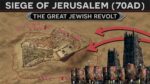
Jerusalem Was Besieged Again And Conquered By Titus And The Roman Army
____________________________________________________________________________________________________________
Matthew 24:15-22
15. When ye therefore shall see the abomination of desolation, spoken of by Daniel the prophet, stand in the holy place, (whoso readeth, let him understand: – Maccabean Revolt – 167 BC)
16. Then let them which be in Judaea flee into the mountains:
17. Let him which is on the housetop not come down to take any thing out of his house:
18. Neither let him which is in the field return back to take his clothes.
19. And woe unto them that are with child, and to them that give suck in those days!
20. But pray ye that your flight be not in the winter, neither on the sabbath day:
21. For then shall be great tribulation, such as was not since the beginning of the world to this time, no, nor ever shall be.
22. And except those days should be shortened, there should no flesh be saved: but for the elect’s sake those days shall be shortened.
____________________________________________________________________________________________________________
The First Jewish – Roman War
The Siege Of Jerusalem (70 AD)
____________________________________________________________________________________________________________
Who Was Josephus?
Titus Flavius Josephus was a first-century Romano-Jewish historian who was born in Jerusalem, then part of Roman Judea, to a father of priestly descent and a mother who claimed royal ancestry. He fully defected to the Roman side and was granted Roman citizenship and became an advisor and friend of Vespasian’s son Titus, serving as his translator when Titus led the Siege of Jerusalem. Since the siege proved ineffective at stopping the Jewish revolt, the city’s destruction and the looting and destruction of Herod’s Temple (Second Temple) soon followed.
The account of Josephus described Titus as moderate in his approach and, after conferring with others, ordering that the 500-year-old Temple be spared. According to Josephus, it was the Jews who first used fire in the Northwest approach to the Temple to try and stop Roman advances. Only then did Roman soldiers set fire to an apartment adjacent to the Temple, a conflagration which the Jews subsequently made worse.
Josephus had acted as a mediator for the Romans and, when negotiations failed, witnessed the siege and aftermath. He wrote:
Now as soon as the army had no more people to slay or to plunder, because there remained none to be the objects of their fury (for they would not have spared any, had there remained any other work to be done), [Titus] Caesar gave orders that they should now demolish the entire city and Temple, but should leave as many of the towers standing as they were of the greatest eminence; that is, Phasaelus, and Hippicus, and Mariamne; and so much of the wall enclosed the city on the west side. This wall was spared, in order to afford a camp for such as were to lie in garrison [in the Upper City], as were the towers [the three forts] also spared, in order to demonstrate to posterity what kind of city it was, and how well fortified, which the Roman valor had subdued; but for all the rest of the wall [surrounding Jerusalem], it was so thoroughly laid even with the ground by those that dug it up to the foundation, that there was left nothing to make those that came thither believe it [Jerusalem] had ever been inhabited.
This was the end which Jerusalem came to by the madness of those that were for innovations; a city otherwise of great magnificence, and of mighty fame among all mankind.
And truly, the very view itself was a melancholy thing; for those places which were adorned with trees and pleasant gardens, were now become desolate country every way, and its trees were all cut down. Nor could any foreigner that had formerly seen Judaea and the most beautiful suburbs of the city, and now saw it as a desert, but lament and mourn sadly at so great a change. For the war had laid all signs of beauty quite waste. Nor had anyone who had known the place before, had come on a sudden to it now, would he have known it again. But though he [a foreigner] were at the city itself, yet would he have inquired for it.
____________________________________________________________________________________________________________
The Jewish Revolt Against Rome
____________________________________________________________________________________________________________
Siege of Jerusalem (70 AD)
Great Jewish Revolt
Part 1
67 AD to 74 AD
Part 2
Part 3
Part 4
____________________________________________________________________________________________________________
The Great Tribulation
Part One
Part Two
Part Three
Part Four
Part Five
____________________________________________________________________________________________________________


