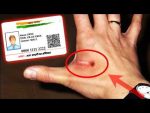
____________________________________________________________________________________________________________
From Micro Chip implants placed inside the hand to Micro Chip implants placed inside the brain
It only took 7 years
____________________________________________________________________________________________________________
August 5, 2024
Neuralink Grafts Brain Chip In Second Trial
____________________________________________________________________________________________________________
May 10, 2024
Elon Musk’s Neuralink Brain Implant Hits A Snag
____________________________________________________________________________________________________________
March 21, 2024
Telepathy: Neuralink’s First Brain Chip Patient Plays Chess With His Mind
____________________________________________________________________________________________________________
February 22, 2024
Neuralink Just MERGED Man And Machine. Is This GOOD Or DANGEROUS?
____________________________________________________________________________________________________________
February 2, 2024
Are Brain Implants The Future Of Computing?
____________________________________________________________________________________________________________
January 30, 2024
Elon Musk’s Neuralink Implants Brain Chip In Human For The First Time
Elon Musk Confirms Successful Implant, Signals Recovery Progress
Elon Musk’s Start-Up Neuralink Implants First Chip In Human Brain
____________________________________________________________________________________________________________
YEAR – 2023
September 20, 2023
Elon Musk’s Neuralink To Start Human Trials For Brain Implant
____________________________________________________________________________________________________________
June 2, 2023
Elon Musk Confirms Neuralink Will Start Human Trials
____________________________________________________________________________________________________________
February 16, 2023
Brain Chip Implants
____________________________________________________________________________________________________________
YEAR – 2022
July 14, 2022
Would You Implant A Debit Card Chip In Your Hand?
____________________________________________________________________________________________________________
April 13, 2022
Microchip Implants For Payment Becoming Reality
____________________________________________________________________________________________________________
YEAR – 2019
October 22, 2019
Should You Get An RFID Implant? The Medical Futurist
____________________________________________________________________________________________________________
YEAR – 2018
November 2018
Are RFID Chip Implants the Future?
What You Should Know About This Biohacking Trend
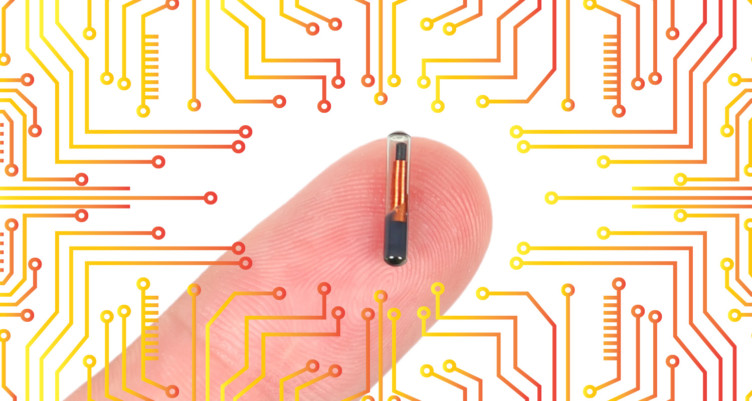
Thousands of people in Sweden are adopting microchip technology that puts the convenience of a credit card in their hands — literally.
Every time you use a key card to open a door or swipe your credit card, you use RFID (radio frequency identification) technology. It’s a ubiquitous and convenient part of everyday life. But what if you could leave your keys at home and ditch your card altogether?
NPR reports that more than 4,000 Swedes have implanted RFID chips into their hands. It’s an idea that’s gaining steam in other parts of the world, including the US. In 2017, Wisconsin-based vending machine company Three Square Market made headlines when 50 employees voluntarily opted to install microchips into their left hands.
Microchipping is also a topic of interest in biohacking circles, including the Biohackers subreddit and Biohack.me
Right now, the chips can perform basic tasks like storing emergency contact details, opening office doors, and storing e-tickets for events. Someday soon, they may help lost children find their way home and notify your doctor if you’re at risk of heart attack.
But are implantable microchips truly safe for your health, your privacy, and your future?
What are RFID chips?
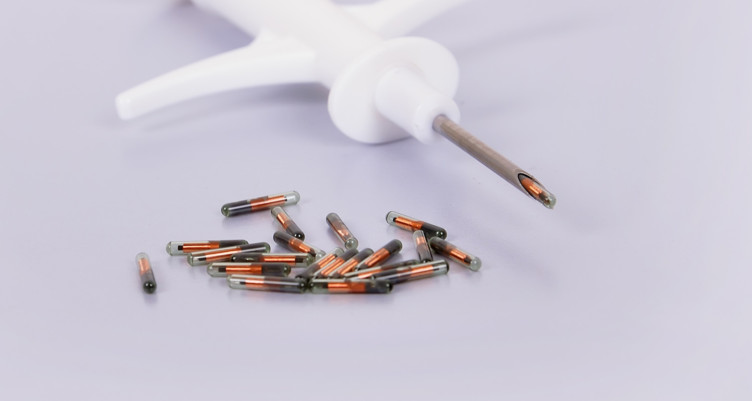
Almost any device that communicates wirelessly uses RF (radio frequency) technology. When people think about implantable RFID chips, they’re generally referring to a microchip encased in a small bioglass tube.
Picture a long grain of rice. Now, imagine that grain of rice inserted into the top of your hand, nestled under your skin between your thumb and index finger. Voila — you’re a cyborg.
RFID chips don’t have a battery or power source. Instead, they’re passive microchips, which means they won’t do anything until they interact with a reader device. It’s the same reason your office key card won’t open every single door in your workplace: It only works with certain readers.
Seattle-based company Dangerous Things sells both implantable RFID chips and NFC (near-field communication) tags. RFID chips are ideal for tasks like opening doors and unlocking computers. NFC tags can store user information like Bitcoin wallet addresses and contact details.
You can buy your own chip pre-loaded in a sterile needle. On its FAQ page, Dangerous Things says that customers can work with one of the company’s professional body piercing or body modification partners to safely install the chip. Or, for the truly savage at heart, you can install it on your own.
More than just a trend
Picture a long grain of rice. Now, imagine that grain of rice inserted into the top of your hand, nestled under your skin between your thumb and index finger. Voila — you’re a cyborg.
RFID chips don’t have a battery or power source. Instead, they’re passive microchips, which means they won’t do anything until they interact with a reader device. It’s the same reason your office key card won’t open every single door in your workplace: It only works with certain readers.
You can buy your own chip pre-loaded in a sterile needle. On its FAQ page, Dangerous Things says that customers can work with one of the company’s professional body piercing or body modification partners to safely install the chip. Or, for the truly savage at heart, you can install it on your own.

Implantable microchips sound distinctly sci-fi, but they’re not completely new. If you’ve ever microchipped a pet, you already have experience with the benefits of implantable RFID technology.
But is there any significant benefit to this technology for humans? Not yet.
Take the example of Three Square Market. The company’s microchips gave employees the ability to open doors, log into computers, and pay for snacks. Nothing groundbreaking or superhuman — but pretty convenient.
For Three Square Market, this is just one step toward a more connected future. The company says it is developing a GPS-enabled microchip. In theory, the device could help people track their loved ones, like children and aging parents. Patrick McMullan, president of Three Square Market, told The Hustle earlier this month that he envisions a future where the company’s RFID chips can help doctors screen for heart attacks, protect children with GPS monitoring, and track wandering Alzheimer’s patients.
In short, inserting RFID chips into humans is new territory with big potential for data sharing — and that’s a serious case of buyer beware.
Are RFID chip implants safe?
But is there any significant benefit to this technology for humans? Not yet.
Take the example of Three Square Market. The company’s microchips gave employees the ability to open doors, log into computers, and pay for snacks. Nothing groundbreaking or superhuman — but pretty convenient.
For Three Square Market, this is just one step toward a more connected future. The company says it is developing a GPS-enabled microchip. In theory, the device could help people track their loved ones, like children and aging parents. Patrick McMullan, president of Three Square Market, told The Hustle earlier this month that he envisions a future where the company’s RFID chips can help doctors screen for heart attacks, protect children with GPS monitoring, and track wandering Alzheimer’s patients.
In short, inserting RFID chips into humans is new territory with big potential for data sharing — and that’s a serious case of buyer beware.
Microchipping has its roots in transhumanism, the idea that humans can enhance their capabilities with the use of technology. But in the case of RFID chips, those capabilities might do more harm than good by opening people up to security risks, privacy concerns, and long-term toxicity.
Security risks
Many key cards that businesses use are vulnerable to cloning, which means that it’s possible for hackers to clone badge access and impersonate employee credentials. You can minimize your risk by leaving your physical access card at home or using an RFID-blocking sleeve.
But that’s a major problem with implantable RFID chips for access control: You can’t turn off an implant in your hand, which increases your risk of getting hacked.
But that’s a major problem with implantable RFID chips for access control: You can’t turn off an implant in your hand, which increases your risk of getting hacked.
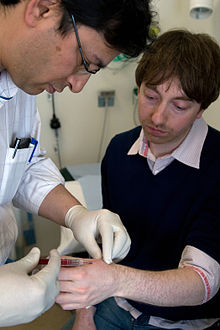
It’s also too early to tell whether implantable RFID chips offer adequate security protection. In a conversation with global security adviser and futurist Marc Goodman on the Bulletproof Radio podcast, Bulletproof Founder Dave Asprey says, “There’s no way anything is going into my body unless I can look at the firmware code, and I can look at all of the other code there, and I know it has appropriate security stuff in it.”
Chips like those offered by Dangerous Things are programmable, so you have a measure of control over your code. But as RFID chip technology advances and companies like Three Square Market offer turnkey systems, there’s no telling whether that capability will change.
Privacy concerns
There’s also the question of where all this information will be stored, especially as RFID chips evolve and can hold more sensitive information. McMullan’s vision of a microchip that helps parents monitor their child’s location might sound like a life-saving advancement. But once the company’s app collects consumer data, there’s no telling how that information will be used.
It might be safely stored on secure servers in the cloud — or it might be shared with subsidiaries and partners. This is unregulated territory. That means you have to do your due diligence and decide how much of your sensitive data you’re willing to share — and whether you trust the company you’re sharing it with.
Long-term toxicity
In the world of microchipping, buyers have to take active steps to make sure they’re buying from reputable companies that monitor and control their materials. You shouldn’t insert anything in your body that isn’t biomedical grade, period.
Companies like Sweden-based Biohax International coat their chips in biosafe glass, and Dangerous Things rigorously tests the safety of its devices. Unfortunately, this isn’t the norm — not all companies hold themselves to high standards, which means you could expose yourself to metal toxicity. In one test of another vendor’s product, Dangerous Things found that the glass tested positive for lead contamination.
Heavy metals are bad for your body. They mess with your thyroid function, which contributes to hormone disruption, fatigue, and brain fog, among other problems. You can learn more about the dangers of heavy metals in this episode of the Bulletproof Radio podcast with Joseph Pizzorno, a leading naturopathic physician.
The other drawback? Although RFID chips are encased in glass, there’s no telling whether that barrier provide adequate protection against the metal in the microchips long-term. It’s hard to tell until these chips have been in humans for at least 20 to 40 years, minimum.
In short, it’s new tech, so the early adopters are guinea pigs. Microchips are convenient, and they have lots of future potential — but there are easier and safer ways to biohack your way to a better you.
Chips like those offered by Dangerous Things are programmable, so you have a measure of control over your code. But as RFID chip technology advances and companies like Three Square Market offer turnkey systems, there’s no telling whether that capability will change.
It might be safely stored on secure servers in the cloud — or it might be shared with subsidiaries and partners. This is unregulated territory. That means you have to do your due diligence and decide how much of your sensitive data you’re willing to share — and whether you trust the company you’re sharing it with.
Companies like Sweden-based Biohax International coat their chips in biosafe glass, and Dangerous Things rigorously tests the safety of its devices. Unfortunately, this isn’t the norm — not all companies hold themselves to high standards, which means you could expose yourself to metal toxicity. In one test of another vendor’s product, Dangerous Things found that the glass tested positive for lead contamination.
Heavy metals are bad for your body. They mess with your thyroid function, which contributes to hormone disruption, fatigue, and brain fog, among other problems. You can learn more about the dangers of heavy metals in this episode of the Bulletproof Radio podcast with Joseph Pizzorno, a leading naturopathic physician.
The other drawback? Although RFID chips are encased in glass, there’s no telling whether that barrier provide adequate protection against the metal in the microchips long-term. It’s hard to tell until these chips have been in humans for at least 20 to 40 years, minimum.
In short, it’s new tech, so the early adopters are guinea pigs. Microchips are convenient, and they have lots of future potential — but there are easier and safer ways to biohack your way to a better you.
____________________________________________________________________________________________________________
YEAR – 2017
April 4, 2017
Some Swedish workers are getting microchips implanted in their hands
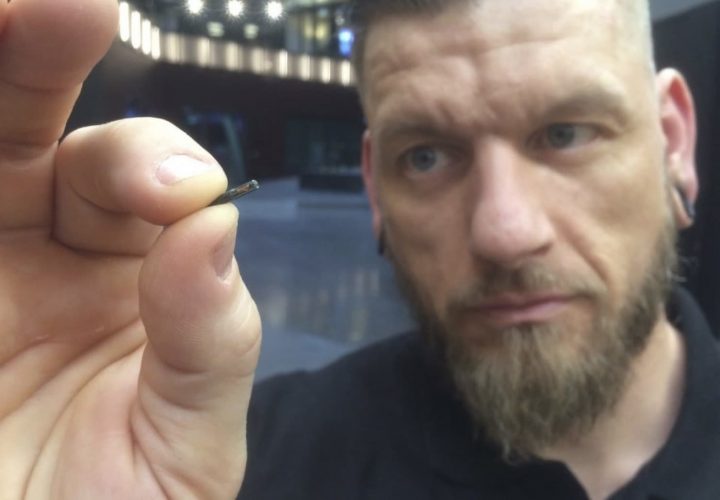
Jowan Osterlund from Biohax Sweden holds a small microchip implant, similar to those implanted in workers at the Epicenter hub in Stockholm.
How would you feel about having a microchip implanted in your hand to make things more convenient at work?
In Sweden, some workers are actually volunteering to do just that, electing to have a chip the size of a grain of rice implanted in their bodies to help them unlock doors, operate printers, open storage lockers and even buy smoothies with the wave of their hand, according to an Associated Press report. Epicenter, a digital hub in Stockholm that houses more than 300 start-ups and innovation labs for larger companies, has made the implanted chip available to its workers and to member organizations in recent years. It’s a biohacking experiment in simplicity that’s been embraced by some early adopters associated with the center but represents a technological frontier sure to make others shudder.
But while it may sound like the dawning of an era of a cyborg workforce, management consultants say they’re hearing little interest in the concept so far, and those leading the experiment in Sweden say it’s an entirely voluntary exercise intended simply as a technological test for convenience. “It’s very early to try to depict where this is going,” Patrick Mesterton, co-founder and chief executive of Epicenter, said in an interview with The Washington Post. “We’re just doing this because it’s interesting. We want to play around with technology.”
The promise behind the implant being offered at Epicenter is efficiency. People who get “chipped” — the same technology used to track pets or deliveries — can replace key cards, employee badges and credit cards for certain functions at the facility with technology that can’t be lost or left behind.
Every once in a while, Epicenter, with the help of its “chief disruption officer,” who is one of the founders of BioNyfiken, the Swedish Association of Biohackers, organizes a “chip and beer” or “chip and wine” event after work. They bring in an outside firm to offer the procedure, which costs about $150, is voluntary and involves plenty of paperwork, Mesterton said. “Then they can ask us if they want to activate the chip on the services in the building.”
Mesterton said about 75 of the 2,000 people who work for the organizations housed at Epicenter had elected to have the chip implanted, including six of his 12 employees. Another 75 people who have no direct affiliation with Epicenter, but have attended open events at the facility, have chosen to be chipped out of their own interest. (A chain of gyms in Sweden, Mesterton said, offers access through embedded chips.)
The technology does not allow for any kind of monitoring, he said. It “doesn’t even carry that ability. It’s exactly the same as if you would use a single key card,” he said. Known as a “passive chip,” it has no built-in power supply and can’t send signals about its position. “If a person is worried about being traced, your mobile phone or Internet search history poses a bigger threat than the RFID chip we use ever would do,” Mesterton said in an email.
Ethical or privacy issues, however, could become a concern if the chips do more in the future and organizations embrace the technology. As Ben Libberton, a microbiologist at Stockholm’s Karolinska Institute, told the Associated Press, “conceptually, you could get data about your health, you could get data about your whereabouts, how often you’re working, how long you’re working, if you’re taking toilet breaks and things like that.”
That’s one reason management consultants say such chips are unlikely to show up in American workplaces anytime soon. Michael Chui, a partner with the McKinsey Global Institute who leads its research on the impact of long-term technology trends, said that while there is “a broad awareness for the technical ability for this to happen,” right now there is “zero interest in actually doing it.”
For one, the business case isn’t very high, with “smart badges” and biometric scanners able to do much of the same work. Then, he said, “there is a general creep factor about it.”
Josh Bersin, who leads a unit at Deloitte that does human resources research, says that while wearable devices have become more common, particularly among manufacturing employees or drivers, big employers are still wary of such technology. “For lots of big companies, just the idea of a smart badge is scary enough,” he said. Suggesting that employees put something inside their bodies — “that’s a big leap. I can leave my smart badge or my phone at home.” He hasn’t had clients suggest it.
More likely, he said, is that companies will make more use out of sensor technology that can be embedded inside workers’ badges. Such devices can track location data, listen in on the emotion of employees’ voices and suggest, say, the most effective places for retail clerks to stand to improve sales. One company, Bersin said, used high-tech badges to find that employees with a positive attitude also tended to have more physical mobility during the day, a finding they used to redesign work practices, shorten meetings and even move others outside.
Others think it’s possible the technology could be tried in the United States within a few years, at least as the next iteration of biometric scanners that log people in and out of work sites. C.R. Wright, a partner with the employment law firm Fisher Phillips in Atlanta, said technology such as fingerprint or hand scans have become more popular as a way to avoid forgotten badges, prevent workers from “buddy punching” the clock, and secure particularly sensitive or secretive facilities.
“We already have biometric tags and packaging. It’s jumping to the human application,” he said. Though any kind of embedded microchip is likely to bring pushback from workers, “within the next five years, I would think it will be tried here.”
Some Swedish Workers Are Getting Microchips Implanted In Their Hands
But while it may sound like the dawning of an era of a cyborg workforce, management consultants say they’re hearing little interest in the concept so far, and those leading the experiment in Sweden say it’s an entirely voluntary exercise intended simply as a technological test for convenience. “It’s very early to try to depict where this is going,” Patrick Mesterton, co-founder and chief executive of Epicenter, said in an interview with The Washington Post. “We’re just doing this because it’s interesting. We want to play around with technology.”
The promise behind the implant being offered at Epicenter is efficiency. People who get “chipped” — the same technology used to track pets or deliveries — can replace key cards, employee badges and credit cards for certain functions at the facility with technology that can’t be lost or left behind.
Mesterton said about 75 of the 2,000 people who work for the organizations housed at Epicenter had elected to have the chip implanted, including six of his 12 employees. Another 75 people who have no direct affiliation with Epicenter, but have attended open events at the facility, have chosen to be chipped out of their own interest. (A chain of gyms in Sweden, Mesterton said, offers access through embedded chips.)
The technology does not allow for any kind of monitoring, he said. It “doesn’t even carry that ability. It’s exactly the same as if you would use a single key card,” he said. Known as a “passive chip,” it has no built-in power supply and can’t send signals about its position. “If a person is worried about being traced, your mobile phone or Internet search history poses a bigger threat than the RFID chip we use ever would do,” Mesterton said in an email.
Ethical or privacy issues, however, could become a concern if the chips do more in the future and organizations embrace the technology. As Ben Libberton, a microbiologist at Stockholm’s Karolinska Institute, told the Associated Press, “conceptually, you could get data about your health, you could get data about your whereabouts, how often you’re working, how long you’re working, if you’re taking toilet breaks and things like that.”
For one, the business case isn’t very high, with “smart badges” and biometric scanners able to do much of the same work. Then, he said, “there is a general creep factor about it.”
Josh Bersin, who leads a unit at Deloitte that does human resources research, says that while wearable devices have become more common, particularly among manufacturing employees or drivers, big employers are still wary of such technology. “For lots of big companies, just the idea of a smart badge is scary enough,” he said. Suggesting that employees put something inside their bodies — “that’s a big leap. I can leave my smart badge or my phone at home.” He hasn’t had clients suggest it.
More likely, he said, is that companies will make more use out of sensor technology that can be embedded inside workers’ badges. Such devices can track location data, listen in on the emotion of employees’ voices and suggest, say, the most effective places for retail clerks to stand to improve sales. One company, Bersin said, used high-tech badges to find that employees with a positive attitude also tended to have more physical mobility during the day, a finding they used to redesign work practices, shorten meetings and even move others outside.
“We already have biometric tags and packaging. It’s jumping to the human application,” he said. Though any kind of embedded microchip is likely to bring pushback from workers, “within the next five years, I would think it will be tried here.”
____________________________________________________________________________________________________________
It has been said that these RFID MicroChips contain
“Lithium”
____________________________________________________________________________________________________________
Lithium-Induced Rash
Sir: Lithium has been used as a mood stabilizer for decades and has been approved by the U.S. Food and Drug Administration for acute and maintenance therapy of mania in bipolar disorder. The Physicians’ Desk Reference lists generalized pruritus with or without rash as one of the dermatologic side effects of lithium.1 We present an interesting case of maculopapular rash that we believe was induced with lithium.
Case report. Ms. A, a 60-year-old woman with a past psychiatric history of bipolar disorder, was brought to the emergency room in 2005 by her family for some odd behaviors. The family described a 2-week history of spending sprees, staying up all night, talking excessively, and making inappropriate phone calls. She called her former employers and was verbally abusive to them, which resulted in a restraining order being issued against her. A thorough medical work-up in the emergency room did not reveal any significant findings. Her past medical history was significant for coronary bypass graft, end stage renal disease requiring dialysis, and gastritis. Her current medications were captopril, omeprazole, atrovastatin, aspirin, spirono-lactone, amiodarone, and cetrizine. She was found to have pressured speech with a circumstantial thought process without any psychosis or cognitive impairment. She was later transferred to the psychiatric floor for stabilization. The patient had a history of bipolar disorder with 4 past psychiatric hospitalizations, the last being 6 years ago. She had been on divalproex and lithium in the past with no adverse effects, but noncompliance has been an ongoing issue in her case. There had been no psychiatric follow-up for the last 5 years.
A diagnosis of bipolar disorder, most recent episode manic, was made using the DSM-IV diagnostic criteria, and she was started on lithium 300 mg at bedtime and que-tiapine 25 mg at bedtime on an as-needed basis for sleep. Within a few days a significant symptomatic improvement was noticed. On the sixth day after initiation of lithium, she was found to have a red maculopapular rash about 5 cm × 3 cm in size over the left pretibial area. There were no complaints of itching or any signs of systemic infection. Her lithium level a day before was 0.5 mEq/L. Her lithium was withheld, resulting in a fading of her rash over the next 2 days. Unfortunately, she left the hospital against medical advice and went to the home of her daughter, who convinced us that the patient would follow up with outpatient psychiatry within the next few days.
It has been reported that women are at increased risk of cutaneous lesions when treated with lithium, usually within the first year of its initiation.2 In our case, the temporal association of the onset of the rash within a week of the initiation of lithium and its fading within 2 days of its discontinuation points to a causal relationship. Although the exact mechanism is unclear, it has been proposed that inhibition of adenylate cyclase/cyclic AMP systems induced by lithium could be responsible for the cutaneous conditions.2
Other lithium-induced skin conditions include psoriasis, acne, folliculitis, exfoliative dermatitis, seborrheic dermatitis, and herpetiform dermatitis. The prevalence rate of lithium-induced cutaneous reaction has been reported to be 34% in one study2 and 45% in another.3
Further investigation regarding cutaneous lesions associated with lithium therapy is warranted as this distressing side effect could adversely affect the medication compliance. – Link Below:
National Library Of Medicine — Lithium-Induced Rash
____________________________________________________________________________________________________________
And What Does The Bible Say?
Revelation 13:15-17
15. And he had power to give life unto the image of the beast, that the image of the beast should both speak, and cause that as many as would not worship the image of the beast should be killed.
16. And he causeth all, both small and great, rich and poor, free and bond, to receive a mark in their right hand, or in their foreheads:
17. And that no man might buy or sell, save he that had the mark, or the name of the beast, or the number of his name.
Revelation 16: 1-2
1. And I heard a great voice out of the temple saying to the seven angels, Go your ways, and pour out the vials of the wrath of God upon the earth.
2. And the first went, and poured out his vial upon the earth; and there fell a noisome and grievous sore upon the men which had the mark of the beast, and upon them which worshipped his image.
____________________________________________________________________________________________________________


